
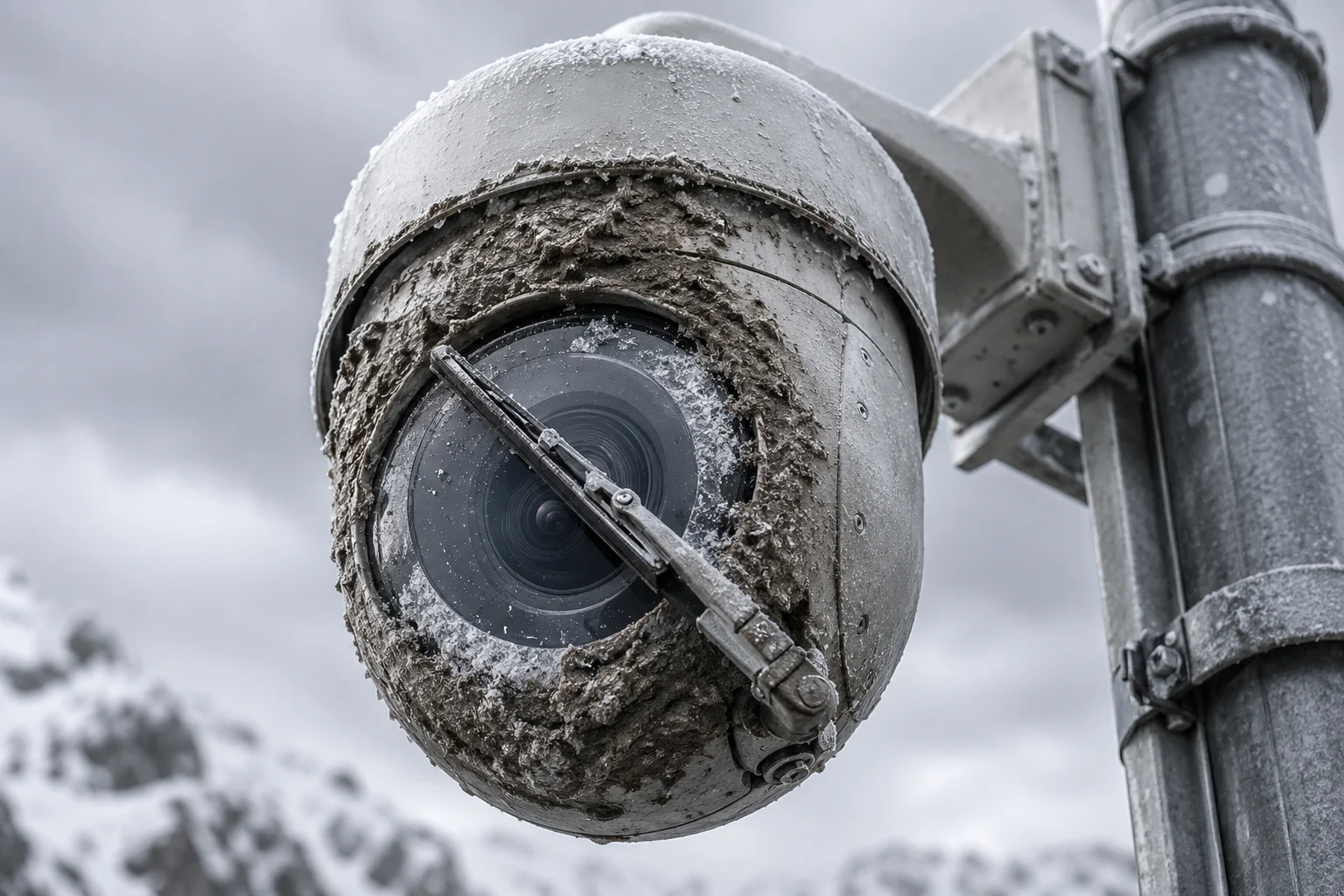
I’ve watched remote cameras go blind in minutes — ice locks the wiper, mud cakes the lens, and the whole system becomes useless.
Yes, our wiper motor torque1 delivers 1.5–2.0 N·m of startup torque through a full-metal worm gear reducer2. This force is enough to break through dried industrial mud and light ice. For heavy ice, the system pairs motor power with a built-in heater to soften the bond before wiping.
Below, I’ll walk you through exactly how the motor handles snow loads, how AI triggers double-wipes, how current sensing3 protects the gears, and how you can force a heavy-duty cycle from your phone. Let’s get into it.
Table of Contents
Does the High-Torque Stepper Motor Prevent the Wiper From Stalling Under a Heavy Snow Load?
I’ve seen cheap wiper motors burn out after one winter. Snow piles up, the motor fights it, and then it just dies.
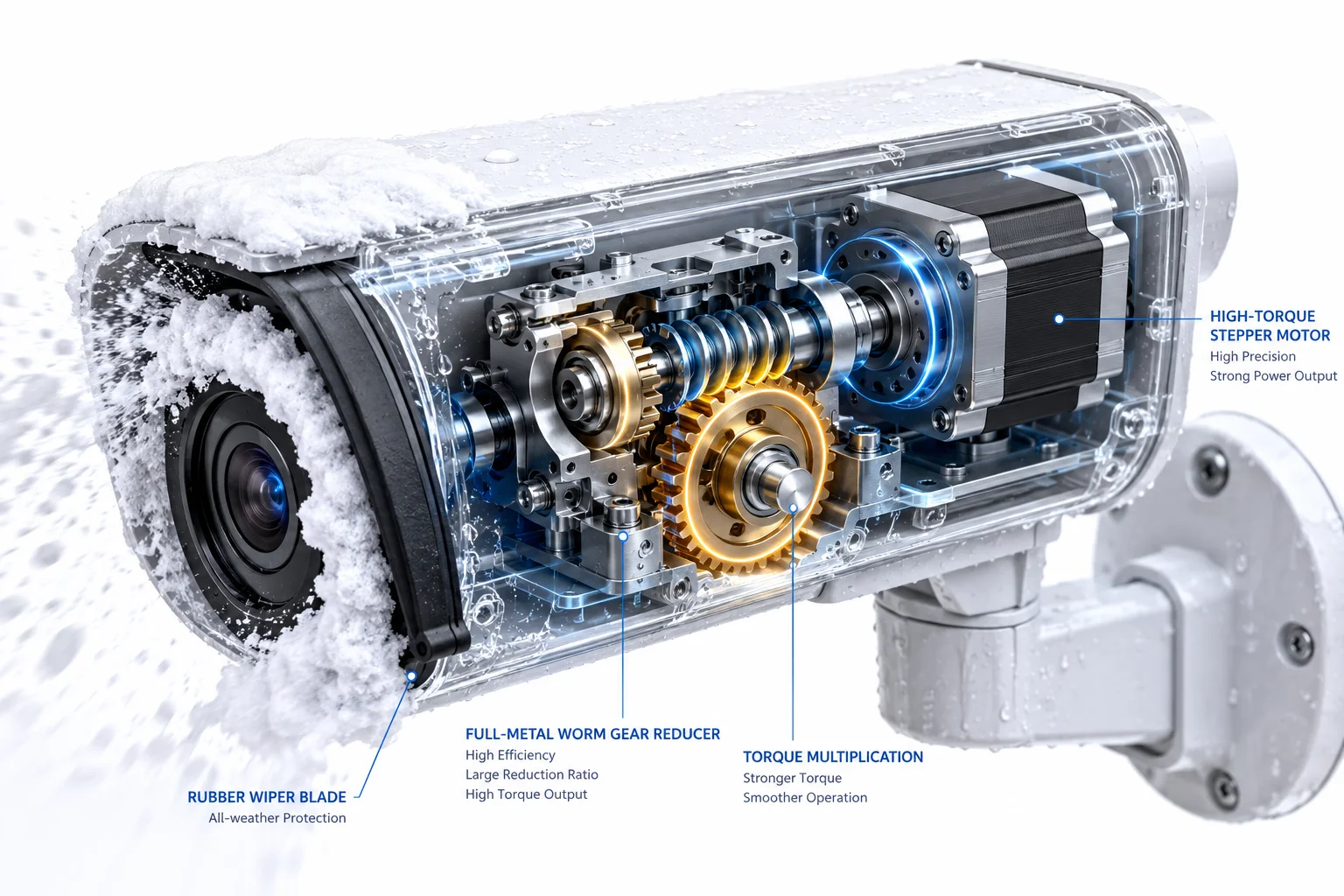
Our high-torque stepper motor4 uses a full-metal worm gear reducer that multiplies force and prevents stalling. The system delivers consistent torque even when wet snow adds 3–5x the normal resistance on the wiper blade. If the load exceeds safe limits, current sensing stops the motor before damage occurs.
How the Stepper Motor Handles Snow Resistance
A stepper motor5 works differently from a basic DC motor. It moves in precise steps. Each step delivers a fixed amount of force. This means the motor doesn’t “guess” how hard to push. It applies consistent power at every point in the wiper’s arc.
When heavy snow sits on the lens cover, the wiper blade must push through a thick, wet mass. The resistance can spike to several times what a dry wipe requires. Our motor handles this because of two things: raw torque output and the gear reduction system.
The Worm Gear Advantage
The worm gear reducer inside the housing does two jobs:
- It multiplies the motor’s torque by a large ratio. A small, efficient motor can produce the same force as a much bigger one.
- It provides reverse self-locking6. This means external forces — like wind gusts or the weight of packed snow — cannot push the wiper arm backward.
This self-locking feature is critical for outdoor PTZ cameras. Without it, a strong wind could physically move the wiper off its park position and block the AI tracking path.
Torque Specs in Real Conditions
| Condition | Resistance Level | Motor Response | Result |
|---|---|---|---|
| Dry dust | Low (baseline) | Normal step frequency | Clean in 1 pass |
| Wet snow (light) | 2–3x baseline | Normal step frequency, full torque | Clean in 1–2 passes |
| Wet snow (heavy) | 4–5x baseline | Reduced speed, maximum torque | Clean in 2–3 passes |
| Packed ice layer | Beyond safe limit | Current sensing triggers stop | Heater activates first |
What “Stalling” Actually Means
A motor stalls when the load exceeds its maximum torque. At that point, the motor stops turning but keeps drawing current. This generates heat. Heat destroys windings. The motor dies.
Our firmware prevents this. The system monitors current draw in real time. If the current rises above a set threshold for more than 200 milliseconds, the controller cuts power. The motor never reaches a thermal failure point. Instead, the system switches to a different strategy — usually activating the heater module and waiting before trying again.
For David and other integrators working in northern climates, this means one thing: the camera stays alive through winter without a truck roll.
Will the Wiper Automatically “Double-Wipe” if the AI Detects an Obscured Lens?
I’ve deployed cameras that wiped on a fixed schedule — every 30 minutes. But mud doesn’t wait for a schedule. By the time the wiper runs, you’ve already lost 20 minutes of footage.
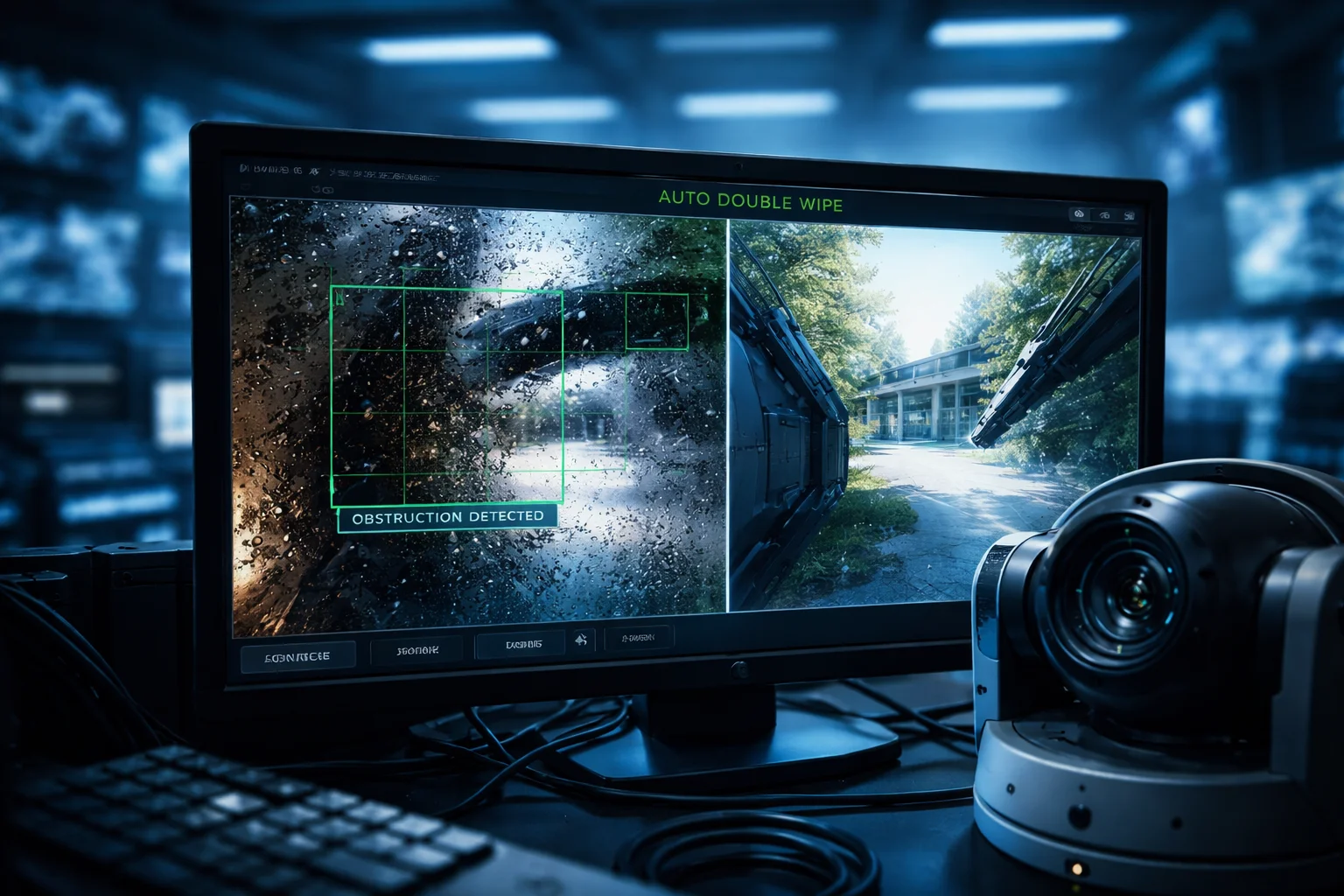
Yes. Our AI image analysis7 detects lens obstruction in real time. When the system identifies a drop in image clarity — from mud splatter, water droplets, or dust buildup — it triggers an immediate double-wipe cycle8 without any human input. This keeps the lens clear between scheduled intervals.
How the AI Knows the Lens Is Dirty
The detection logic doesn’t use a separate sensor. It analyzes the video feed itself. The algorithm looks for specific patterns:
- A sudden drop in contrast across a large portion of the frame
- Irregular blob shapes that don’t match known objects
- Edge sharpness falling below a calibrated baseline
When two or more of these conditions are true at the same time, the system flags the lens as obscured. The response is immediate: the wiper runs two full passes. If the image quality doesn’t improve after the double-wipe, the system can escalate — triggering the washer pump9 (if installed) followed by another wipe cycle.
Why “Double-Wipe” Instead of Single
A single wipe often smears rather than clears. This is especially true with oily industrial residue or bird droppings. The first pass breaks the material loose. The second pass sweeps it off the glass. This two-pass approach mimics what you’d do by hand.
The Detection-to-Action Timeline
The entire process — from detection to clean lens — takes less than 3 seconds:
- Frame analysis flags obstruction (< 500ms)
- Controller sends wipe command (< 100ms)
- First wipe pass completes (~1 second)
- Second wipe pass completes (~1 second)
- Post-wipe image check confirms clarity
Configurable Sensitivity
Not every site needs the same trigger threshold. A camera overlooking a clean parking lot might get false triggers from rain. A camera at a concrete plant might need maximum sensitivity. You can adjust the detection sensitivity through the web interface or our CMS platform. Three preset levels are available:
- Low: Only triggers on major obstruction (>60% of frame affected)
- Medium: Triggers on moderate obstruction (>30% of frame affected)
- High: Triggers on minor spots (>15% of frame affected)
For integrators managing dozens of cameras across different environments, this per-camera tuning saves a lot of headaches.
How Does the Motor’s “Current Sensing” Logic Protect the Gears if the Wiper Is Frozen to the Glass?
I learned this the hard way on a project in northern Canada. The wiper froze solid overnight. The old system just kept pushing until the gear teeth stripped. Replacing that assembly at -20°C was not fun.
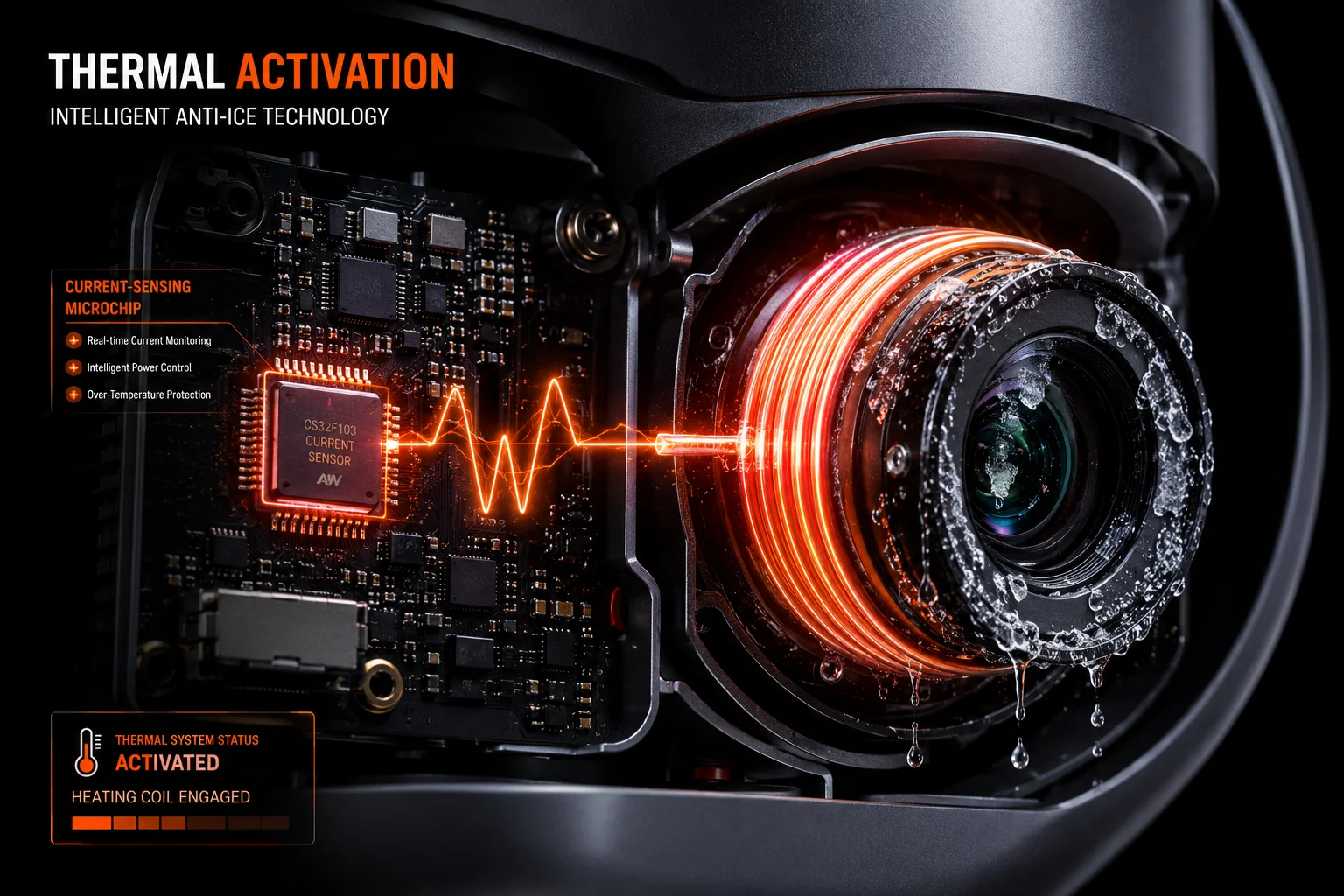
The motor controller monitors electrical current in real time. When the wiper is frozen and cannot move, current spikes immediately. Our firmware detects this spike within 200 milliseconds and cuts motor power. It then activates the glass heater10 to melt the ice bond before attempting another wipe cycle.
The Physics of a Frozen Wiper
When water sits between the rubber blade and the glass, then freezes, it creates an adhesive bond. This bond can be incredibly strong — sometimes exceeding 10 N·m of resistance at the blade tip. No wiper motor should try to break this by force. The rubber tears. The gear teeth crack. The motor overheats.
Current sensing solves this problem at the electrical level, before any mechanical damage happens.
How Current Sensing Works Step by Step
The motor controller has a small resistor in the power circuit. By measuring the voltage across this resistor, the controller knows exactly how much current the motor is drawing at any moment.
| Motor State | Current Draw | System Action |
|---|---|---|
| Free running (no load) | 0.2–0.4 A | Normal operation |
| Normal wipe (light debris) | 0.5–0.8 A | Normal operation |
| Heavy load (thick mud) | 0.9–1.2 A | Reduced speed, continues |
| Frozen/locked | >1.5 A spike | Immediate power cut |
When the current exceeds the safe threshold, the firmware executes this sequence:
- Motor power cut (within 200ms of detection)
- System logs the event with timestamp
- Heater module activates at full power
- Timer starts (default: 5 minutes)
- After timer expires, motor attempts a small “test nudge” — just 5 degrees of rotation
- If the test nudge succeeds (current stays normal), full wipe cycle begins
- If the test nudge fails (current spikes again), heater continues for another 5 minutes
Why This Matters for Unmanned Sites
David, if your cameras sit on a tower 50 km from the nearest technician, a burned-out wiper motor means a truck roll. That costs $500–$2,000 depending on location. Our current sensing logic exists specifically to prevent that scenario. The system protects itself and waits for conditions to improve.
The Heater Integration
The glass heater is not a separate, disconnected system. It’s part of the same control loop. The wiper controller and the heater controller share data. When current sensing triggers a freeze alert, the heater doesn’t just turn on — it runs at maximum output until the surface temperature reaches a target (typically 5°C above freezing). Only then does the wiper retry.
This closed-loop approach means the system adapts to actual conditions, not just a timer. On a mild night with light frost, the heater might only run for 2 minutes. On a severe night at -30°C, it might run for 15 minutes. Either way, the wiper only moves when it’s safe to move.
Can I Manually Trigger a “Heavy Duty” Wipe Cycle via the Mobile App for Stubborn Debris?
Sometimes the AI doesn’t catch everything. Maybe tree sap landed on the lens in a spot that doesn’t trigger the algorithm. You check the live feed, see the smear, and want to fix it right now.
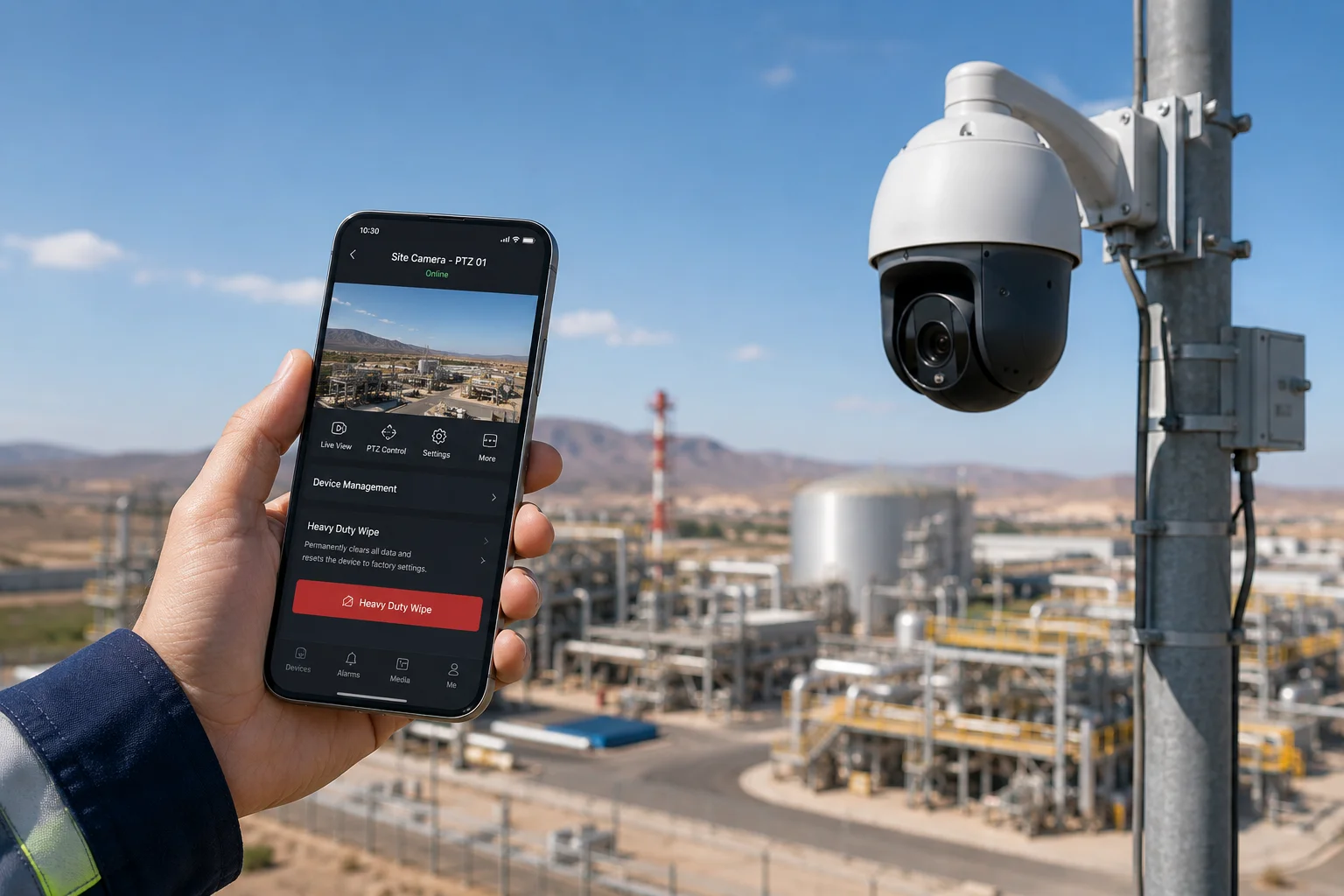
Yes. Our mobile app and web interface both include a one-tap “Heavy Duty Wipe” button. This triggers a multi-pass cleaning cycle — up to 5 consecutive wipes paired with the washer pump if installed. You can activate it from anywhere with a network connection, no need to be on-site.
What the Heavy Duty Cycle Does
A standard wipe is one or two passes. The heavy duty cycle is different. It runs a full cleaning sequence designed for stubborn material:
- Washer pump activates for 2 seconds (sprays cleaning fluid or water onto the glass)
- Pause for 1 second (lets the fluid soak into the debris)
- Wiper runs 5 consecutive full-arc passes at reduced speed for maximum contact pressure
- Washer pump activates again for 1 second
- Final 2 wipe passes at normal speed to clear remaining fluid
This entire sequence takes about 15 seconds. You can watch it happen in real time through the live feed on your phone.
Access Methods
You’re not limited to just the mobile app. The heavy duty wipe can be triggered through:
- Mobile app (iOS/Android): One-tap button on the live view screen
- Web interface: Available in the camera’s control panel
- CMS/VMS integration: Mapped as a custom command via ONVIF auxiliary commands11
- API call: For integrators who build their own dashboards, a simple HTTP POST triggers the cycle
Customizing the Cycle
The default 5-pass cycle works for most situations. But you can adjust it. Through the settings menu, you can change:
- Number of wipe passes (1–10)
- Washer pump duration (0–5 seconds)
- Soak delay between spray and wipe (0–3 seconds)
- Wipe speed (slow for heavy debris, fast for light rinse)
When Manual Override Makes Sense
The AI detection handles 90% of cases automatically. But certain debris types are hard for algorithms to detect:
| Debris Type | AI Detection Rate | Manual Trigger Needed? |
|---|---|---|
| Mud splatter | 95% | Rarely |
| Water droplets | 85% | Sometimes |
| Bird droppings | 70% | Often |
| Tree sap / resin | 40% | Usually |
| Insect residue | 50% | Often |
| Thin oil film | 30% | Almost always |
For sites with frequent sap or insect problems, I recommend setting up a scheduled heavy duty cycle (e.g., every 4 hours) in addition to the AI-triggered wipes. This gives you a baseline cleaning rhythm while the AI handles unexpected events between cycles.
Remote Maintenance Without a Truck Roll
This feature exists because of a simple truth: sending a technician to wipe a camera lens is expensive and slow. With the mobile app trigger, David or any site manager can solve the problem in 15 seconds from their office. The camera stays operational. The footage stays clear. The client stays happy.
For integrators managing large deployments across multiple sites, this remote wipe capability can be scripted. You can trigger heavy duty cycles across 50 cameras simultaneously through the API — useful after a dust storm or heavy rain event.
Conclusion
Our wiper system combines high-torque motor power, intelligent current protection, AI-driven auto-cleaning, and remote manual control. Together, these features keep your PTZ camera lens clear in ice, mud, snow, and industrial grime — without burning out hardware or requiring a site visit.
1. Explanation of torque in electric motors and its importance for overcoming resistance. ↩︎ 2. How worm gear reducers multiply torque and provide self-locking properties. ↩︎ 3. How current sensing protects motors from overload and stall conditions. ↩︎ 4. Principle of stepper motors: precise steps, consistent torque, and open-loop control. ↩︎ 5. Principle of stepper motors: precise steps, consistent torque, and open-loop control. ↩︎ 6. Why worm gears prevent external forces from moving the wiper arm backward. ↩︎ 7. How AI algorithms analyze video frames to detect lens obstruction. ↩︎ 8. Why multiple wiper passes improve cleaning effectiveness for stubborn debris. ↩︎ 9. Typical automotive-grade washer pump used to spray cleaning fluid on the lens. ↩︎ 10. How glass heaters soften ice bonds before wiper activation. ↩︎ 11. ONVIF standard for sending custom commands (like wipe) from VMS or CMS. ↩︎