
I’ve seen too many integrators pick the cheaper panel upfront, only to pay triple in truck rolls1 when their remote PTZ cameras go offline in winter.
For solar-powered 4G PTZ surveillance systems, monocrystalline panels deliver far better long-term cost-effectiveness than polycrystalline. The higher efficiency, smaller footprint, and superior low-light charging of mono panels reduce total system cost over 3-5 years, even though the initial panel price is slightly higher.
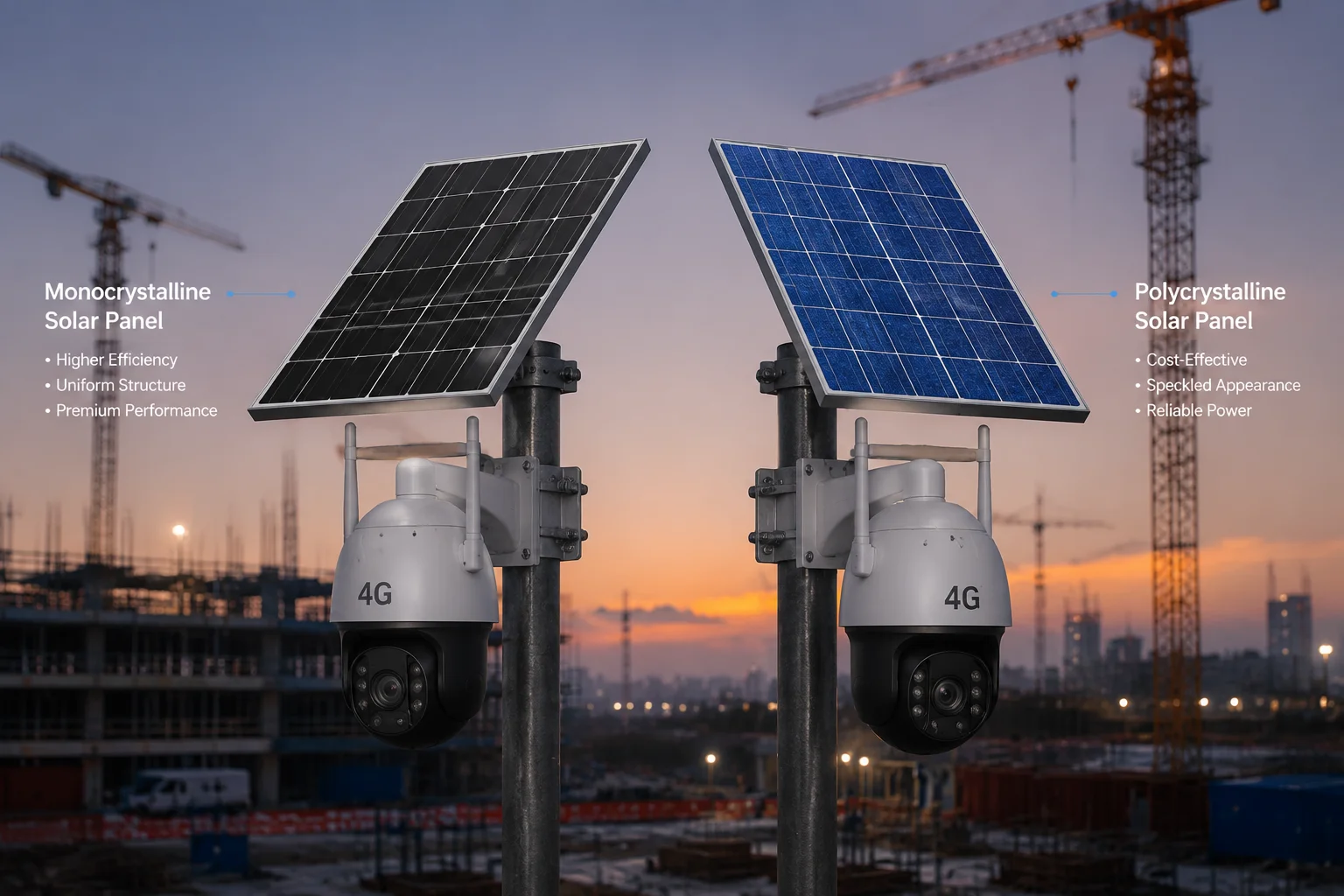
Below, I break down the specific scenarios where this difference matters most. Whether you deploy in cold Canadian provinces or the scorching Arizona desert, the numbers tell a clear story. Let me walk you through each case.
Table of Contents
Why Is Monocrystalline Preferred for High-Latitude North American Regions Like Canada?
In Canada, I deal with short winter days and heavy cloud cover for months. A panel that can’t charge in weak light means a dead camera and an expensive service call.
Monocrystalline is preferred for high-latitude regions like Canada because its higher silicon purity allows it to generate usable power in low-light and overcast conditions. This means the panel starts charging earlier in the morning and keeps charging later in the evening, which is critical when winter daylight drops below 8 hours.

The Low-Light Problem in Northern Deployments
When you install a solar PTZ camera in Alberta or Ontario, you face a harsh reality. From November to February, the sun sits low on the horizon. Cloud cover is frequent. The effective solar window can shrink to just 4-5 peak sun hours per day. Your 4G PTZ camera, however, does not care about the weather. It still needs power 24 hours a day. Even in standby mode, the 4G module sends heartbeat packets to maintain its network connection. This draws 3-5 watts continuously.
Monocrystalline cells use single-crystal silicon. The electrons flow through the material with less resistance. This means even when sunlight is weak, say 200 W/m² instead of the standard 1000 W/m², a mono panel still converts a meaningful portion into electricity. Polycrystalline panels2, built from multiple silicon fragments, have more grain boundaries. These boundaries block electron flow. In weak light, this internal resistance becomes a bigger problem, and the panel output drops faster.
Real-World Charging Window Comparison
| Condition | Mono Panel Output | Poly Panel Output | Difference |
|---|---|---|---|
| Full sun (1000 W/m²) | 100W | 100W (larger panel) | Minimal |
| Overcast (300 W/m²) | ~30W | ~22W | Mono gives 36% more |
| Dawn/Dusk (150 W/m²) | ~14W | ~8W | Mono gives 75% more |
| Heavy cloud (100 W/m²) | ~9W | ~4W | Mono gives 125% more |
That extra power at dawn and dusk adds 1-2 hours of effective charging per day. Over a Canadian winter, this is the difference between a system that stays online and one that shuts down every few days. Each shutdown means a potential truck roll costing $500-$1500 in remote areas. The mono panel pays for itself after preventing just one service visit.
Why This Matters for 4G Connectivity
A 4G PTZ system3 is not like a simple IP camera on a wired network. When the battery voltage drops below a threshold, the MPPT controller4 cuts power to protect the battery. The camera goes offline. When power returns, the 4G module must re-register on the cellular network. This takes time. During that gap, you have no surveillance coverage. For construction sites or critical infrastructure, that gap is unacceptable. Mono panels keep the battery topped up even on bad days, so the system never hits that low-voltage cutoff.
How Much Extra Area Would a Polycrystalline Panel Need to Match a 100W Mono Panel?
I often get asked: “Can’t I just use a bigger poly panel and save money?” You can. But the hidden costs add up fast.
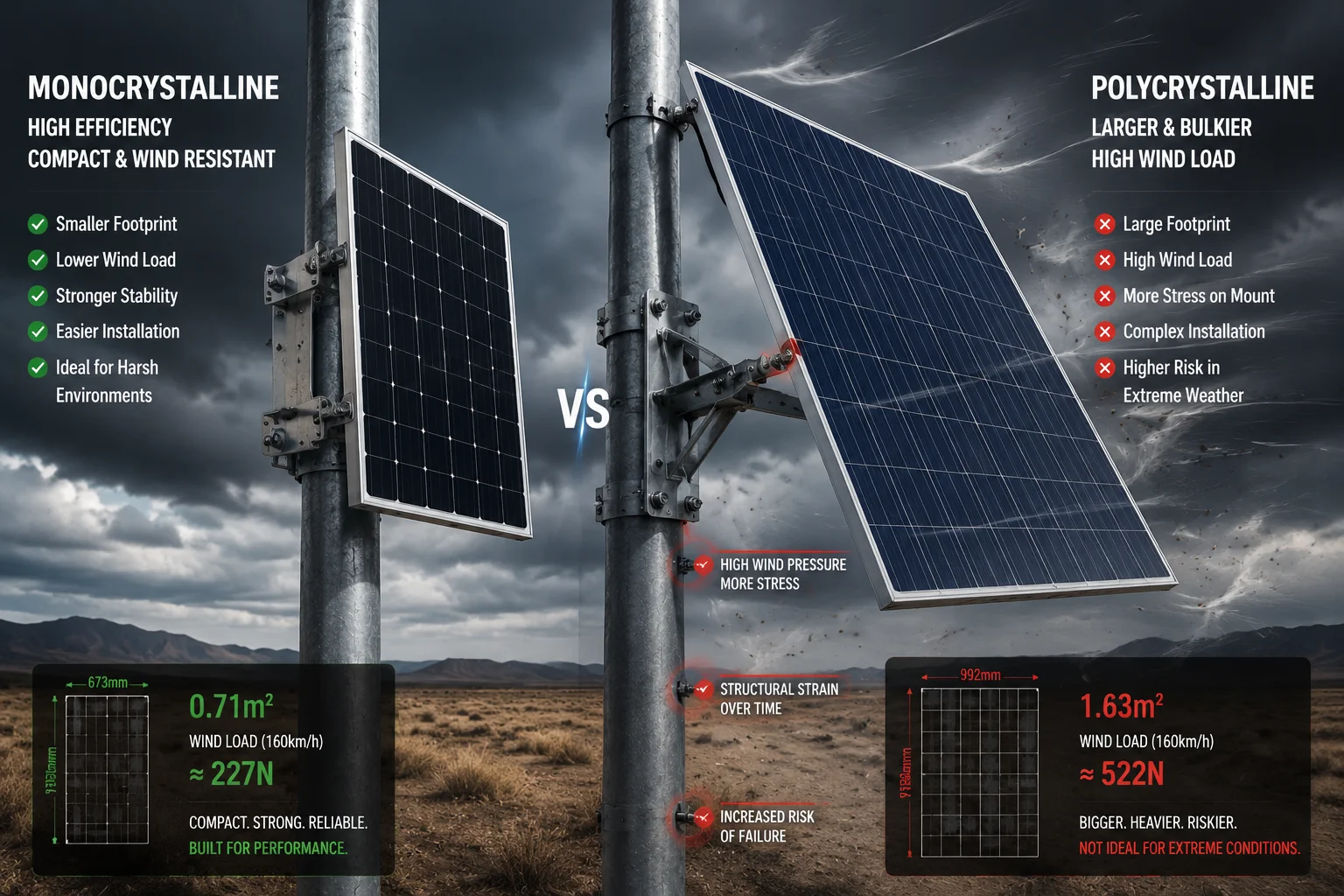
A polycrystalline panel needs roughly 20-25% more surface area to match the output of a 100W monocrystalline panel. A typical 100W mono panel measures about 0.45 m², while a poly panel producing the same wattage requires approximately 0.55-0.58 m². This extra size increases wind load, bracket weight, and pole stress.
The Math Behind the Size Difference
Monocrystalline panels achieve 20-22% cell efficiency5. Polycrystalline panels reach 15-17%. Let’s do the simple calculation for a 100W requirement:
- Mono panel area needed: 100W ÷ (1000 W/m² × 0.20) = 0.50 m²
- Poly panel area needed: 100W ÷ (1000 W/m² × 0.16) = 0.625 m²
That’s 25% more panel area. But the cost impact goes far beyond the panel itself.
Hidden Costs of a Larger Panel
When you mount a solar panel on a pole for a PTZ camera, the panel acts like a sail. Wind pushes against it. The force increases with area. A 25% larger panel means 25% more wind force on the mounting bracket and the pole.
| Cost Factor | 100W Mono System | 100W Poly System | Extra Cost for Poly |
|---|---|---|---|
| Panel cost | $85 | $65 | -$20 (savings) |
| Bracket (heavier gauge) | $40 | $55 | +$15 |
| Pole reinforcement | Standard | Upgraded | +$30-50 |
| Shipping (larger box) | $15 | $22 | +$7 |
| Install labor (heavier) | $80 | $100 | +$20 |
| Total system cost | $220 | $242-262 | +$22-42 more |
The poly panel “saves” $20 on the panel itself. But it adds $42-62 in structural and logistics costs. This is what I mean by hidden costs. The panel price is just one line item in a full BOM.
Wind Load and Structural Safety
In North American plains — think Texas, Oklahoma, Kansas — wind speeds regularly exceed 60 mph during storms. Building codes require pole-mounted equipment to withstand these loads. A larger panel catches more wind. The bending moment at the pole base increases. You either need a thicker pole wall or a deeper foundation. Both cost money. Both take more install time.
For a fleet deployment of 50-100 cameras across a construction company’s job sites, that $40 per-unit difference becomes $2,000-$4,000 in extra structural costs. The mono panel eliminates this problem by keeping the panel compact and the wind profile small.
Is the Lower “Temperature Coefficient” of Monocrystalline Better for the Hot Arizona Desert?
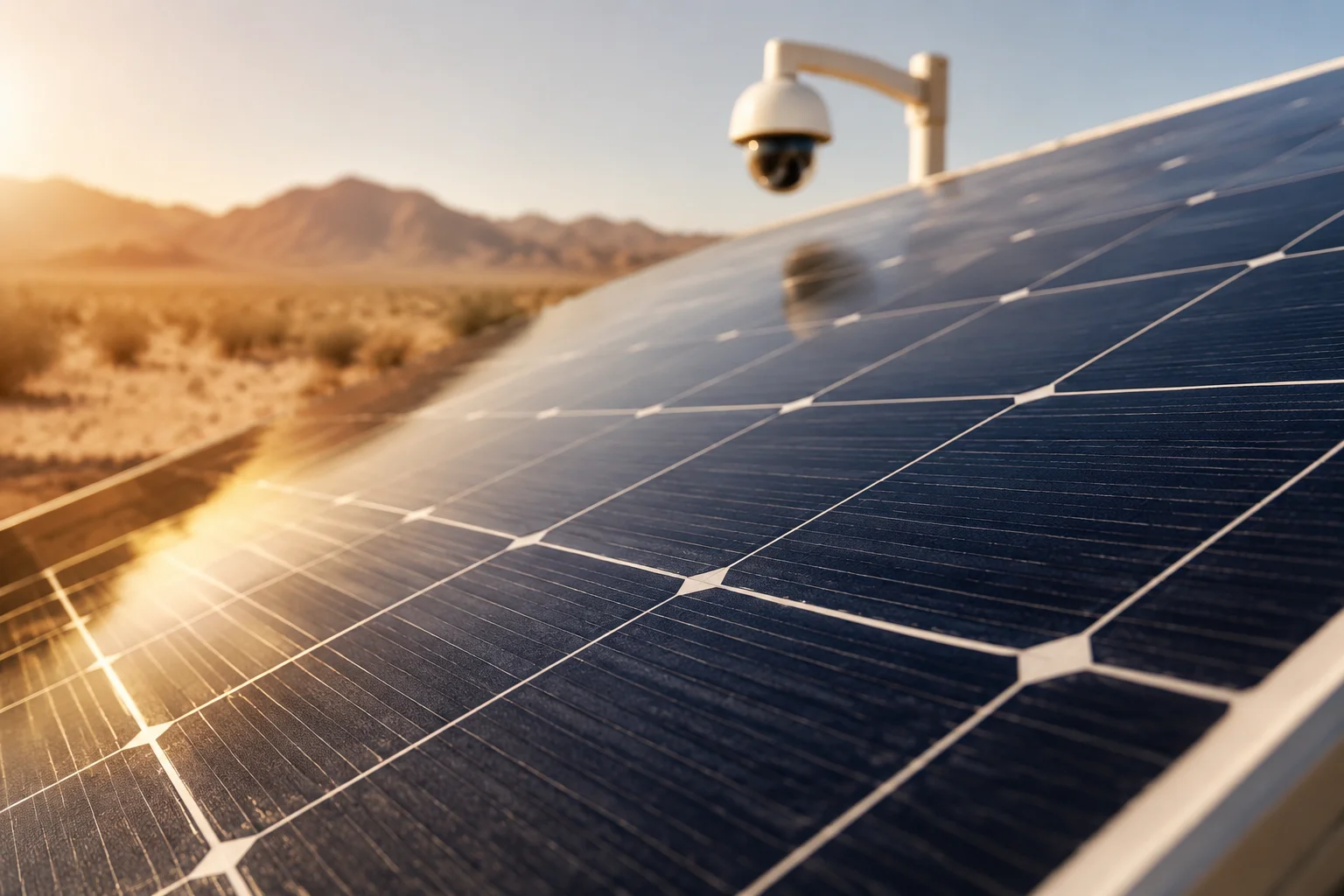
I’ve tested panels in desert conditions where surface temperatures hit 70°C. At those temps, every fraction of a percent in temperature coefficient matters.
Yes, monocrystalline’s lower temperature coefficient makes it significantly better for hot environments like Arizona. Mono panels lose about 0.35% output per degree Celsius above 25°C, while poly panels lose 0.40-0.50%. At a panel surface temperature of 65°C, this difference means mono delivers 8-10% more real-world power than poly.
What Is Temperature Coefficient and Why Does It Matter?
Every solar panel has a rated power. That rating is measured at 25°C under standard test conditions (STC). But in the real world, panels get hot. Very hot. In Arizona, ambient air temperature reaches 45°C in summer. The panel surface, absorbing direct sunlight, can reach 65-75°C. That’s 40-50°C above the STC rating.
Temperature coefficient tells you how much power you lose for each degree above 25°C. It’s expressed as a percentage per degree Celsius.
- Monocrystalline: typically -0.35%/°C
- Polycrystalline: typically -0.45%/°C
This looks like a small difference. It’s not.
Calculating Real Power Loss in Desert Heat
Let’s say your panel surface hits 65°C on a typical Arizona summer afternoon. That’s 40°C above the 25°C baseline.
Mono panel power loss: 40 × 0.35% = 14% loss. A 100W panel produces 86W.
Poly panel power loss: 40 × 0.45% = 18% loss. A 100W-equivalent poly panel produces 82W.
That’s a 4W difference. Sounds small? Over 6 hours of peak sun, that’s 24Wh per day. Over a 120-day Arizona summer, that’s 2,880Wh — nearly 3 kWh of extra energy from the mono panel. For a system running a 40Ah battery, this extra energy provides a meaningful buffer against overnight drain.
Long-Term Heat Damage
Heat doesn’t just reduce output temporarily. It causes permanent damage over time. Polycrystalline panels, with their multi-grain structure, are more prone to micro-cracks under thermal cycling6. Each day, the panel heats up to 70°C and cools down to 20°C at night. This expansion and contraction stresses the cell structure.
After 3-4 years in desert conditions, poly panels often show:
- Visible hotspots on thermal imaging
- 8-12% permanent degradation beyond normal aging
- Increased risk of junction box failure
Mono panels degrade too, but at a slower rate. Their single-crystal structure handles thermal stress better. After 5 years in the same conditions, mono panels typically show only 3-5% degradation beyond the normal 0.5%/year aging rate.
Impact on MPPT Controller Stability
Here’s something many people overlook. When a panel’s output voltage fluctuates due to temperature swings, the MPPT controller must constantly adjust. Poly panels, with their higher temperature sensitivity, cause more voltage fluctuation throughout the day. This forces the MPPT controller to hunt for the optimal operating point more frequently.
In some cases, rapid voltage changes can cause the MPPT controller to reset. Each reset means a brief interruption in charging. For a 4G PTZ camera that needs stable power, these micro-interruptions add up. Mono panels provide a smoother, more predictable voltage curve, which keeps the MPPT controller stable and the battery charging consistent.
Can I Request a “Bifacial” Monocrystalline Panel for Extra Energy Harvest from Ground Reflection?
I’ve been getting more requests for bifacial panels lately, especially from integrators deploying in snow-covered or light-colored terrain.
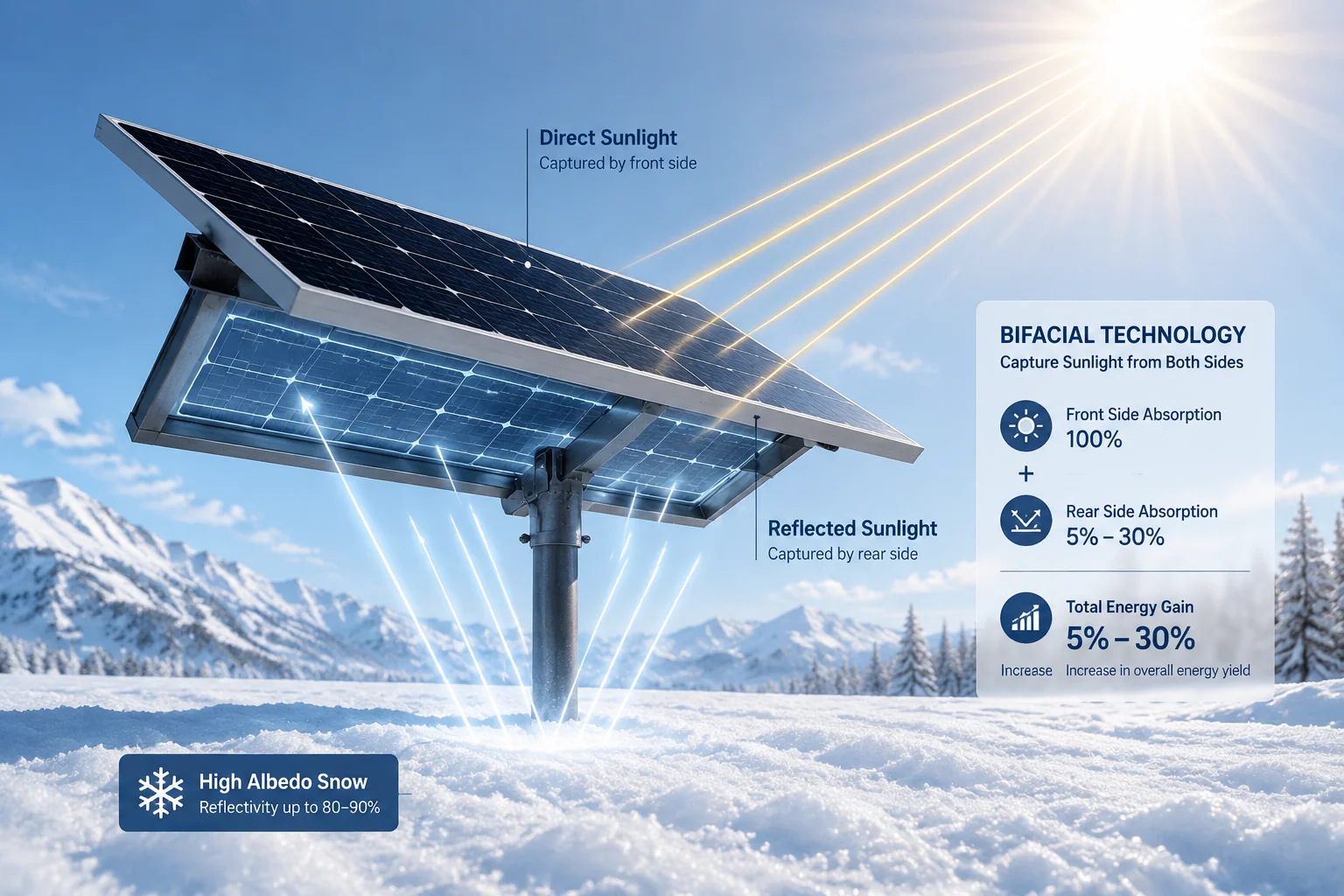
Yes, bifacial monocrystalline panels can capture reflected light from the ground on their rear side, boosting total energy harvest by 5-25% depending on surface albedo. For solar PTZ cameras installed over concrete, sand, or snow, a bifacial mono panel can significantly extend daily charging without increasing panel size.
How Bifacial Panels Work
A standard solar panel has an opaque backsheet. Light hits the front, gets converted to electricity, and any light that passes through is absorbed by the backsheet and wasted. A bifacial panel replaces that backsheet with a transparent layer (usually glass). Now the rear side of the cells can also absorb light — specifically, light that bounces off the ground below.
This reflected light is called “albedo.” Different surfaces reflect different amounts of light (albedo7).
| Ground Surface | Albedo (Reflection %) | Bifacial Gain |
|---|---|---|
| Fresh snow | 80-90% | 20-25% |
| White concrete | 40-50% | 12-15% |
| Light sand/gravel | 30-40% | 10-12% |
| Dry grass | 20-25% | 5-8% |
| Dark asphalt | 5-10% | 2-3% |
When Bifacial Makes Sense for PTZ Cameras
Not every deployment benefits from bifacial. The panel needs clearance from the ground to allow light to reach the rear side. For pole-mounted PTZ cameras, this is usually not a problem. The panel sits 3-5 meters above ground on the pole. There’s plenty of space for reflected light to reach the back.
The best scenarios for bifacial in PTZ deployments:
- Snow regions (Canada, northern US): Snow reflects up to 90% of light. In winter, when you need every watt, the rear side of a bifacial panel can add 20-25% extra power. This partially compensates for the shorter days.
- Concrete yards (construction sites, warehouses): Light-colored concrete reflects 40-50% of light. A bifacial panel over a concrete pad gains 12-15% extra energy for free.
- Desert sand (Middle East, Arizona): Light sand reflects 30-40%. Combined with the high direct irradiance in deserts, bifacial panels perform exceptionally well.
Cost-Benefit for B2B Projects
Bifacial mono panels cost about 10-15% more than standard mono panels. But in the right environment, they produce 10-25% more energy. The payback is immediate in high-albedo locations.
For a system integrator like David deploying 20 cameras across a snowy Canadian oil field, bifacial panels could mean the difference between specifying a 100W panel and needing a 120W panel. Staying with the smaller 100W bifacial panel keeps the wind profile low, the bracket standard, and the shipping costs down — while still delivering the energy of a larger panel.
Practical Considerations
There are a few things to keep in mind when requesting bifacial panels for PTZ systems:
- Mounting angle matters. A steeper tilt angle exposes more of the rear side to ground reflection. For high-latitude sites, you already want a steep angle (50-60°) to catch low winter sun. This also maximizes bifacial gain.
- Keep the rear side clean. Dust or bird droppings on the back glass reduce rear-side output. Pole-mounted panels are less prone to this than rooftop panels, but it’s worth noting.
- Frame design. Some bifacial panels use frameless glass-glass construction. Make sure your bracket design can accommodate this. At , we can match the bracket to whatever panel format you choose.
Conclusion
For solar PTZ camera systems, monocrystalline wins on total cost of ownership8. Its efficiency, durability, and low-light performance reduce truck rolls and keep your 4G cameras online year-round. The upfront savings of polycrystalline disappear once you factor in structural costs, heat degradation, and maintenance visits.
1. Understand the cost of truck rolls in remote service scenarios. ↩︎ 2. Understand how polycrystalline solar cells are made and their efficiency limitations. ↩︎ 3. Understand the power requirements and connectivity of PTZ cameras. ↩︎ 4. Learn how MPPT controllers optimize solar charging for batteries. ↩︎ 5. Compare solar cell efficiency ratings and what they mean. ↩︎ 6. Learn how heat cycling degrades solar panel performance over time. ↩︎ 7. Learn about albedo and its effect on solar panel performance. ↩︎ 8. Learn how to calculate TCO for solar-powered systems. ↩︎