
I’ve seen too many solar PTZ systems die in the field because someone picked the wrong battery chemistry. The replacement cost is painful. The truck roll to a remote site is worse.
For most North American outdoor monitoring projects, LiFePO4 is the better choice. It offers 3 to 5 times the cycle life of NCM1, stays stable in extreme heat, and won’t catch fire if damaged. NCM only wins when you need compact size or must operate in deep cold without a heating system.
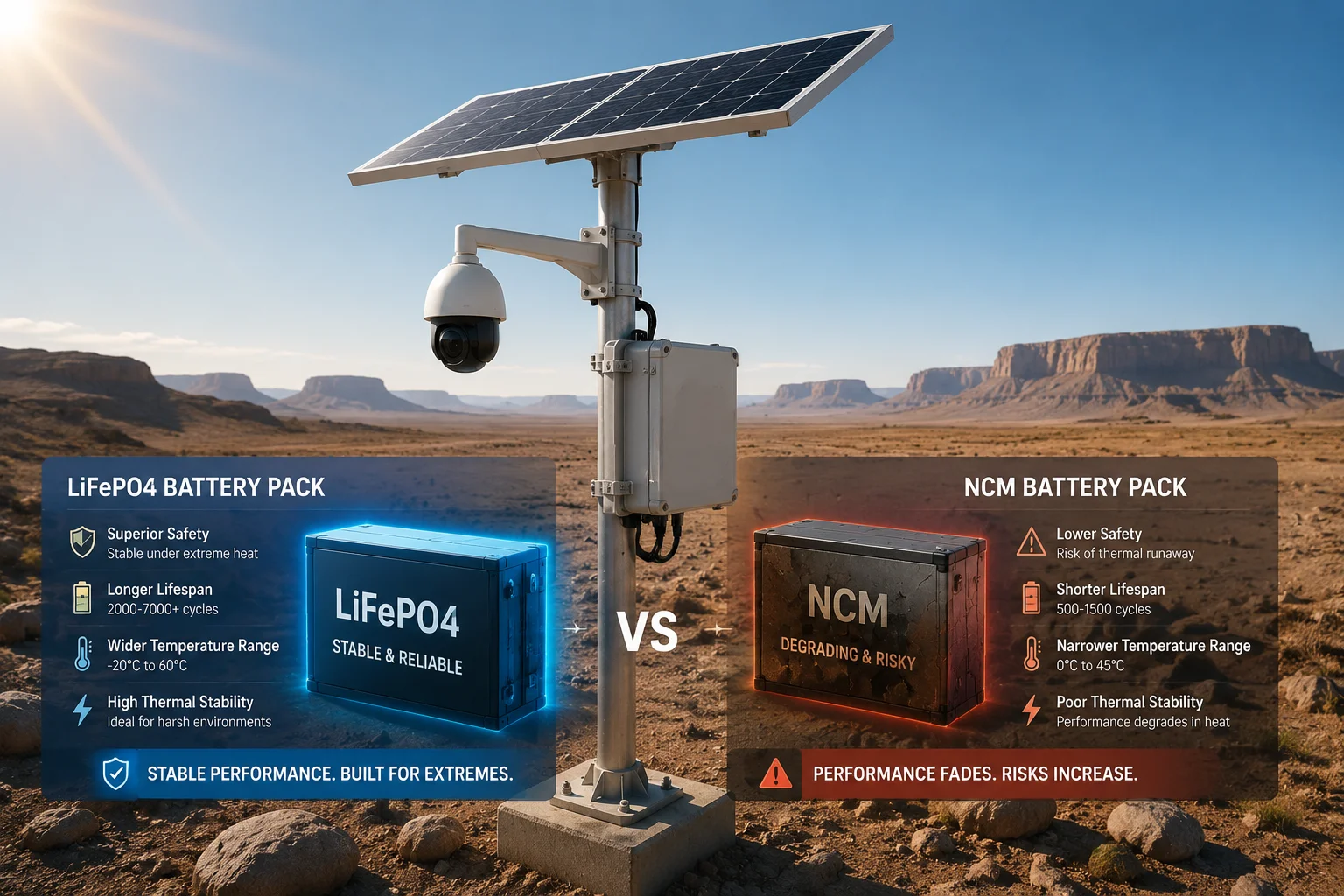
Below, I’ll break down exactly how these two battery types perform across real deployment conditions — from Arizona deserts to Canadian winters — so you can make the right call for your next project.
Table of Contents
Why Is LiFePO4 Safer for High-Temperature Desert Environments Like Arizona?
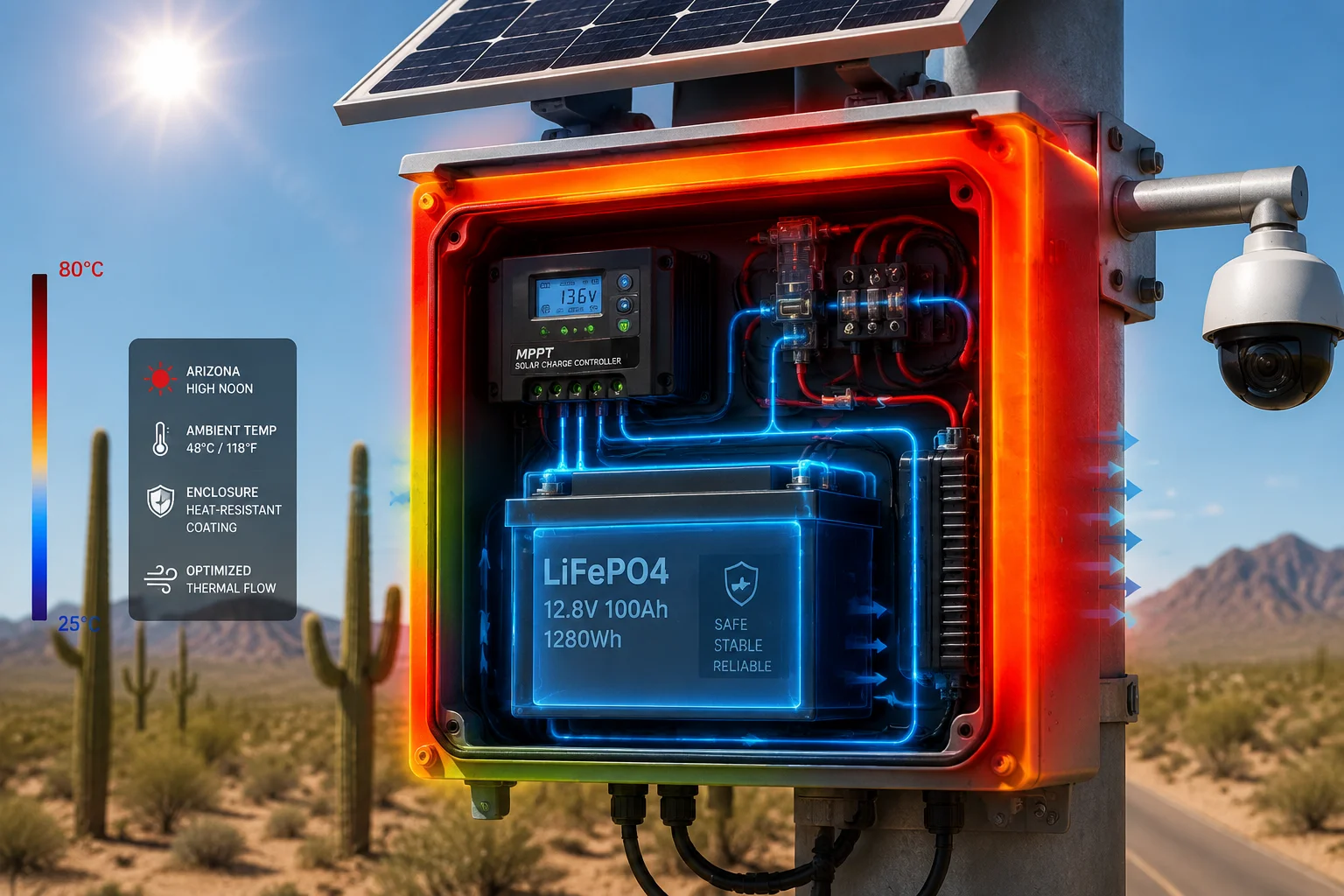
I’ve shipped solar PTZ systems to sites in Texas and Arizona where the metal enclosure hits 60°C or higher in summer. At those temperatures, battery chemistry matters more than anything else on your spec sheet.
LiFePO4 is safer because its thermal runaway temperature exceeds 400°C, compared to roughly 200°C for NCM. This means LiFePO4 stays chemically stable inside sun-baked metal housings where NCM cells risk swelling, venting, or catching fire.
What Happens Inside a Hot Enclosure
Think about a typical pole-mounted solar surveillance system in Phoenix. The sun beats down on a sealed metal box all day. There’s no air conditioning inside. The internal temperature can climb 20 to 30 degrees above ambient. On a 45°C day, that’s 65 to 75°C inside the box.
At these temperatures, NCM cells start to degrade fast. The electrolyte breaks down. Gas builds up inside the cell pouch. You get swelling first. Then, if the BMS doesn’t cut off charging in time, you get thermal runaway. That means fire.
LiFePO4 doesn’t have this problem. The iron-phosphate crystal structure is extremely stable. Even at 60°C or 70°C, the chemical bonds hold. The cell doesn’t generate extra heat on its own. It just keeps working.
Capacity Fade8 Comparison in Heat
| Condition | LiFePO4 Capacity After 2 Years | NCM Capacity After 2 Years |
|---|---|---|
| Operated at 25°C | ~95% remaining | ~90% remaining |
| Operated at 45°C | ~90% remaining | ~75% remaining |
| Operated at 60°C | ~85% remaining | ~60% remaining |
This table shows why LiFePO4 is the standard for industrial solar systems in hot climates. After two years at 60°C, an NCM pack has lost nearly half its useful capacity. You’ll need to replace it. A LiFePO4 pack still has plenty of life left.
Fire Risk in Remote Locations
Here’s something many integrators overlook. If your system is mounted near dry brush, on a wooden pole, or next to a fuel storage area, a battery fire isn’t just a hardware loss. It’s a liability nightmare. LiFePO4 cells don’t produce oxygen during failure. They may smoke, but they won’t sustain a flame. NCM cells contain oxygen in their cathode structure. Once thermal runaway starts, they feed their own fire. For deployments near forests, oil fields, or gas stations, LiFePO4 isn’t just better — it’s the only responsible choice.
How Does the Cold-Weather Performance of NCM Compare to LiFePO4 for Canadian Winters?
I get this question a lot from integrators in Ontario and Alberta. They know LiFePO4 is safer, but they worry it won’t work when temperatures drop below minus 20°C.
NCM outperforms LiFePO4 in cold weather because it maintains higher discharge voltage and capacity below 0°C. However, the real issue is charging — LiFePO4 cannot be charged below freezing without a heated BMS, while NCM tolerates low-temperature charging slightly better.
The Charging Problem Is Bigger Than the Discharge Problem
Most people focus on discharge performance. Can the battery power my PTZ camera at minus 20°C? Both chemistries can discharge in cold weather, though NCM does it better. But the real killer is charging.
LiFePO4 has a hard rule: do not charge below 0°C. If you push current into a LiFePO4 cell at minus 10°C, lithium metal plates onto the anode surface. This creates dendrites7 — tiny metal spikes that can short‑circuit the cell internally. The damage is permanent. The cell loses capacity and may eventually fail.
NCM is more forgiving. You can charge it down to about minus 10°C at reduced current without major damage. But below minus 20°C, even NCM struggles.
The Self-Heating BMS Solution
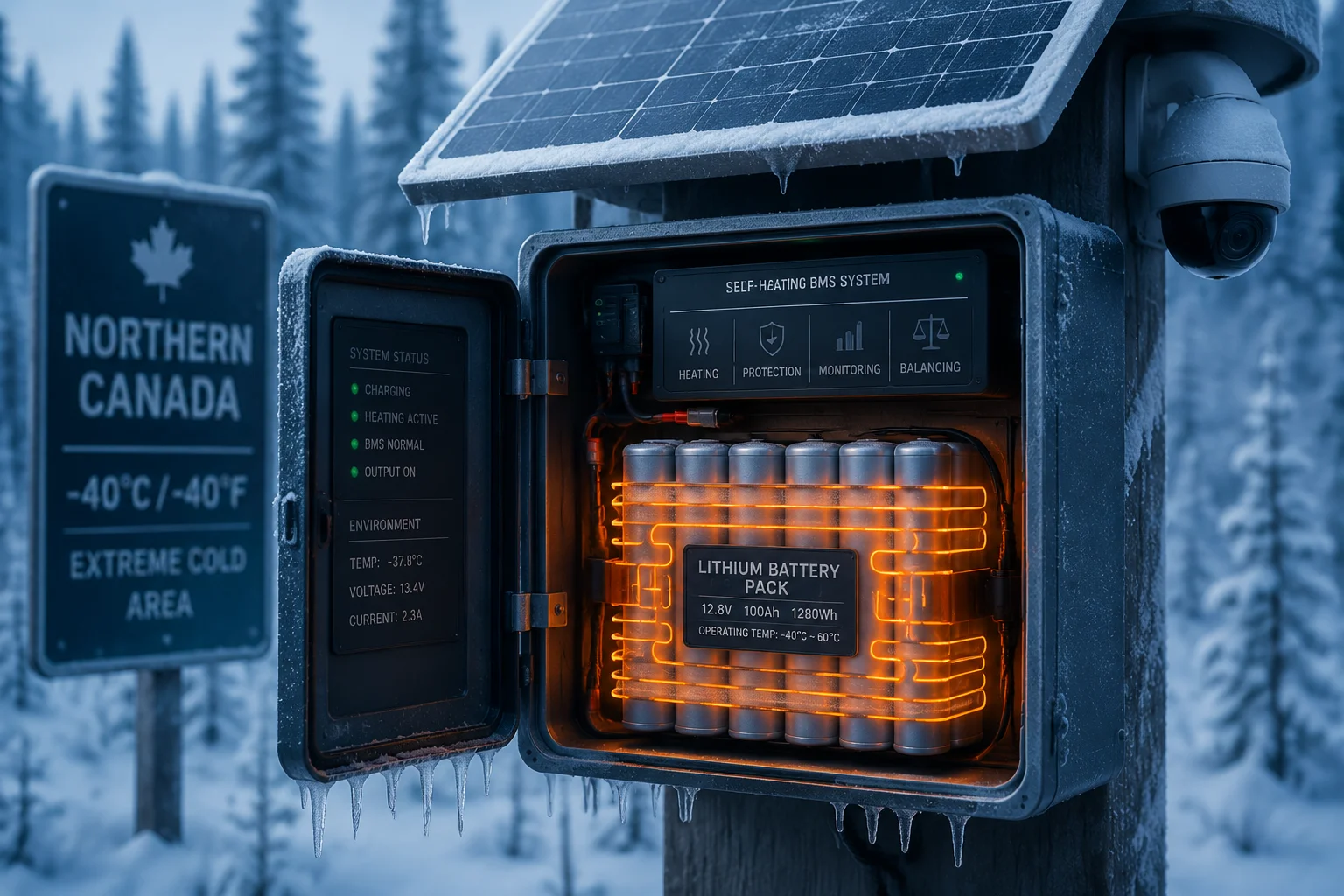
For northern deployments, I always recommend LiFePO4 with a self‑heating BMS2. Here’s how it works:
- The BMS monitors cell temperature.
- When temperature drops below 5°C, it activates a heating film wrapped around the cells.
- The heater draws power from the solar panel or from the battery’s own reserve.
- Once cells reach 5 to 10°C, charging begins normally.
This adds about 15 to 20% to the battery module cost. But it gives you the safety and longevity of LiFePO4 without the cold-weather penalty.
Low-Temperature Discharge Comparison
| Temperature | LiFePO4 Available Capacity | NCM Available Capacity |
|---|---|---|
| 25°C | 100% | 100% |
| 0°C | ~80% | ~90% |
| -10°C | ~60% | ~80% |
| -20°C | ~40% | ~65% |
| -30°C | ~20% (risky) | ~45% |
If you’re deploying in northern Canada without budget for a heating system, and your enclosure has very limited space, NCM may be the practical choice. But for most projects, the self-heating LiFePO4 approach gives better long-term value.
Will LiFePO4 Really Last 3 to 5 Times Longer Than NCM in a Daily-Cycling PTZ System?
I’ve had customers push back on this claim. They think it sounds like marketing. But the numbers are real, and I’ll show you why.
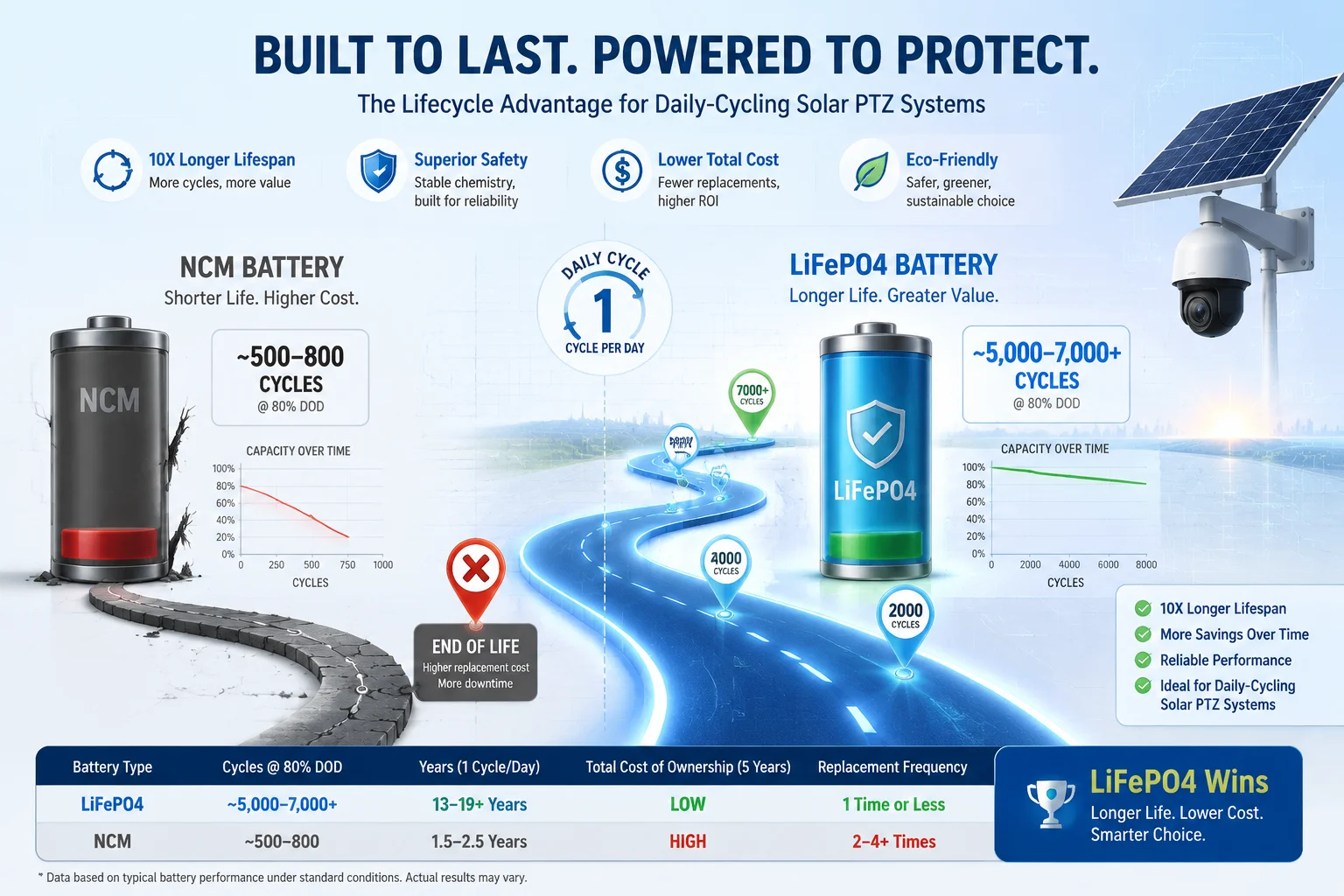
Yes. LiFePO4 delivers 2,000 to 5,000 charge cycles versus 500 to 1,000 for NCM. In a solar PTZ system that cycles once per day, LiFePO4 lasts 6 to 14 years while NCM lasts only 1.5 to 3 years before capacity drops below usable levels.
What “One Cycle Per Day” Means
A solar-powered PTZ camera charges during the day and discharges at night. That’s roughly one full cycle every 24 hours. Some systems cycle even more if the load is heavy and the solar input is limited during cloudy seasons.
At one cycle per day, you get 365 cycles per year. Let’s do the math:
- NCM at 800 cycles: 800 ÷ 365 = 2.2 years to reach end of life
- LiFePO4 at 3,000 cycles: 3,000 ÷ 365 = 8.2 years to reach end of life
That’s not 3 to 5 times longer in theory. That’s 3 to 5 times longer in practice.
The True Cost of Battery Replacement
The battery itself might cost $150 to $300. But what about the truck roll? In remote monitoring — construction sites, pipelines, farms, highway corridors — sending a technician to swap a battery can cost $500 to $2,000 per visit. You need a bucket truck, a trained worker, and half a day of travel.
If you use NCM, you’ll replace batteries 3 to 4 times over a 10-year project. If you use LiFePO4, you replace it once or not at all.
Total Cost of Ownership Over 10 Years
| Cost Item | LiFePO4 | NCM |
|---|---|---|
| Initial battery cost | $250 | $180 |
| Replacements needed (10 years) | 0-1 | 3-4 |
| Total battery spend | $250-$500 | $720-$900 |
| Truck roll cost per swap | $800 | $800 |
| Total truck roll spend | $0-$800 | $2,400-$3,200 |
| Total 10-year cost | $250-$1,300 | $3,120-$4,100 |
The upfront price difference between LiFePO4 and NCM is small. The lifetime cost difference is massive. For any project with a 5-year or longer horizon, LiFePO4 pays for itself many times over.
Depth of Discharge Matters Too
LiFePO4 handles deep discharge better than NCM. You can regularly discharge a LiFePO4 cell to 80% or even 90% depth of discharge without major cycle life loss. NCM cells degrade much faster if you discharge them past 80%. This means in real-world use — where cloudy days force deeper discharges — LiFePO4’s advantage grows even larger.
Which Battery Chemistry Is Easier to Clear Through U.S. Customs and Airline Regulations?
I deal with international shipping every week. Battery compliance is one of the most common headaches my customers face when importing solar monitoring systems into North America.
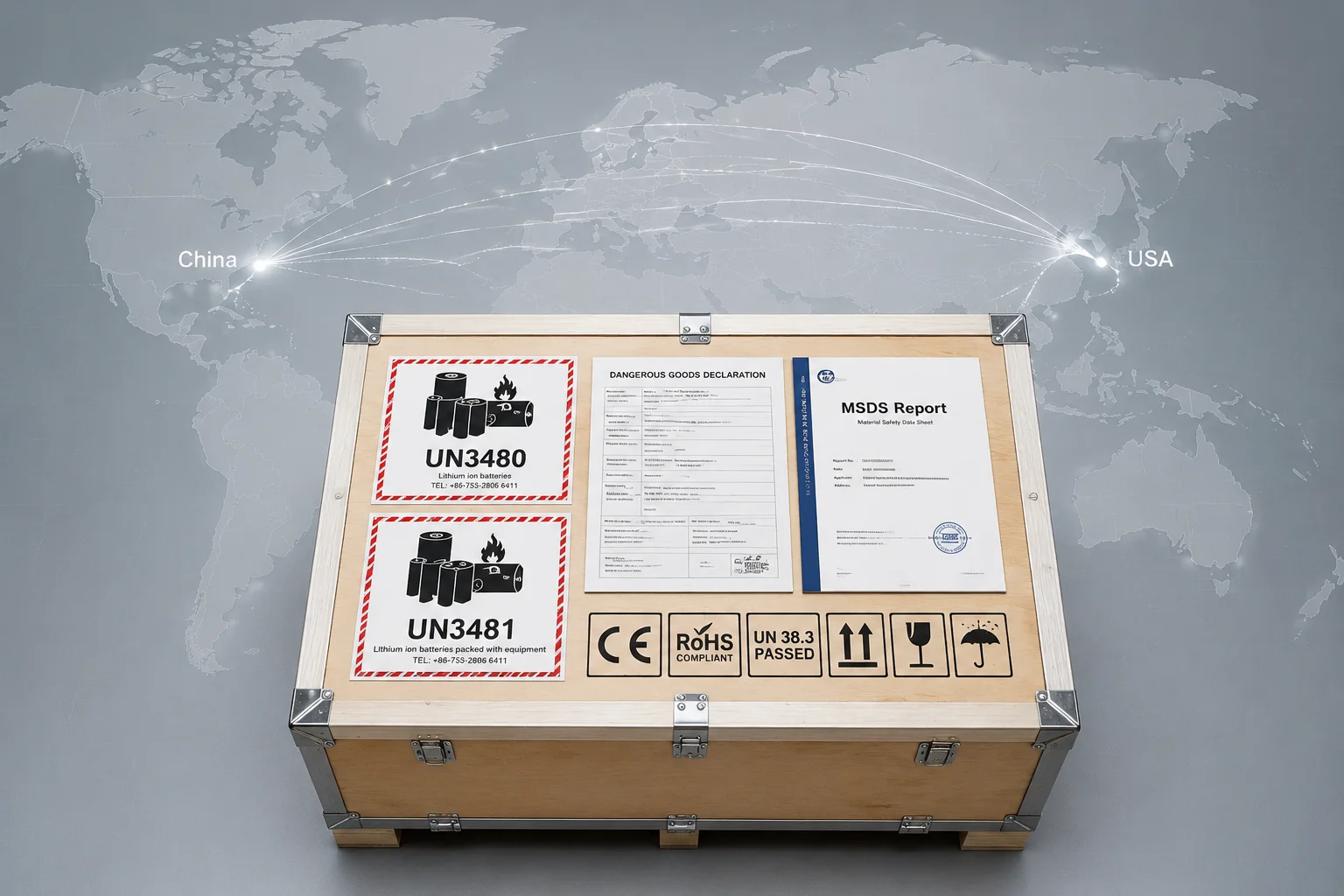
LiFePO4 is easier to ship and clear through customs because it is classified as a safer lithium chemistry. It faces fewer restrictions under UN3480/UN3481 transport rules, passes UL safety certifications more readily, and is less likely to trigger additional inspection or documentation requirements.
UN Transport Classification
Both LiFePO4 and NCM fall under the same UN number for shipping: UN3480 (lithium-ion batteries) or UN3481 (lithium-ion batteries packed with equipment). But in practice, carriers and customs agents treat them differently.
LiFePO4’s non-flammable nature means it often qualifies for less restrictive packaging requirements. Some freight forwarders offer lower shipping rates for LiFePO4 because the insurance risk is lower. NCM batteries, especially large packs, sometimes require Class 9 dangerous goods6 labeling and special handling fees.
UL Certification Path
For the North American market, UL certification is critical. The two main standards are:
LiFePO4 cells pass abuse tests (nail penetration, crush, overcharge) more easily because they don’t produce flames during failure. This makes the certification process faster and cheaper. NCM cells require more robust protection circuits and enclosure designs to pass the same tests, which adds engineering time and cost.
Practical Shipping Tips
If you’re importing solar PTZ systems with built-in batteries from China to the U.S. or Canada, here’s what I recommend:
- Ship LiFePO4 packs by sea freight with standard lithium battery documentation. Most freight forwarders handle this routinely.
- For air freight samples, LiFePO4 under 100Wh per pack can often ship as Section II (less restrictive). NCM packs of the same size may face stricter Section I requirements depending on the carrier.
- Always include the UN38.33 test report, MSDS, and a packing declaration. Missing paperwork causes delays regardless of chemistry.
State and Local Fire Codes
Some U.S. jurisdictions have started adopting fire codes that restrict NCM battery installations in certain building types. New York City, for example, has strict rules about lithium battery storage after several e-bike battery fires. While these codes mainly target consumer products today, the trend is moving toward stricter rules for all NCM installations. LiFePO4 systems are generally exempt from these additional restrictions because of their inherent safety profile.
Conclusion
For North American outdoor monitoring, LiFePO4 wins on safety, lifespan, and total cost. Use NCM only when extreme cold and tight space leave no other option. Pair LiFePO4 with a self-heating BMS, and you get the best of both worlds.
1. Detailed explanation of nickel‑cobalt‑manganese cathode chemistry and its trade‑offs. ↩︎ 2. Explanation of how integrated heating elements enable LiFePO4 charging below freezing. ↩︎ 3. UN standard for lithium battery transport testing required for customs clearance. ↩︎ 4. UL safety standard for stationary energy storage systems, applicable to large battery packs. ↩︎ 5. UL safety standard for household and commercial battery packs, often required for import. ↩︎ 6. Hazard classification for lithium‑ion batteries that affects shipping fees and labeling. ↩︎ 7. How lithium dendrite formation short‑circuits cells and why it is more dangerous in NCM. ↩︎ 8. Explanation of how heat accelerates capacity loss in NCM vs LiFePO4 cells. ↩︎