
I often see battery choices turn into a cost trap. A lighter battery can look smart at first, but shipping, duties, and compliance can quietly break the budget.
The best balance is usually not the highest Wh/kg battery, but the one that gives enough runtime with the lowest landed cost. In many B2B projects, LiFePO4 wins because it lowers risk, supports long service life, and often improves total ROI even when it is heavier.
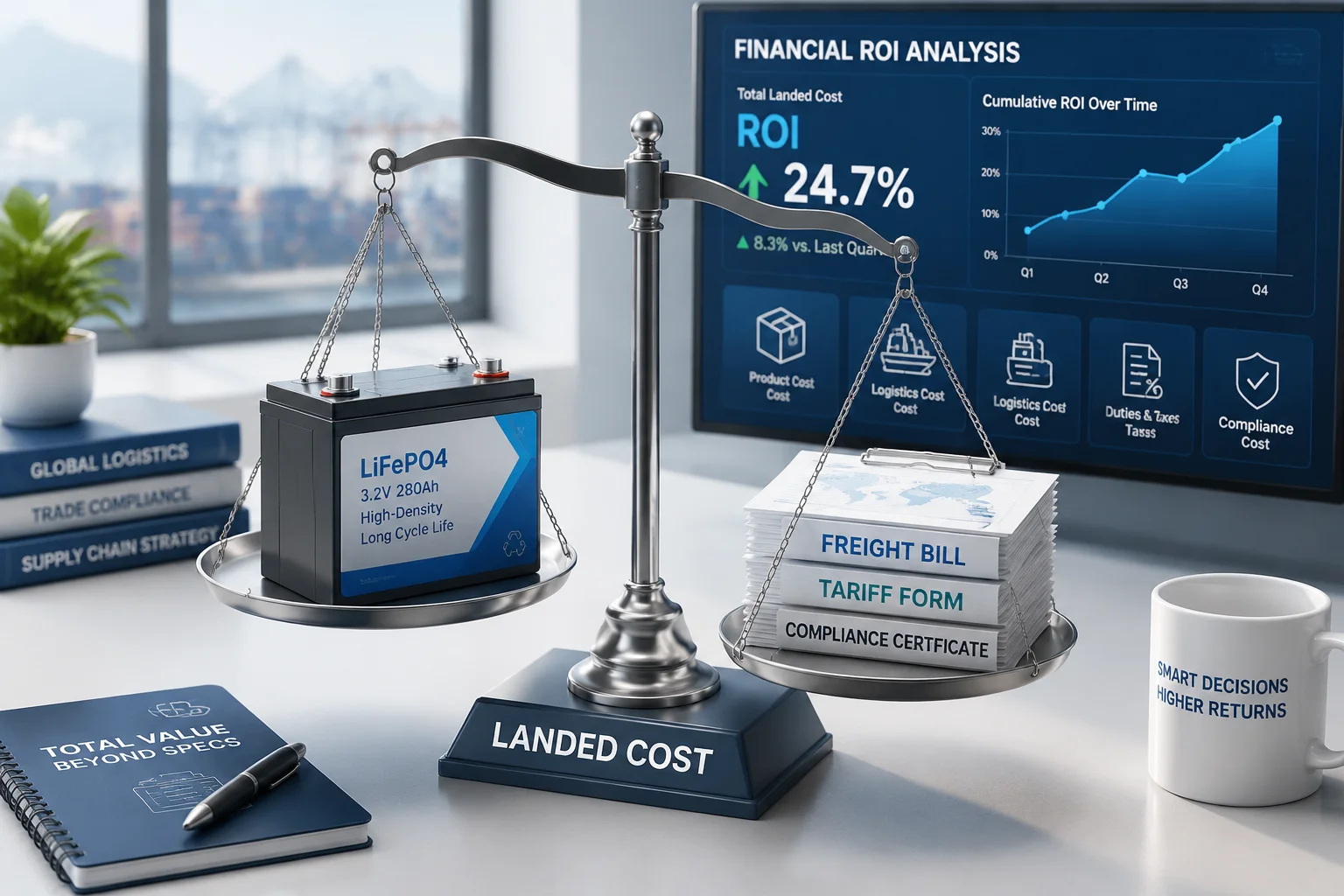
I need to look at this problem the same way I would design a real project. I do not only check battery specs. I also check freight rules, tariff code, installation cost, service life, and the final cost per day of use.
Table of Contents
Does a higher energy density battery significantly reduce my international air freight fees?
I often think a smaller and lighter battery should save money. But then I see the air freight quote, and the savings are not as big as I hoped.
A higher energy density1 battery can reduce chargeable weight, but it does not always cut international air freight fees by a large amount because dangerous goods rules, packaging, airline limits, and handling fees can still drive the price up.
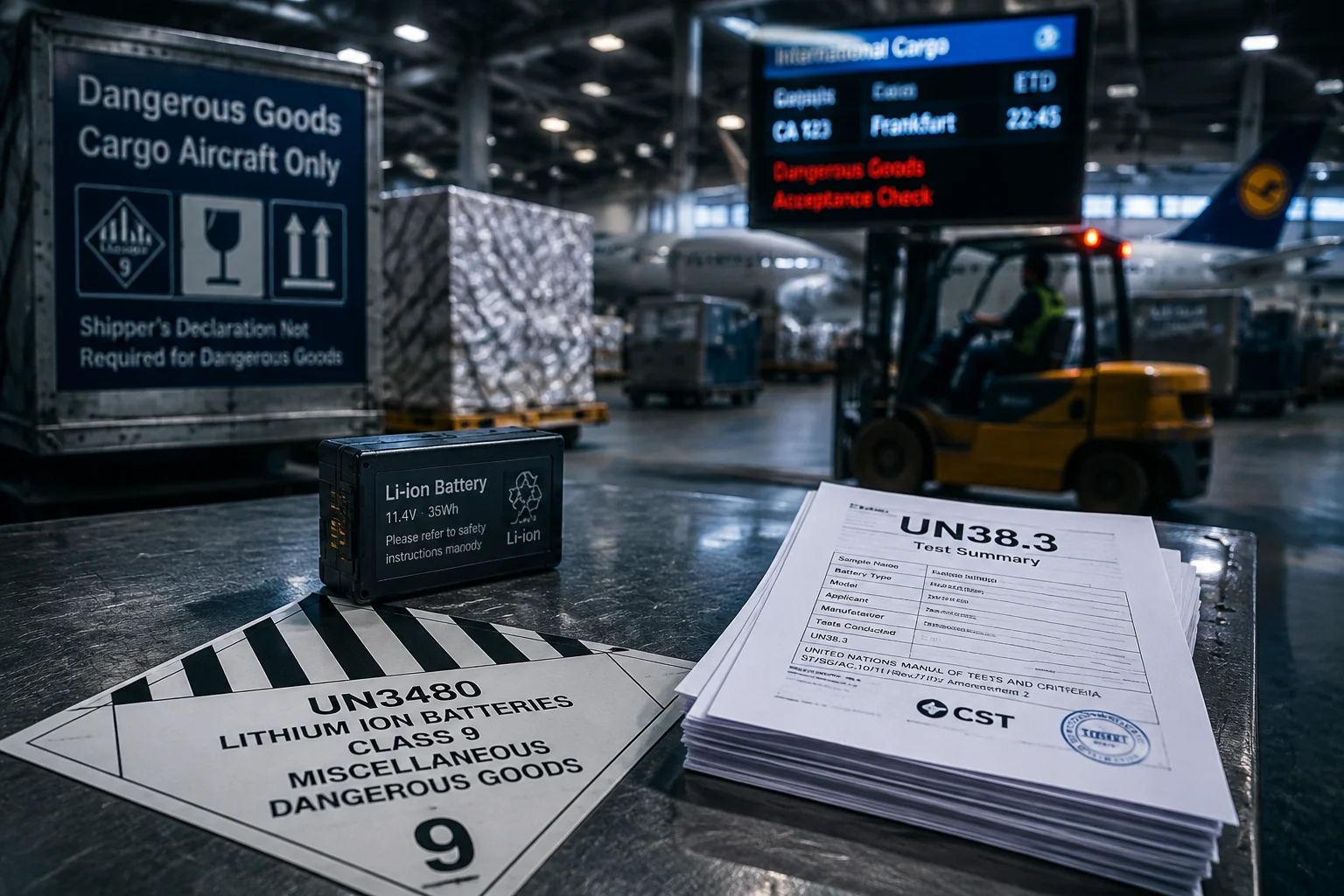
I need to separate two things in my mind. The first is physical weight. The second is shipping class. Air freight does not price only by kilos. It also prices by risk. A battery with high Wh/kg often still falls into strict dangerous goods7 handling. That means special packing, labels, paperwork, and sometimes a limited route. I have seen cases where the battery was lighter, but the total air cost stayed high because the carrier treated it as Class 9 cargo. In other words, the freight bill does not fall in a straight line with battery weight.
How I compare freight savings with real shipping charges
I usually compare battery options by asking a simple question: if I cut the battery weight by 20% or 30%, how much does the total freight bill really change? In many real projects, the answer is less than people expect. The airline may charge by volumetric weight3, so a smaller box helps. But if the battery needs UN38.32 proof, MSDS, a dangerous goods declaration, and special packaging, those fixed costs remain. If the route uses a hub that has strict battery rules, the carrier may add more fees too.
I also look at the project type. For a small sample order, the fixed dangerous goods cost can be a big part of the total. For a large order, the per-unit freight can improve, but only if the shipment is packed well and the battery design is stable. This is why I do not say “high density always saves shipping money.” I say it may help, but only after I check the whole shipping stack.
A simple freight comparison table
| Factor | Higher energy density battery | Lower energy density battery |
|---|---|---|
| Battery weight | Lower | Higher |
| Volumetric size | Often smaller | Often larger |
| Dangerous goods handling | Usually still needed | Usually still needed |
| Fixed paperwork cost | Similar | Similar |
| Total air freight impact | Sometimes moderate savings | Sometimes higher cost |
| Best use case | Tight space, premium runtime | Safer, longer life, easier planning |
I use this table as a reality check. If the project needs fast delivery and air shipping, then battery size matters. But if the order is large, sea freight may be smarter, and the battery density gap becomes less important. I also remind myself that a battery is not the final product. It is only one part of the landed cost. If I save $50 on freight but lose $200 in extra compliance time, I did not save money at all.
How do I calculate the duty savings if I import the battery and camera separately?
I sometimes see buyers want to split the battery and camera into two imports. That sounds smart because the duty rate may look lower on one line. But I always check the full tax and customs picture first.
To calculate duty savings, I compare the duty on the full integrated system with the duty on each separated item, then add extra freight, brokerage, storage, and compliance costs. If the split import lowers the tax but raises other costs, the savings may disappear.
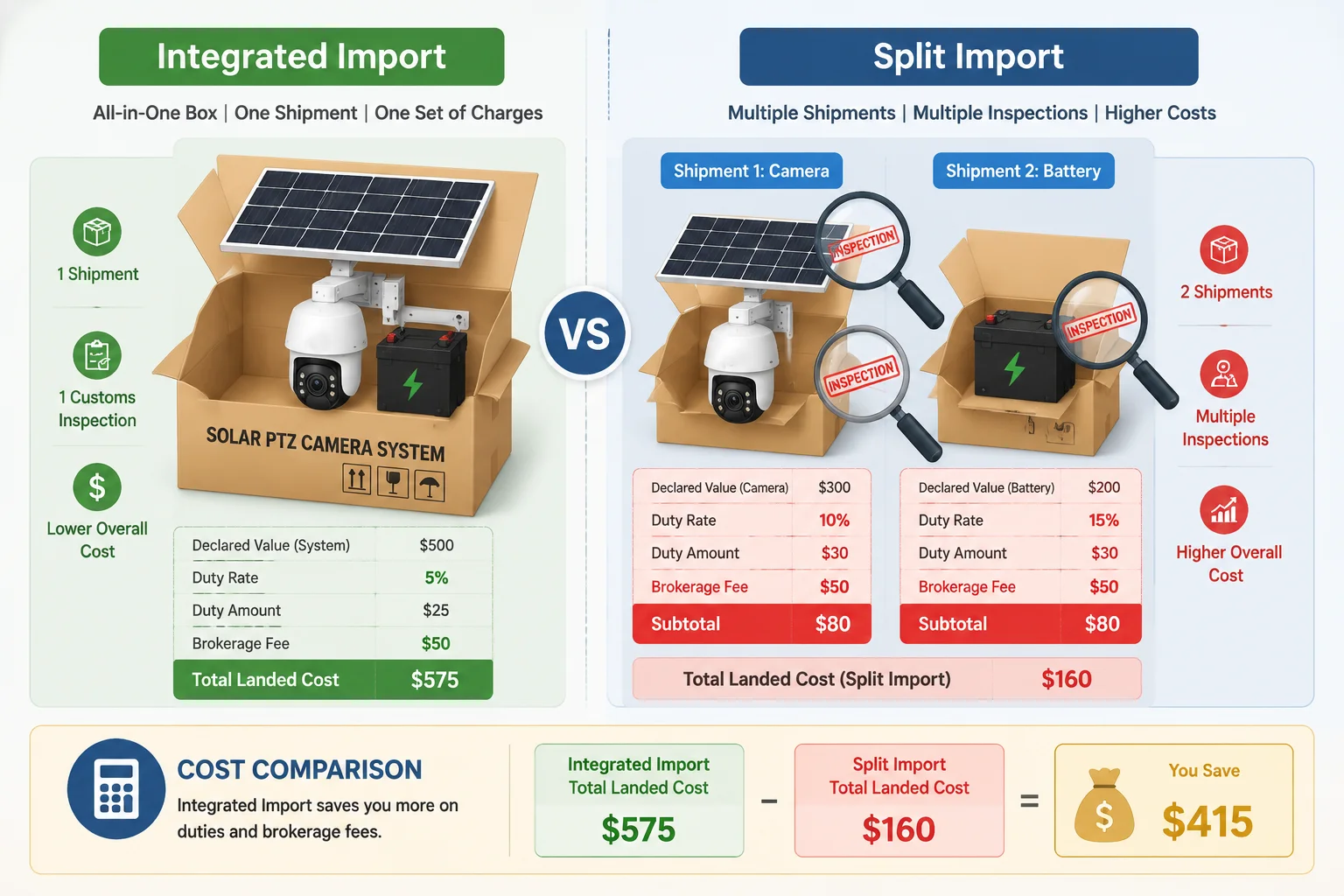
I need to be careful here because customs does not always accept the story I want to tell. If the battery and camera are designed to work as one system, some customs offices may look at the real function, not just the invoice line. That means the HS code4 can change based on how the product is built and sold. If I import the camera as one item and the battery as another item, I may get a lower duty rate on one line. But I may also create more paperwork, more inspection risk, and more delay. In a project with a strict deadline, delay can cost more than duty.
The math I use for duty savings
I usually run this simple model:
| Item | Option A: Integrated import | Option B: Split import |
|---|---|---|
| Camera value | $X | $X |
| Battery value | Included | Separate |
| Duty rate | Rate on full system | Different rates by item |
| Freight | One shipment | Two shipments |
| Brokerage | One filing | Two filings |
| Customs risk | Lower process risk | Higher process risk |
| Total landed cost | Compare | Compare |
The key is not just the duty rate. The key is the final landed cost.
I also think about the country of import. In some markets, batteries have a special tariff code5. In some places, the system may qualify for a different classification if the battery is built into the device. But I cannot assume the customs officer will accept my preferred split just because I wrote it on the invoice. I need consistent packing, clear product descriptions, and clean technical files.
Why split imports can help, but also hurt
I know split imports can help in a few cases. For example, if I buy the camera system first and source batteries locally later, I may reduce cross-border battery shipping costs. That can work well when the battery is bulky and the target market has local stock. It can also help if the battery is easier to source from a domestic supplier.
But split imports can hurt when the customer wants a ready-to-install system. The buyer then has to handle local assembly, local testing, and local warranty issues. That adds time and risk. If the battery and camera are separated too much, I may also lose product control. The system may no longer arrive as one tested unit. For a B2B project, that can create support problems later. So I do not chase duty savings alone. I compare duty savings against real execution cost.
What is the “Sweet Spot” for battery capacity that maximizes runtime without hitting luxury tariffs?
I often hear people ask for the biggest battery possible. I understand why. More capacity sounds like more uptime and fewer site visits. But I also know bigger batteries can push the project into a more expensive logistics and tax zone.
The sweet spot is the smallest battery capacity that still meets the required runtime, plus a safety buffer. This often gives the best balance between long runtime, lower shipping pain, lower duty exposure, and better total project ROI.
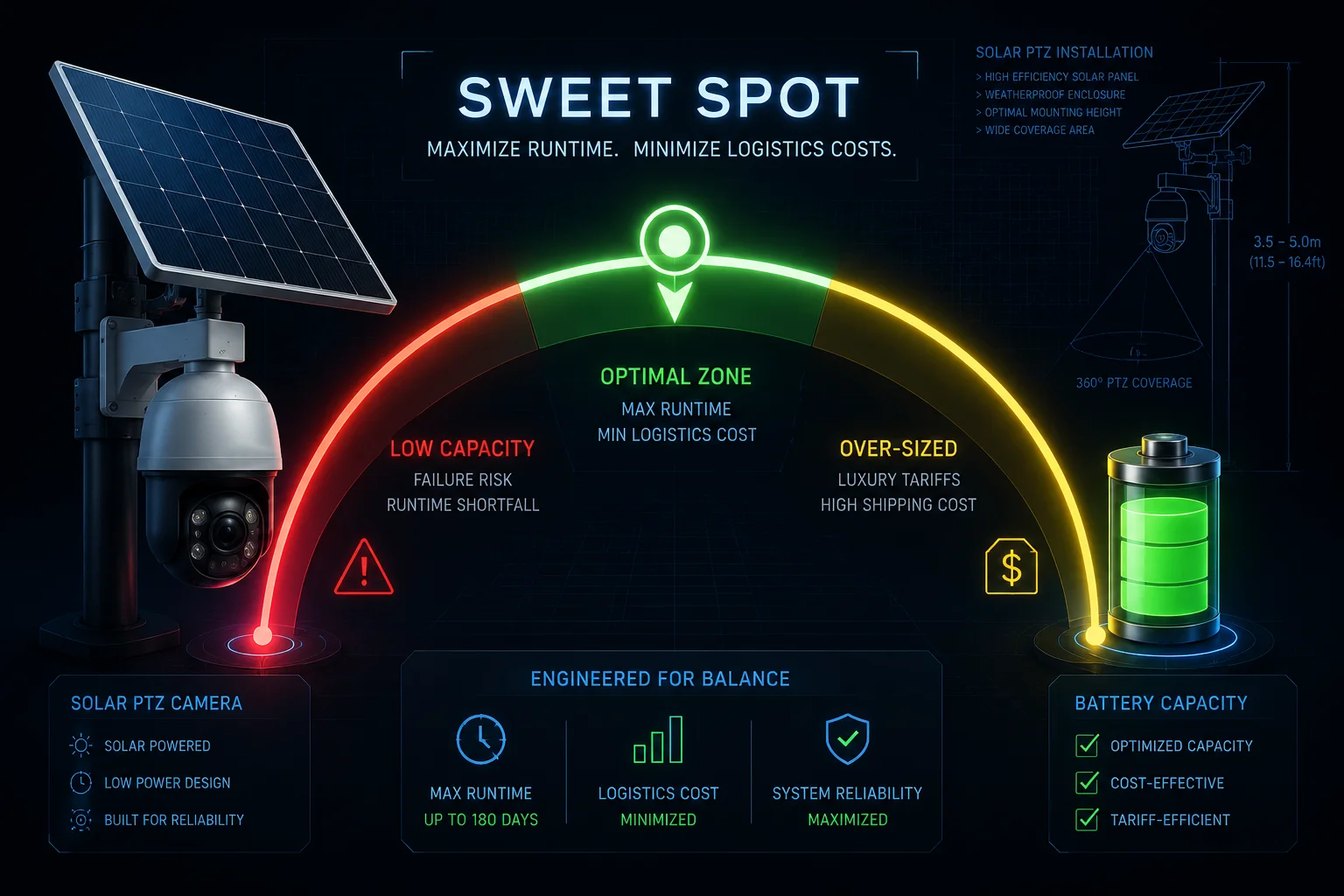
I usually start from the real use case, not from the battery catalog. I ask how many watts the camera system draws, how many hours it must run without sun, how much reserve I need for cloudy days, and how much room I have in the housing. When I do that, I often find that the “best” battery is not the largest one. It is the one that covers the duty cycle with a smart margin. If I go too small, the system fails in bad weather. If I go too large, I may pay extra for freight, packaging, and customs handling. The middle point is usually the right point.
How I size battery capacity in real projects
I use a simple formula in my head:
Required Wh = Load (W) × Hours of autonomy
Then I add a buffer for:
- cold weather
- aging
- charging loss
- peak load
- cloudy days
After that, I ask a second question: does this size force a new freight class, special handling, or a much higher tariff? If yes, I test a smaller option. A smaller battery may still meet the runtime target if I improve solar input, reduce idle load, or use a smarter power schedule. That is where real design work starts.
Capacity, runtime, and cost trade-off table
| Battery choice | Runtime | Shipping cost | Tariff risk | Maintenance need | Project fit |
|---|---|---|---|---|---|
| Small battery | Shorter | Lower | Lower | Higher | Short projects, warm areas |
| Mid-size battery | Balanced | Balanced | Balanced | Balanced | Most B2B sites |
| Large battery | Longer | Higher | Higher | Lower | Remote sites, harsh weather |
I do not chase the biggest number on the spec sheet. I chase the lowest cost per useful day. That mindset helps me avoid what I call the “luxury tariff trap.” Some battery sizes look elegant on paper, but they create higher shipping charges, more packaging, and more customs attention. If I can reach the same runtime with a mid-size pack and better system tuning, I usually choose that path.
Why the sweet spot is often not the peak-spec battery
I also think about the life of the whole system. A bigger battery may seem safer because it gives more reserve. But if the battery is too large for the housing, it can force a bigger enclosure, stronger brackets, and more labor time. That adds hidden cost. In a solar PTZ camera8 project, the battery does not live alone. It affects the pole, the box, the seal, the weight balance, and even the installation crew size. So the sweet spot is not just about chemistry. It is about the whole field setup.
Will choosing a lower-density but safer LiFePO4 battery increase my overall project ROI?
I often hear the word “safer,” but I do not treat it as a soft idea. In field projects, safety can become a direct money issue. A safer battery can reduce downtime, returns, and service calls.
Yes, a lower-density LiFePO4 battery can increase total ROI because it often lasts longer, handles heat better, and reduces failure risk. Even if it is heavier, the lower maintenance cost and longer cycle life can beat the upfront savings of a high-density pack.
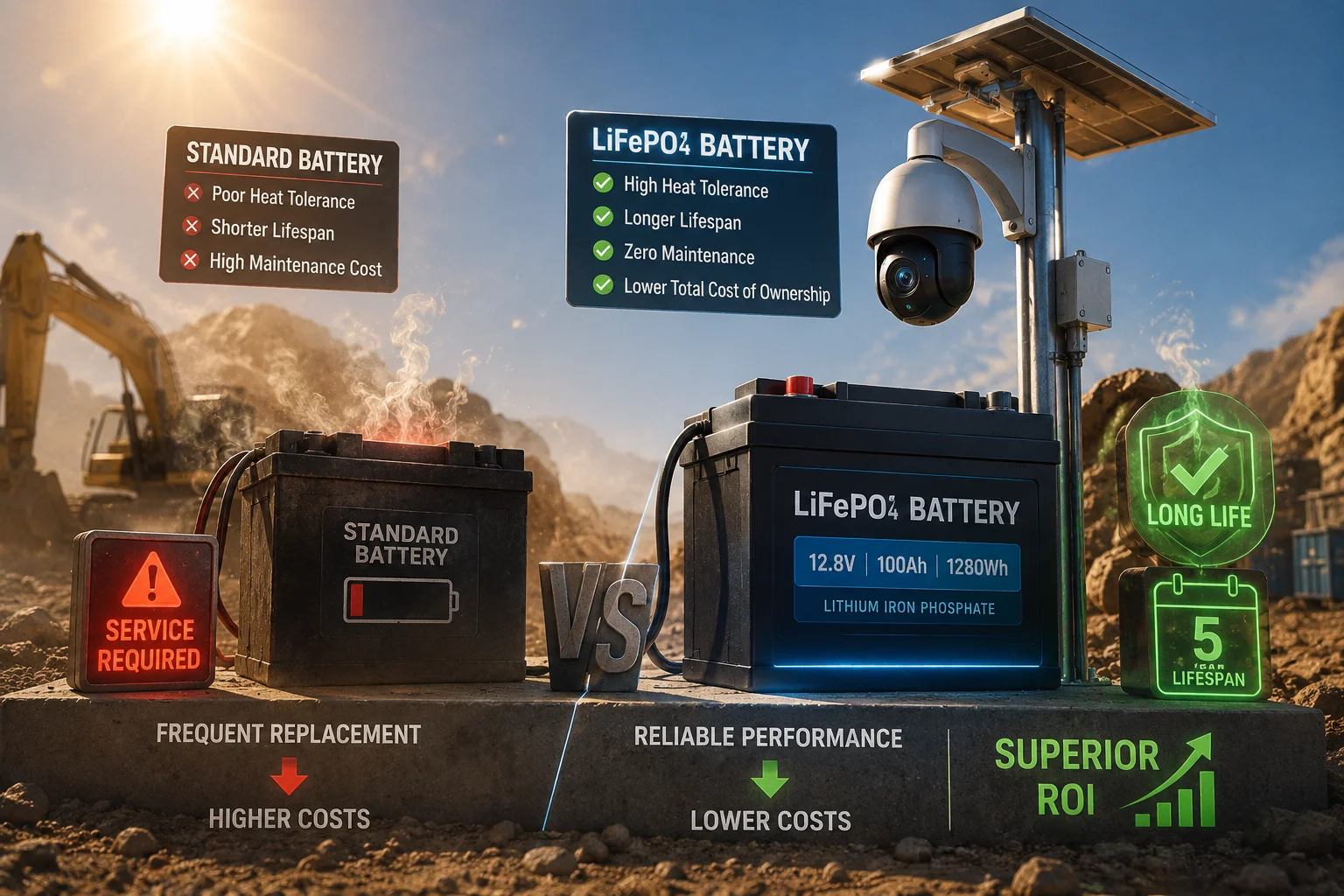
I look at ROI in a broad way. I do not only compare battery purchase price. I compare install cost, freight cost, failure cost, service cost, and replacement cost over time. LiFePO4 usually helps on the long-term side. It has strong thermal stability6, and it can survive many more cycles in many outdoor jobs. That matters a lot for remote security sites. If a battery failure means a truck roll, a site visit, and a lost customer, then the cheaper battery can become the expensive battery very fast. I have seen many projects where the total cost of one repair exceeded the savings from buying the lower-cost chemistry in the first place.
Why safer chemistry often wins in B2B projects
I like LiFePO4 in long-life field systems because it fits the way B2B customers think. My buyers care about uptime, low service calls, and stable performance. They do not want a battery that saves a little on day one but causes field problems in year two. LiFePO4 also tends to hold up better in hot weather, which matters for outdoor poles, farms, and roadside sites. When I combine that with the long cycle life, the cost per cycle can be lower even if the unit price is higher. That is the kind of math that matters.
ROI comparison table
| Metric | High-density battery | LiFePO4 battery |
|---|---|---|
| Upfront unit cost | Often lower or similar | Often higher |
| Weight | Lower | Higher |
| Thermal stability | Lower | Higher |
| Cycle life | Shorter | Longer |
| Service calls | More possible | Fewer possible |
| Total ROI | Can be weaker | Often stronger |
I also think about warranty risk. If I sell a system to a distributor or integrator, they care about repeat orders and low support pain. A battery that lasts longer and fails less often supports that goal. It also protects my brand. For a company like mine, where I build professional PTZ solar systems, my reputation depends on stable field performance. A low-density battery that is safer and more durable can be the better business choice because it lowers hidden costs across the whole project life.
My practical rule for ROI
My rule is simple: if the site is hard to reach, or the customer expects long service intervals, I lean toward LiFePO4. If the site is very space-limited and short-term use is the goal, I may test another option. But I still do not let battery weight lead the decision alone. I let service life and total cost lead.
Conclusion
I balance battery density, shipping, duty, and service life by focusing on landed cost, not just Wh/kg. The best battery is the one that meets runtime needs and keeps the total project ROI strong.
1. Understand the metric for battery energy storage per unit mass. ↩︎ 2. UN standard for testing lithium batteries for safe transport. ↩︎ 3. Explanation of how freight charges are calculated based on package volume. ↩︎ 4. Harmonized System code used for customs classification and duty rates. ↩︎ 5. Detailed classification codes used for import duties. ↩︎ 6. Battery’s ability to resist temperature-related failure. ↩︎ 7. Overview of IATA dangerous goods regulations for air freight. ↩︎ 8. Pan-tilt-zoom camera used in security and surveillance. ↩︎