
I’ve seen too many PTZ cameras fail at the coast — not because the electronics died, but because the housing corroded and locked up every moving part.
A die-cast aluminum PTZ housing can last 10 to 25 years in salty coastal environments when it uses marine-grade surface treatments. Without proper coatings, bare ADC12 aluminum will show heavy white oxidation in just 1 to 3 years. The real lifespan depends on alloy choice, coating quality, and fastener materials — not the aluminum itself.
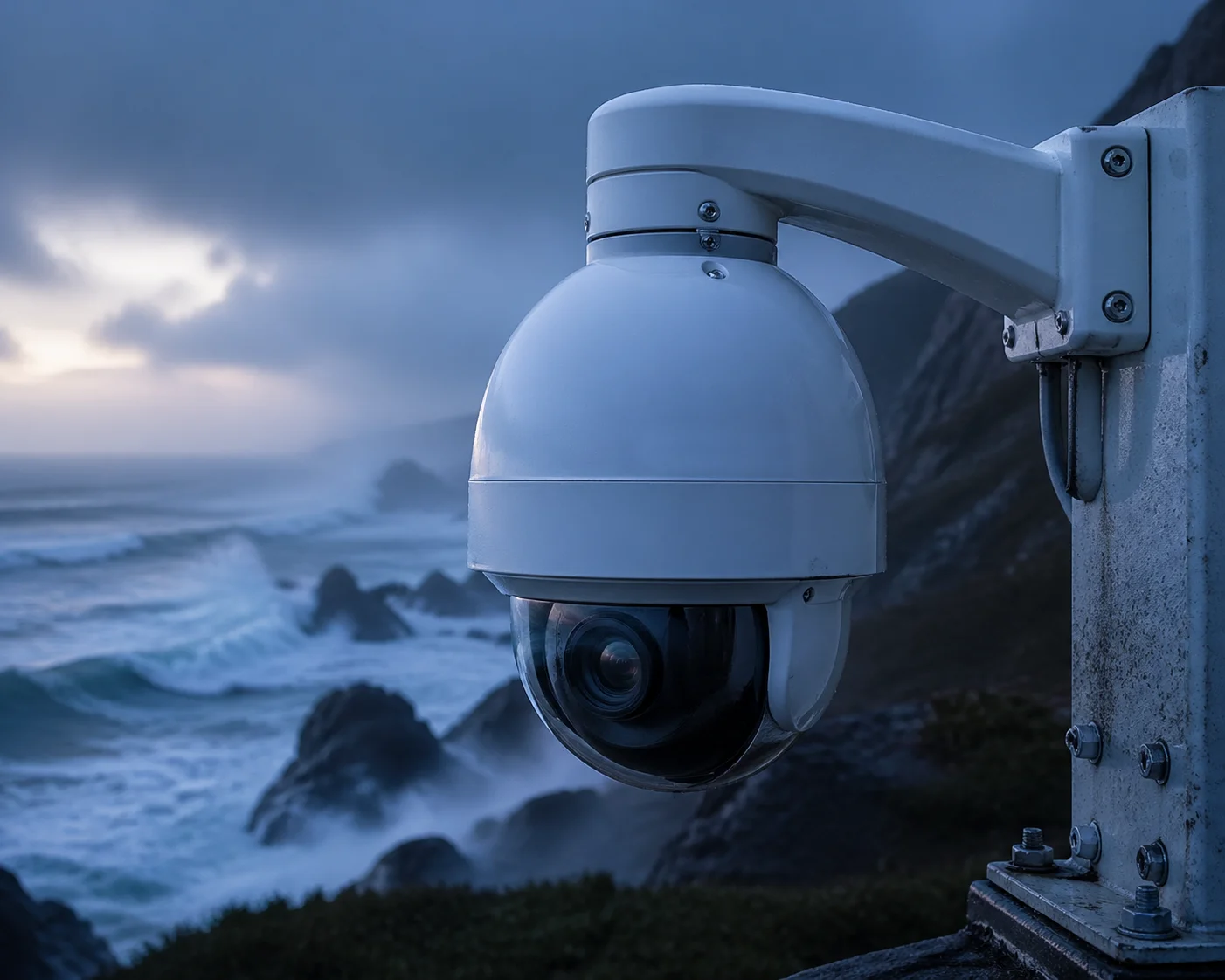
Below, I break down the exact tests, coatings, fastener specs, and comparisons you need to evaluate before committing to any PTZ housing for a coastal project. Every detail here comes from real field experience and lab data — the kind of information that saves you from expensive truck rolls two years down the road.
Table of Contents
Does My Camera Housing Pass a 48-Hour or 96-Hour Salt Spray Test?
If your supplier only talks about 48 or 96 hours of salt spray testing, that should raise a red flag. I’ve learned the hard way that those numbers barely scratch the surface for real coastal deployments.
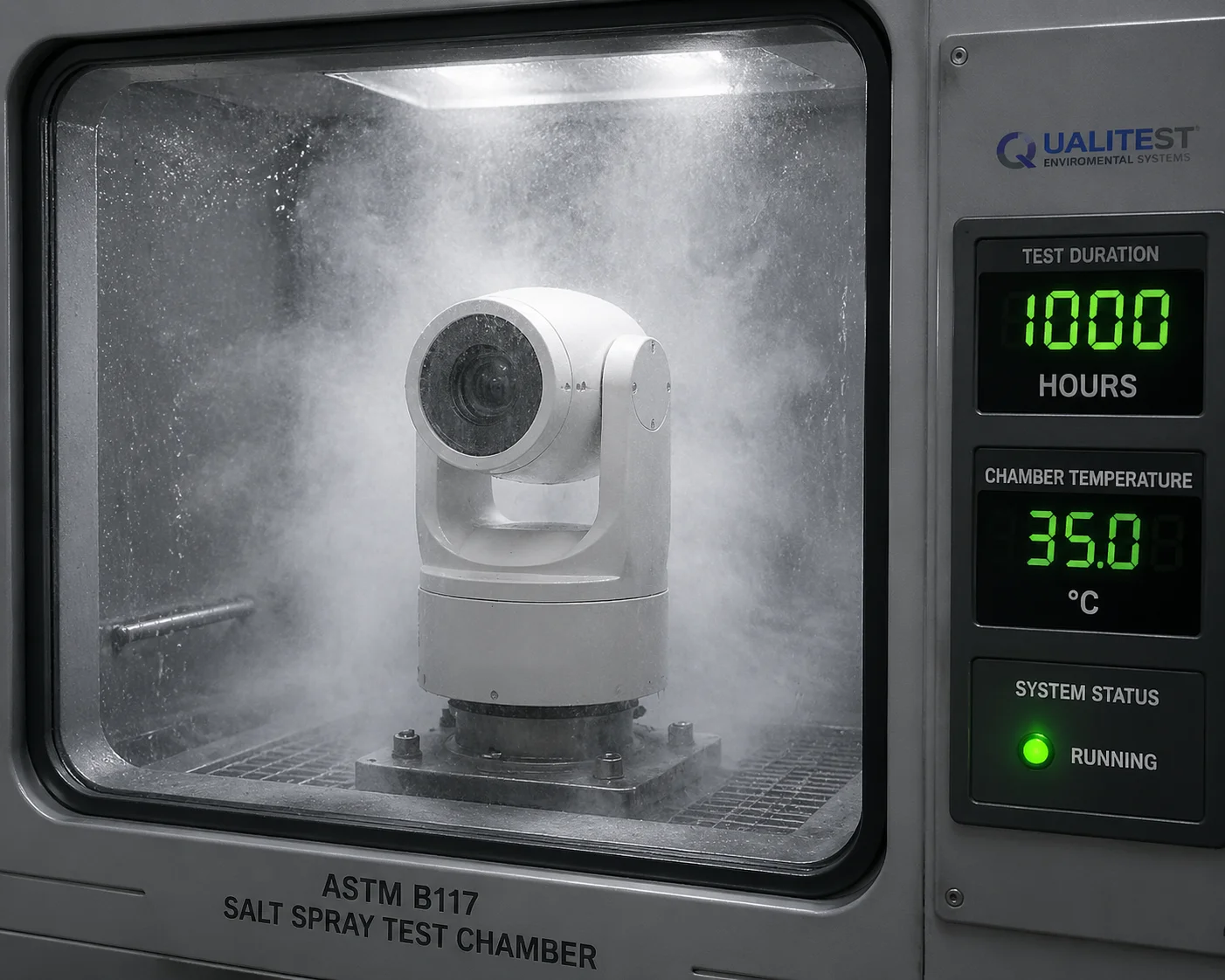
A 48-hour or 96-hour salt spray test is far too short for coastal use. Industrial-grade PTZ housings should pass at least 1,000 hours of neutral salt spray testing (ASTM B117 1). At Loyalty-Secu, our housings are tested to 1,000–2,000 hours, which translates to roughly 10–15+ years of real-world coastal corrosion resistance.
Why 48 Hours Means Almost Nothing
Let me put this in simple terms. The neutral salt spray test (NSS) under ASTM B117 uses a 5% sodium chloride solution sprayed continuously inside a sealed chamber at 35°C. It speeds up corrosion so you can see years of damage in days. The industry rule of thumb is that 24 hours of NSS testing equals roughly 1 year of natural coastal exposure. So a 48-hour test? That only proves the housing can survive about 2 years. A 96-hour test? About 4 years. For a project in Florida, Southern California, or the Gulf Coast — areas classified as C5-M (very high corrosion) under ISO 12944 2 — that is not enough.
What the Test Hours Actually Mean
| Salt Spray Test Duration | Approximate Real-World Coastal Lifespan | Suitable For |
|---|---|---|
| 48 hours | ~2 years | Indoor or dry climate only |
| 96 hours | ~4 years | Mild humidity, no direct salt exposure |
| 500 hours | ~5–8 years | Light coastal, moderate humidity |
| 1,000 hours | ~10–15 years | Heavy coastal, C4–C5 environments |
| 2,000+ hours | ~15–25 years | Marine, offshore, C5-M environments |
The Hidden Problem With Short Tests
Here is what most suppliers won’t tell you. A 96-hour salt spray test on a bare ADC12 casting will almost always fail. The casting itself — without any coating — can only handle about 50 to 100 hours before pitting starts. So when a supplier says “passes 96-hour salt spray,” ask them: was that tested on the bare casting, or on the finished product with coatings? The answer changes everything.
At Loyalty-Secu, we test the fully finished product — after electrophoretic primer, powder coating, and nano-sealant are all applied. That is the only honest way to measure what your camera will actually face on a pole 200 meters from the ocean.
Ask Your Supplier These 3 Questions
- What is the exact NSS test duration for the finished housing (not the raw material)?
- Can you provide a third-party lab report with photos at 500-hour and 1,000-hour intervals?
- Which standard was used — ASTM B117, ISO 9227, or something else?
If they can’t answer all three, you are taking a gamble with your client’s project.
What Type of Anti-Corrosion Coating Is Applied to the Aluminum Surface?
I’ve seen two identical-looking PTZ cameras installed on the same pier. One lasted 12 years. The other started flaking after 3. The only difference was the coating system underneath the paint.
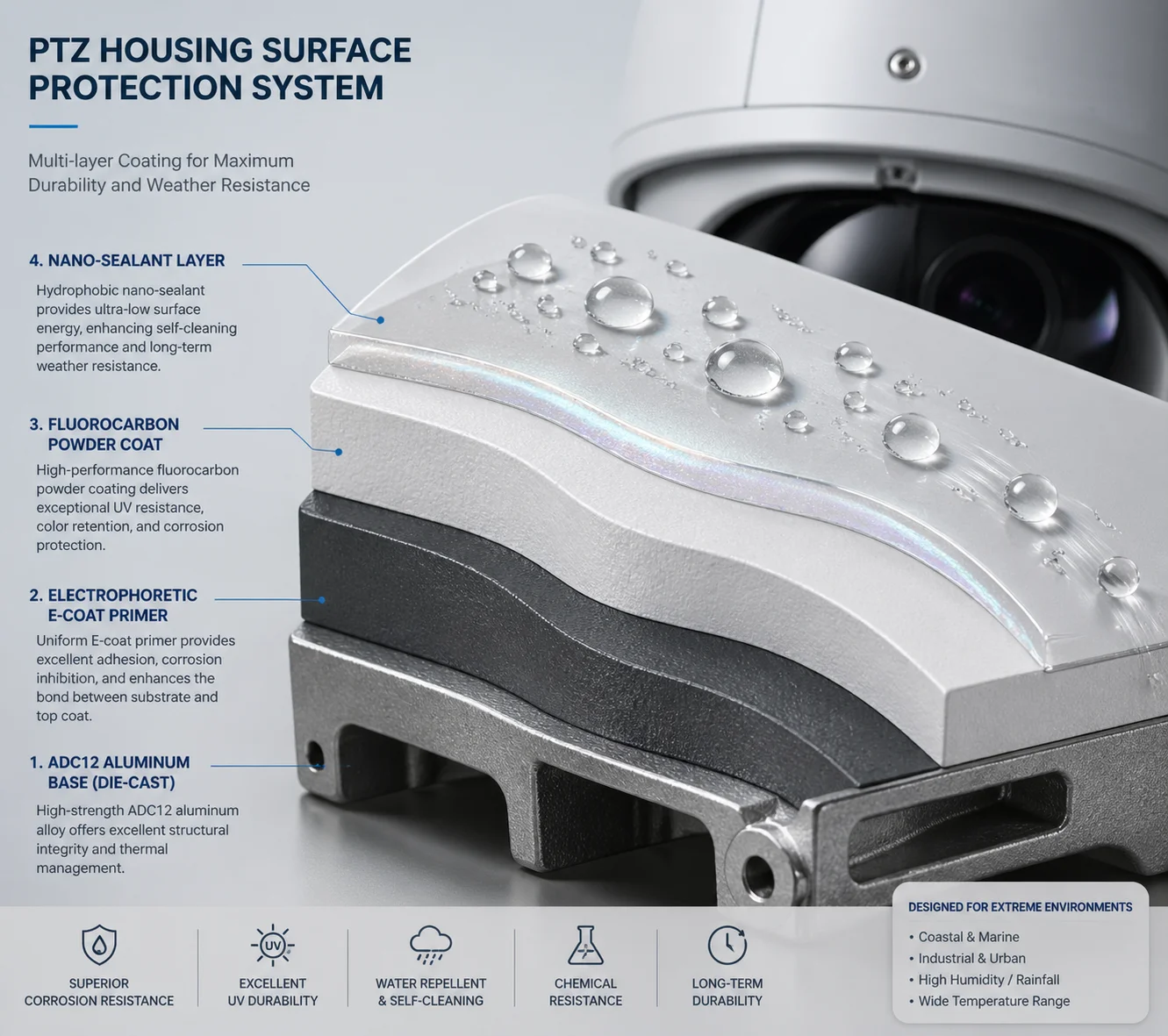
The most effective anti-corrosion system for coastal PTZ housings is a three-layer approach: electrophoretic (e-coat) primer, fluorocarbon or ultra-durable polyester powder coat, and a nano-sealant top layer. This combination blocks chloride ion penetration and resists UV degradation for 10 to 25 years in C5-M marine environments.
Why ADC12 Aluminum Needs an “Outer Jacket”
ADC12 is the most common die-casting alloy in the security camera industry. It is strong, easy to cast, and cost-effective. But it has a weakness. ADC12 contains relatively high levels of silicon and copper. The copper, in particular, makes it vulnerable to pitting corrosion in chloride-rich environments. Without any coating, bare ADC12 exposed to coastal air will develop white aluminum oxide powder within 1 to 2 years. The surface will look rough, chalky, and ugly. Worse, the pitting can eventually create tiny holes that let moisture reach the electronics inside.
That is why the coating is not cosmetic. It is structural protection.
The Three-Layer Defense System
At Loyalty-Secu, we use what I call the “three-layer armor” strategy. Each layer has a specific job:
| Layer | Material | Thickness | Primary Function |
|---|---|---|---|
| Layer 1 — Primer | Electrophoretic (E-coat) | 15–25 µm | Bonds to aluminum at molecular level, blocks moisture migration |
| Layer 2 — Main Coat | Fluorocarbon (PVDF) or Ultra-Durable Polyester Powder | 60–90 µm | Resists UV, salt, rain, and physical abrasion |
| Layer 3 — Sealant | Nano-ceramic or nano-silane sealant | 1–3 µm | Fills micro-pores, repels water, prevents chloride ion penetration |
Fluorocarbon vs. Standard Polyester — A Critical Difference
This is where many projects go wrong. Standard polyester powder coating is cheap and looks fine on day one. But under strong UV — like you get in California, Texas, or the Middle East — standard polyester starts chalking within 4 to 5 years. Chalking means the surface turns into a fine powder. Once that happens, the coating no longer seals the aluminum underneath. Salt and moisture get in, and corrosion begins from the inside out.
Fluorocarbon (PVDF) coatings 3 cost more, but they resist UV degradation for 15 to 20 years. They also have a much lower surface energy, which means salt water beads up and rolls off instead of sitting on the surface. For any project within 1 kilometer of the ocean, I always recommend fluorocarbon.
Ultra-durable polyester is a middle ground. It costs less than PVDF but lasts about 10 to 15 years under heavy UV. For inland coastal areas — say, 5 to 10 kilometers from the shore — it is a solid choice.
The Nano-Sealant Layer Most Suppliers Skip
The third layer is the one most factories skip to save cost. A nano-sealant fills the microscopic pores that exist in every powder coating. These pores are invisible to the eye, but chloride ions are small enough to pass through them. Over years, they accumulate at the aluminum surface and start corrosion underneath the coating — you won’t see it until the paint bubbles and peels off.
A proper nano-sealant 4 closes those pores. It adds maybe $0.50 to $1.00 per unit in production cost. But it can add 5 or more years to the housing’s life. That is the kind of detail that separates a factory that understands coastal deployment from one that just sells boxes.
Will the Mounting Screws and Joints Rust After a Year of Exposure to Sea Air?
This is the question that keeps integrators up at night. I’ve personally visited job sites where the camera worked perfectly — but the pan-tilt mechanism was completely frozen because every screw had rusted solid.
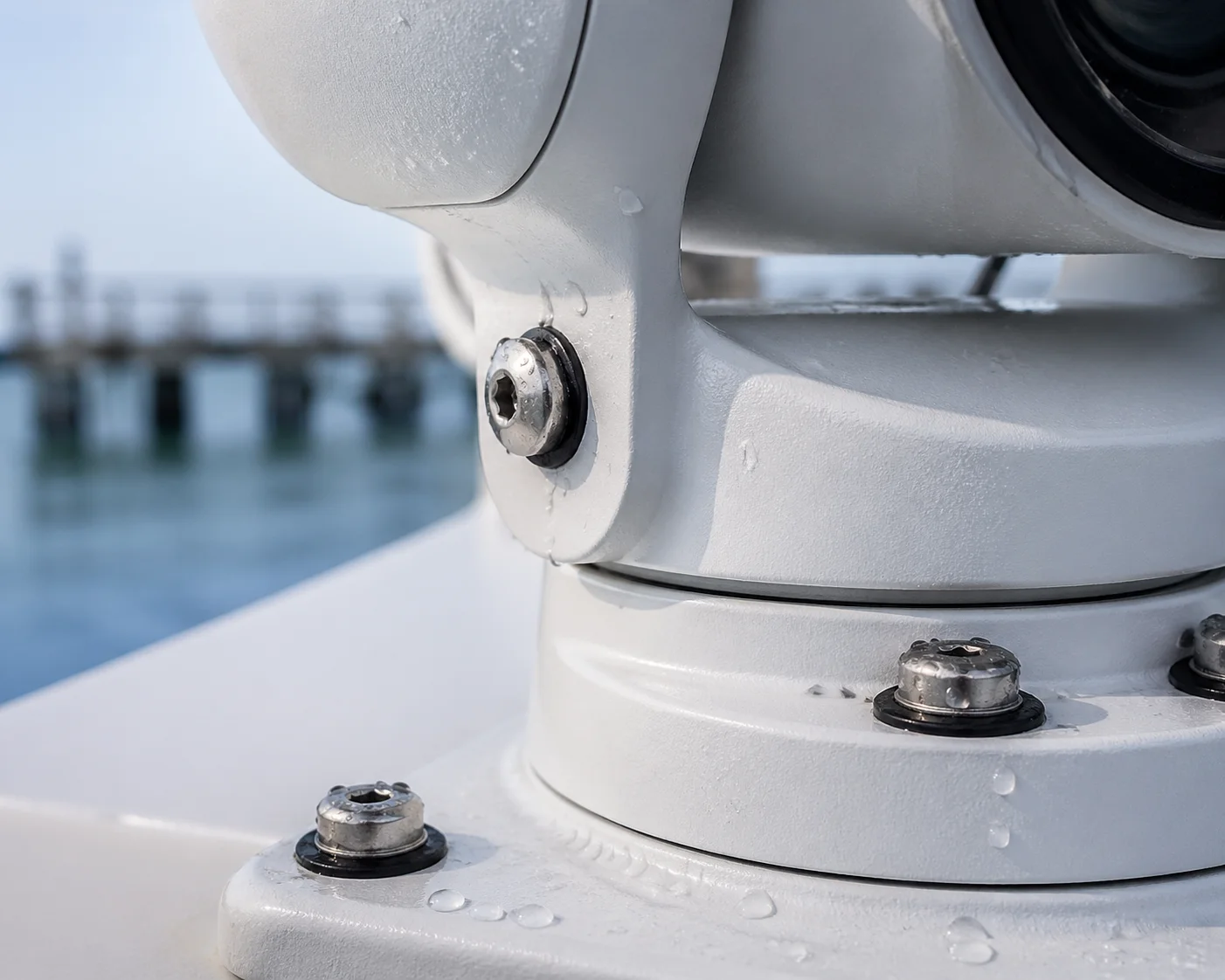
Yes, standard carbon steel or 304 stainless steel screws will rust within 6 to 18 months in direct coastal exposure. For marine environments, all external fasteners must be 316 stainless steel 5 or better. At Loyalty-Secu, every exposed screw, bolt, and bracket on our PTZ cameras uses 316-grade stainless steel to ensure they remain serviceable for 10+ years.
The Real Cost of a Rusted Screw
David, let me frame this in terms you care about: money. A single PTZ camera might cost $500 to $2,000. But if the mounting screws rust and seize after 18 months, here is what happens:
- You can’t adjust the camera angle. The client calls you.
- You send a technician with a truck, a ladder, and tools. That is $300 to $800 per visit in the U.S.
- The technician can’t remove the screws. They drill them out, damaging the housing.
- Now you need a replacement housing or a whole new camera.
- Total cost: $1,000 to $3,000 — for a problem that a $2 stainless steel screw would have prevented.
This is why I say: in coastal projects, the biggest cost is not the camera. It is the corrosion-induced mechanical lockup.
304 vs. 316 Stainless Steel — Know the Difference
| Property | 304 Stainless Steel | 316 Stainless Steel |
|---|---|---|
| Chromium Content | 18–20% | 16–18% |
| Nickel Content | 8–10.5% | 10–14% |
| Molybdenum Content | None | 2–3% |
| Chloride Resistance | Moderate — pits in salt air | High — resists chloride attack |
| Coastal Lifespan | 1–3 years before surface rust | 10–20 years with minimal corrosion |
| Cost Premium | Baseline | ~20–30% more than 304 |
The key difference is molybdenum. This element gives 316 stainless steel its ability to resist chloride ion attack. Without it, 304 stainless will develop brown rust spots within a year at the coast. I’ve seen it happen on projects in Miami, Jeddah, and Da Nang.
Don’t Forget the Joints and Pivot Points
Screws are obvious. But the joints — where the pan motor meets the housing, where the tilt bracket connects to the dome — are even more critical. These are moving parts. If corrosion builds up inside a joint, it creates friction. The motor has to work harder. It draws more current. It overheats. Eventually, the motor burns out or the gear teeth strip.
Good coastal PTZ design includes:
- 316 stainless steel bearings or ceramic bearings in the pan/tilt mechanism
- Marine-grade grease (lithium complex or synthetic) in all pivot points
- Rubber gaskets with UV-resistant EPDM to keep salt water out of joint cavities
- Drainage channels so that any water that does enter can escape instead of pooling
At Loyalty-Secu, we design our housings with sloped surfaces and drain holes at every potential water trap. A flat surface collects salt water. A sloped surface sheds it. That simple design choice can slow local corrosion by 5x.
A Word About Galvanic Corrosion
When you bolt a steel screw into an aluminum housing in the presence of salt water, you create a battery. The aluminum becomes the anode and starts dissolving. This is called galvanic corrosion 6, and it is the number one killer of mixed-metal assemblies at the coast.
The fix is simple: use 316 stainless steel fasteners with a nylon or EPDM washer between the screw head and the aluminum surface. This breaks the electrical contact and stops the galvanic reaction. It costs pennies. But if your supplier doesn’t do it, your housing will corrode around every screw hole within 2 to 3 years.
How Does the Salt-Fog Resistance of Your Housing Compare to Plastic Alternatives?
I get this question a lot. Some integrators think plastic housings are the easy answer for coastal projects — no metal, no corrosion, right? The reality is more complicated than that.
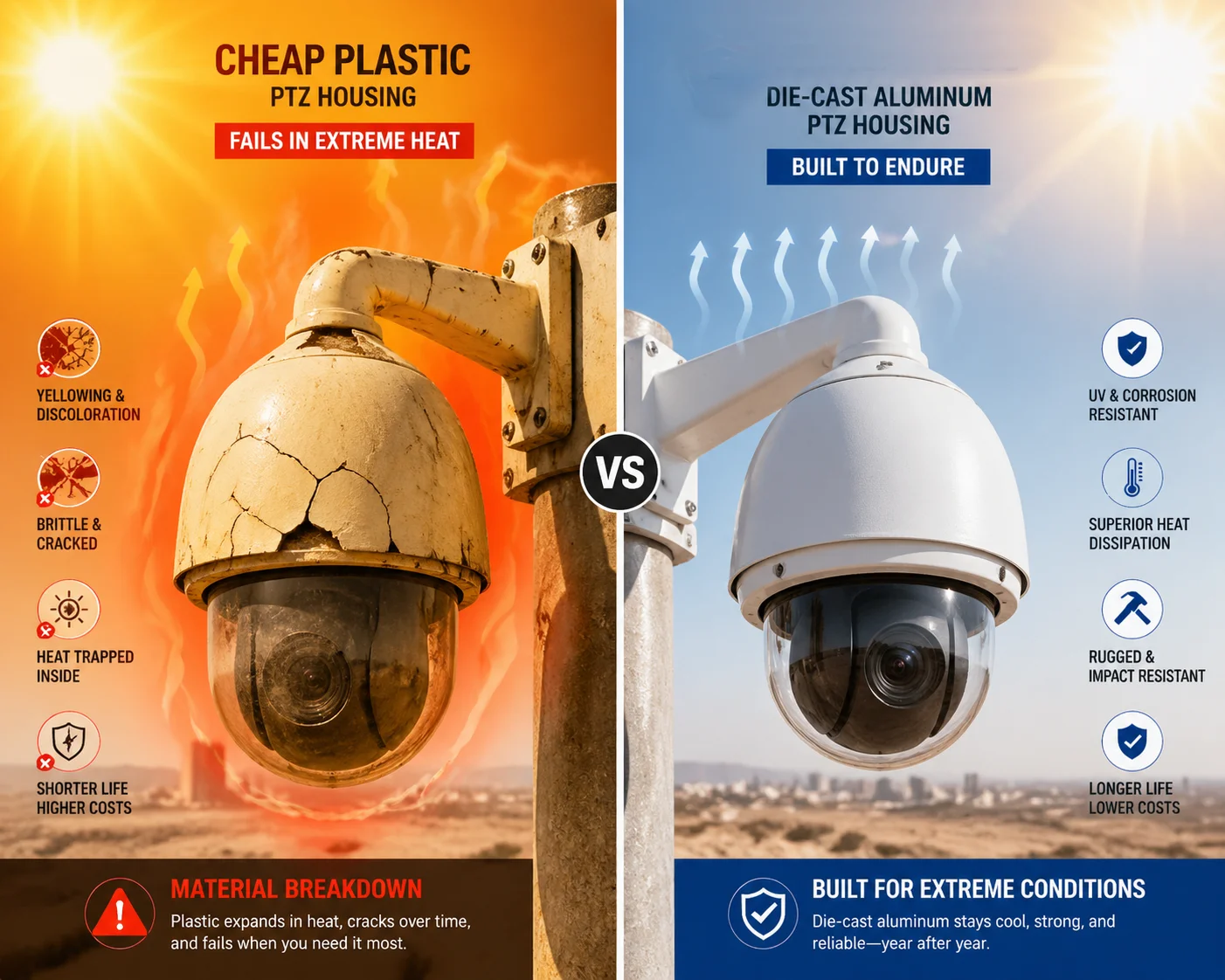
Die-cast aluminum housings with marine-grade coatings outperform plastic alternatives in structural strength, heat dissipation, and long-term UV resistance. While plastic does not corrode, it degrades under UV exposure, becomes brittle in 3 to 7 years, and cannot dissipate the heat generated by high-power PTZ motors and laser illuminators. For professional-grade coastal PTZ cameras, coated aluminum remains the superior choice.
Where Plastic Wins — and Where It Fails
Plastic housings — typically made from ASA, polycarbonate, or glass-filled nylon — do have one clear advantage: they don’t corrode. Salt spray, sea air, rain — none of it causes the kind of oxidation or pitting you see on metal. For small, low-power cameras in residential coastal settings, plastic can work fine for 5 to 8 years.
But professional PTZ cameras are a different animal. Here is why:
Heat Is the Hidden Enemy
A 38X optical zoom PTZ camera with a laser illuminator generates significant heat. The zoom motor, the pan/tilt motors, the IR laser, and the main processor all produce heat that must escape the housing. Aluminum is an excellent thermal conductor — it pulls heat away from the electronics and radiates it into the air. Plastic is a thermal insulator. It traps heat inside.
When internal temperatures rise above 60°C to 70°C, several things happen:
- The image sensor produces more noise, reducing video quality
- The processor may throttle its speed to avoid damage
- Electrolytic capacitors on the main board age faster — every 10°C increase above rated temperature cuts capacitor life in half
- The laser diode’s output power drops, reducing night vision range
I’ve tested both side by side in our Shenzhen lab. Under full load in a 40°C ambient environment, the internal temperature of our aluminum PTZ housing stabilized at 52°C. A comparable plastic housing hit 68°C and triggered thermal throttling within 90 minutes.
UV Degradation — The Silent Killer of Plastic
Plastic doesn’t corrode, but it does degrade. UV radiation breaks the polymer chains in most plastics. Over 3 to 7 years of outdoor exposure, plastic housings become:
- Brittle — they crack under wind load or during maintenance
- Discolored — they turn yellow or chalky white
- Dimensionally unstable — they warp slightly, breaking the IP67 seal and letting moisture in
ASA plastic 7 has better UV resistance than standard ABS, but even ASA shows measurable degradation after 5 to 7 years in high-UV environments like the American Southwest or the Middle East.
Fluorocarbon-coated aluminum, by contrast, maintains its color and structural integrity for 15 to 20 years under the same UV exposure.
Structural Strength Under Wind and Impact
Coastal installations face high winds — sometimes hurricane-force. A PTZ camera on a 10-meter pole acts like a sail. The housing must resist not just the wind load on the camera itself, but also the vibration transmitted through the pole.
Die-cast aluminum has a tensile strength of 300 to 330 MPa (for ADC12). Glass-filled nylon tops out around 80 to 120 MPa. Polycarbonate is about 55 to 75 MPa. In a Category 2 hurricane with sustained winds of 154 to 177 km/h, a plastic housing is far more likely to crack at the mounting bracket than an aluminum one.
The Bottom Line for Coastal Projects
For residential Ring-style cameras? Plastic is fine. For professional PTZ systems that need to run 24/7 for a decade on a coastal highway, port, or oil platform? Die-cast aluminum with proper marine-grade treatment is the only responsible choice. The upfront cost is higher. The 10-year total cost of ownership is dramatically lower.
Conclusion
In salty coastal environments, a properly treated die-cast aluminum PTZ housing lasts 10 to 25 years. The secret is not the aluminum — it is the coating system, the fastener grade, and the drainage design working together.
1. ASTM B117 standard for salt spray (fog) corrosion testing. ↩︎ 2. ISO 12944 corrosion protection classification for coastal zones. ↩︎ 3. PVDF fluorocarbon coating properties for marine environments. ↩︎ 4. How nanocoatings provide super-hydrophobic surface protection. ↩︎ 5. 316 stainless steel grade specification and chloride resistance. ↩︎ 6. Galvanic corrosion between dissimilar metals in salt water. ↩︎ 7. ASA plastic UV resistance vs. aluminum fluorocarbon coating. ↩︎ 8. EPDM rubber gasket material for outdoor weather sealing. ↩︎ 9. ADC12 aluminum alloy composition and corrosion properties. ↩︎ 10. Electrophoretic coating (e-coat) for aluminum corrosion protection. ↩︎