
I’ve watched too many project managers lose sleep over blurry footage after a rainstorm. Water spots, streaks, and fogged-up lenses kill image quality and cost real money in truck rolls.
A quality nano-level hydrophobic coating keeps rain from forming a blurry water film on the lens cover. In light to moderate rain, water beads up and rolls off fast, so the camera sees through mostly dry glass. Image clarity stays close to a sunny day. But in heavy storms, the coating reduces the problem — it does not eliminate it entirely.
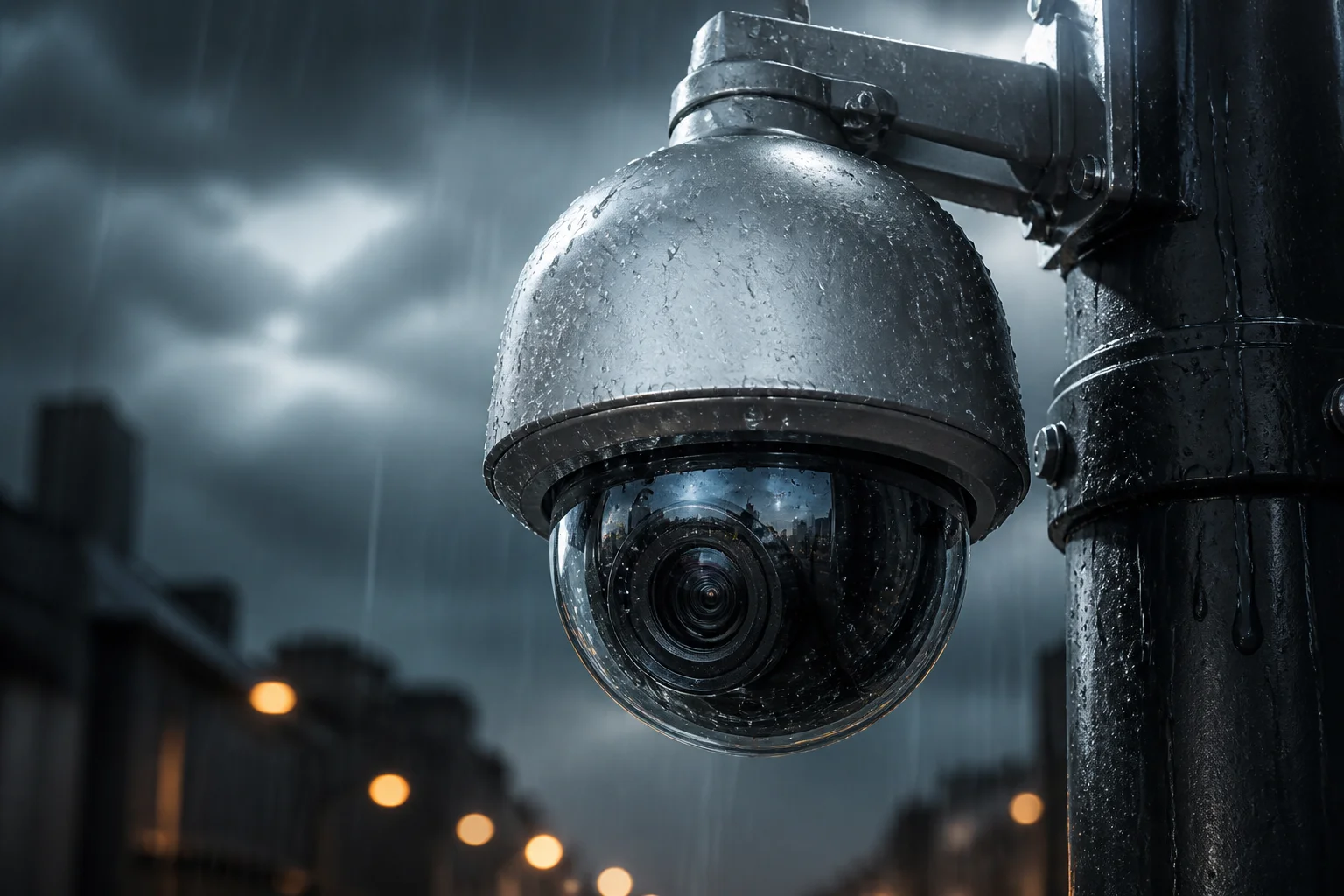
I want to walk you through exactly how this coating works, where it shines, and where it falls short. Below, I break down the four questions I hear most from integrators and project managers who source PTZ cameras from China. Each section gives you the technical detail you need to make a smart purchasing decision.
Table of Contents
Will Water Droplets “Bead Up” and Roll Off the Lens Glass Instantly During a Heavy Storm?
I used to think hydrophobic meant “waterproof.” It doesn’t. It means the glass surface repels water — but physics still has limits when the sky opens up.
In light to moderate rain, yes — water droplets bead up into near-spherical shapes and roll off within seconds. The coating raises the contact angle above 110°, so gravity pulls the beads down before they spread into a film. But during a heavy storm with strong wind, water arrives faster than it can drain, and a thin film may still form temporarily.
How Contact Angle Changes Everything
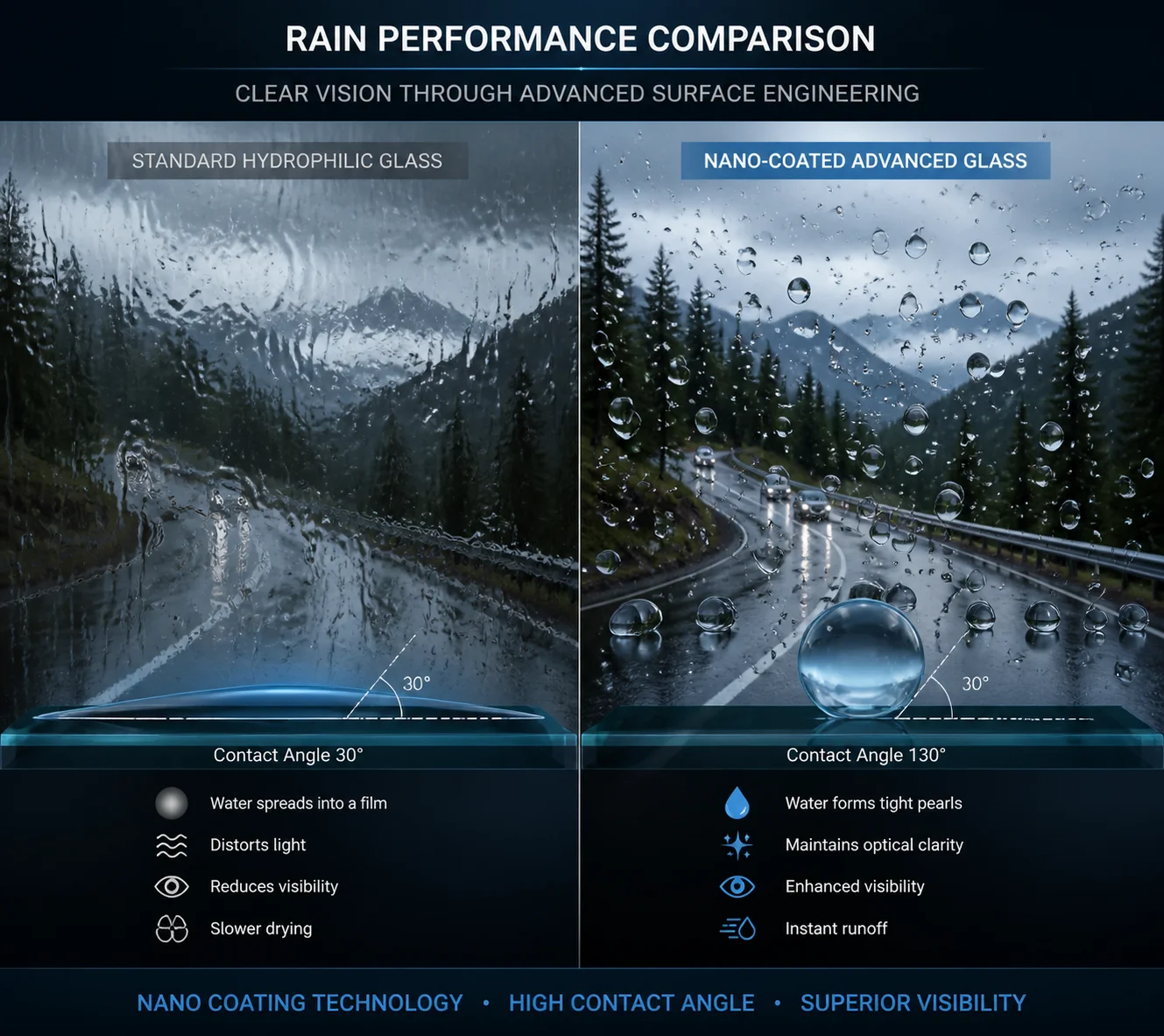
The key number here is the contact angle. On regular glass, water spreads flat because the surface is hydrophilic — it likes water. The contact angle is low, maybe 20° to 40°. This creates a thin, uneven water film that bends light in random directions. Your camera sensor sees a blurry mess instead of a sharp image.
A hydrophobic coating pushes that contact angle above 110°. Some advanced nano-coatings reach 130° or higher. At these angles, each raindrop sits on the glass like a tiny ball. Gravity does the rest. The ball rolls down and falls off the edge of the dome cover.
Here is a simple comparison:
| Surface Type | Contact Angle | Water Behavior | Effect on Image |
|---|---|---|---|
| Bare glass (no coating) | 20°–40° | Water spreads into a flat film | Heavy blur, light refraction, loss of detail |
| Standard hydrophobic coating | 100°–120° | Water forms beads that slide off | Most of the glass stays dry, image stays clear |
| Advanced nano hydrophobic coating | 120°–140° | Water forms near-spherical beads, rolls off fast | Minimal interference, close to dry-day clarity |
What Happens in a Real Heavy Storm?
During a downpour — say, 50 mm per hour or more — the volume of water hitting the dome is simply too high. Even with a great coating, water arrives faster than it can roll off. You will see a thin water layer form on parts of the glass. The image contrast drops. Details like license plates and faces become harder to read.
But here is the important part: the coating still helps. Without it, the dome turns into frosted glass almost immediately. With it, the water layer is thinner and less stable. It breaks up faster when the rain slows down even slightly. So you get usable footage for a larger portion of the storm, not just after it stops.
Wind Makes Things Worse
Strong wind pushes water sideways across the dome. This creates streaks instead of beads. The coating fights this, but wind at 60 km/h or more can overwhelm any passive surface treatment. For extreme weather sites — coastal areas, open plains, high-altitude towers — I always recommend combining the hydrophobic coating with a mechanical wiper or air curtain system 1. The coating handles the light rain. The wiper handles the storms.
What the Research Says
Published studies on automotive and drone camera lenses confirm that hydrophobic coatings reduce the drop in MTF50 image sharpness 2 during simulated rain. The coated samples kept higher signal-to-noise ratios compared to bare glass. This is not just marketing talk — it is backed by lab data.
How Does the Hydrophobic Layer Reduce the Buildup of Dust and Dirt on the Camera’s Face?
Dust buildup is the silent killer of outdoor camera image quality. I’ve seen domes that looked fine from the ground but were covered in a gray film that cut light transmission by 20% or more.
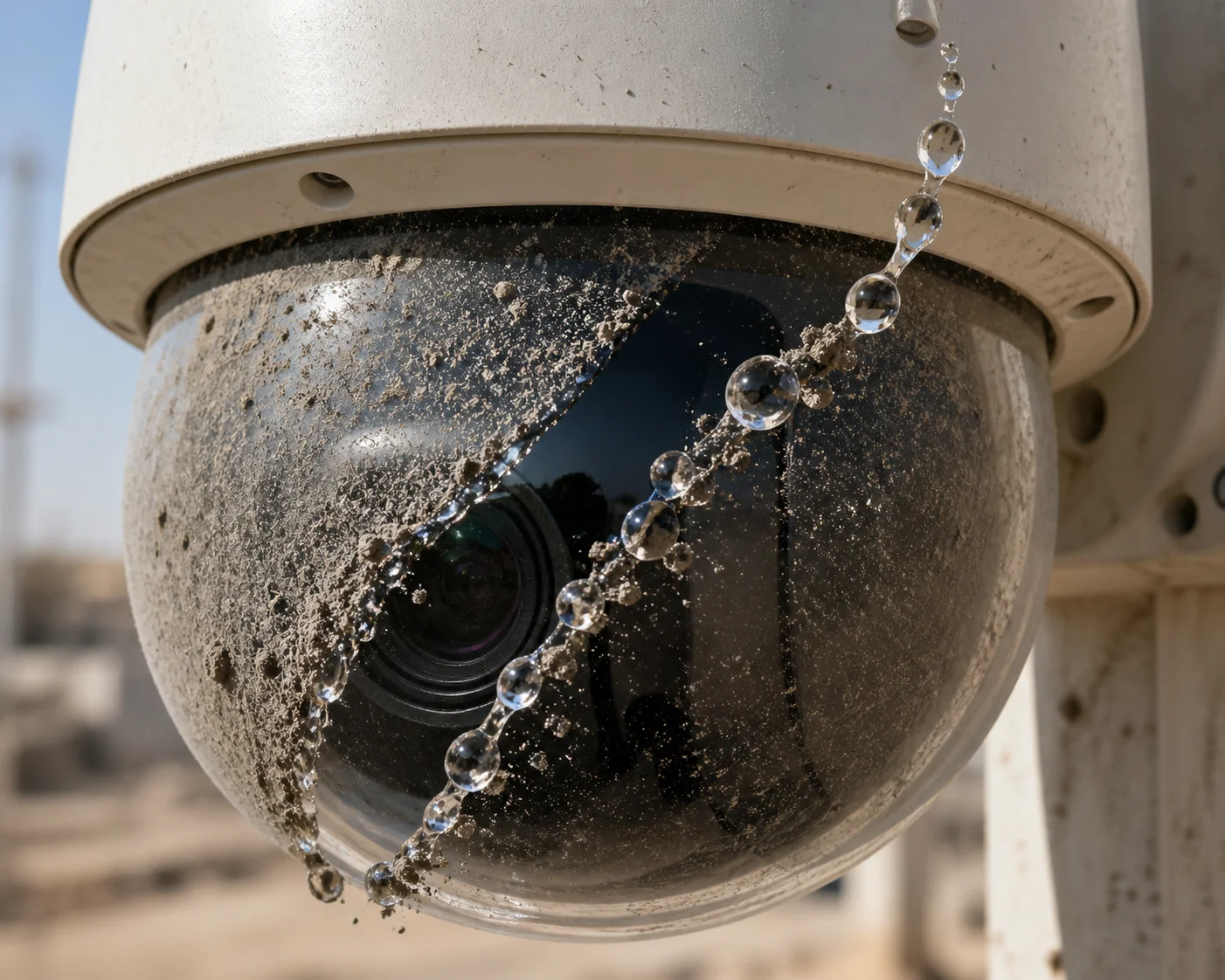
The hydrophobic coating lowers the surface energy of the glass, so dust and dirt particles cannot grip tightly. When rain falls, the rolling water beads pick up loose particles and carry them off the dome. This “self-cleaning” effect keeps the glass cleaner between maintenance visits and reduces the need for manual wipe-downs.
The Self-Cleaning Mechanism Explained
Think of it like a non-stick pan. Food does not stick because the surface energy is low. The same idea applies here. Dust, pollen, bird droppings, and light mud sit loosely on the coated glass. They do not bond to it the way they bond to bare glass.
When it rains — even a light drizzle — the water beads roll across the surface and sweep these particles away. This is called the lotus effect, named after the lotus leaf, which stays clean in muddy ponds because of its micro-textured, water-repelling surface 3.
What It Cleans and What It Cannot
Not all contamination is equal. Here is a breakdown:
| Contamination Type | Self-Cleaning Effectiveness | Notes |
|---|---|---|
| Dry dust and pollen | High | Particles sit loosely, rain washes them off easily |
| Light mud splashes | Medium to High | Most washes off; dried-on mud may need a rinse |
| Bird droppings (fresh) | Medium | Rain helps, but acidic droppings can etch coating over time |
| Oily residue / industrial soot | Low | Oil-based films need manual cleaning with proper solvent |
| Salt spray (coastal areas) | Medium | Salt crystals wash off, but repeated exposure accelerates coating wear |
Why This Matters for Your Maintenance Budget
For integrators like David who deploy cameras in remote locations — oil fields, highway corridors, solar farms — every site visit costs money. A truck roll in rural Texas might cost $300 to $500 4 just in labor and fuel. If the hydrophobic coating cuts your cleaning visits from once a month to once a quarter, the savings add up fast.
I have seen project managers in the Middle East and Southeast Asia report that cameras with proper self-cleaning coatings stayed usable for 4 to 6 months without any manual cleaning. Cameras without the coating needed attention every 3 to 4 weeks. That is a real operational difference.
The “Water Spot” Problem After Rain
Here is something most spec sheets do not mention. Regular glass does not just get dirty from dust. It gets dirty from rain itself. Rainwater carries dissolved minerals. When a water droplet sits on bare glass and evaporates slowly, it leaves behind a white mineral ring — a water spot. Over weeks, these spots build up into a hazy layer that no amount of rain will wash away.
The hydrophobic coating prevents this because the water does not sit still long enough to evaporate. It rolls off before the minerals can deposit and form hard water stains 5. This is one of the biggest practical benefits of the coating, and it is often overlooked.
A Note on Coastal and Industrial Environments
If your project is near the ocean, salt spray is a constant threat. Salt is corrosive and hygroscopic — it attracts moisture. On bare glass, salt crystals form a sticky film that traps more dust and creates a feedback loop of contamination. The hydrophobic coating breaks this loop by preventing the salt from bonding firmly. Rain washes it away before it can build up. For harsh marine sites, always combine the coating with a stainless steel housing rated for salt spray exposure 6.
In industrial zones with oily exhaust or chemical fumes, the coating is less effective. Oil-based contaminants have low surface tension themselves, so they can spread on the coated surface almost as easily as on bare glass. For these environments, you need a mechanical cleaning system — a wiper with cleaning fluid — in addition to the coating.
Is the Coating Durable Enough to Survive Regular Manual Cleaning or High-Pressure Rain?
I have had customers ask me: “If I wipe the dome with a cloth, will I destroy the coating?” It is a fair question. The answer depends on how you clean it.
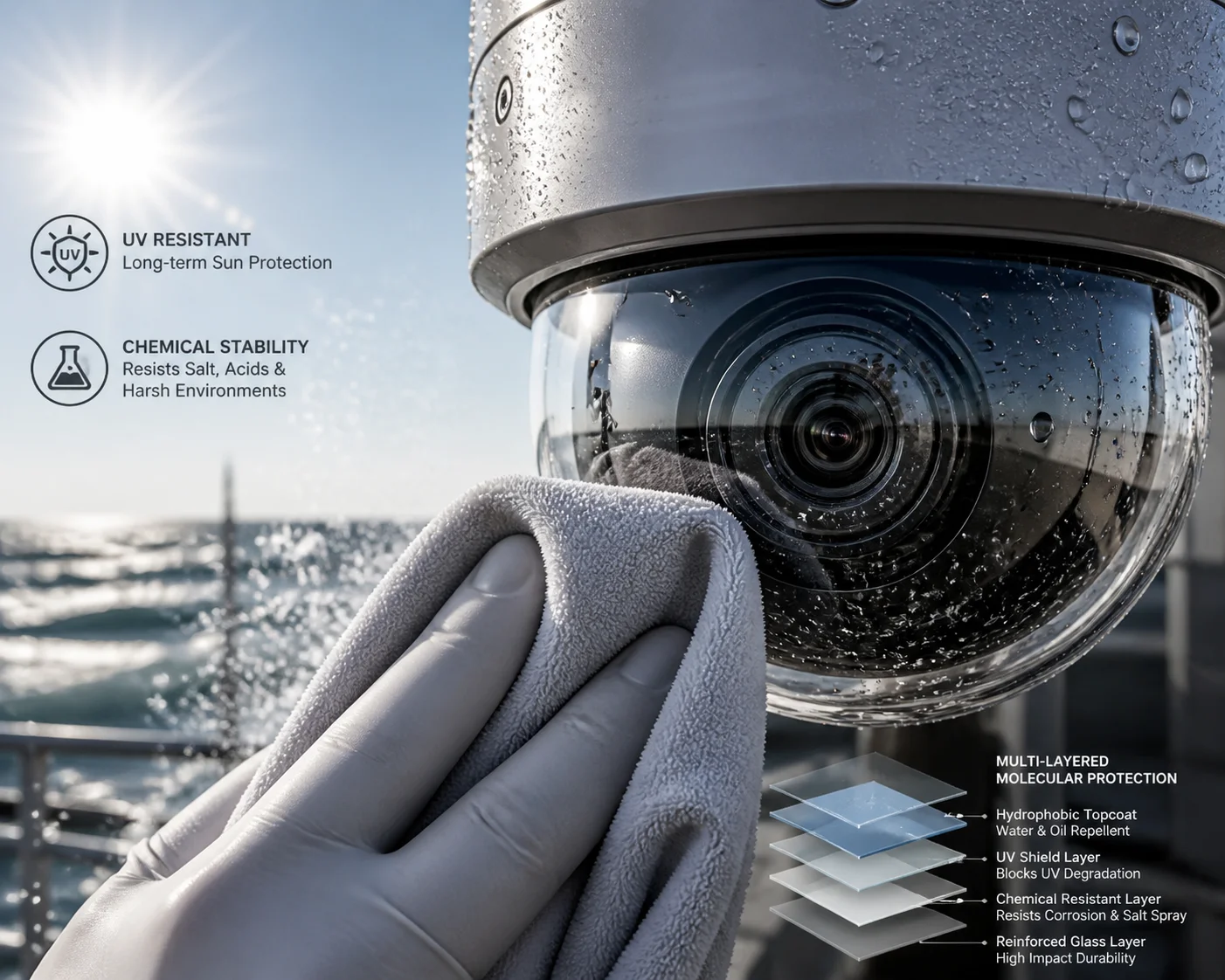
The hydrophobic coating is a nano-scale thin film — typically just a few hundred nanometers thick. It can handle rain impact and gentle cleaning with a soft microfiber cloth and purified water. But dry wiping with rough materials, abrasive cleaners, or high-pressure washers aimed directly at the dome will degrade the coating over time. Most industrial-grade coatings last 24 to 36 months under normal outdoor conditions before performance drops noticeably.
What Wears Down the Coating
The hydrophobic layer is not a thick shield. It is a molecular-level treatment applied to the glass surface. Several factors break it down:
- UV radiation: Prolonged sun exposure breaks the chemical bonds in the coating. In high-UV regions like Texas, Arizona, or the Middle East, this is the primary aging factor.
- Mechanical abrasion: Wiping the dome with a dry cloth, paper towel, or rough rag physically scrapes off the nano-layer. This is the fastest way to destroy the coating.
- Chemical attack: Harsh cleaning agents — ammonia-based glass cleaners, acetone, or industrial solvents — dissolve the coating.
- Sand and wind erosion: In desert environments, wind-blown sand acts like fine sandpaper on the dome surface.
How to Clean Without Damaging the Coating
The rule is simple: wet, soft, and gentle.
- Rinse the dome with clean water first to remove loose grit.
- Use a soft microfiber cloth dampened with purified or distilled water.
- Wipe gently in one direction — do not scrub in circles.
- Never wipe a dry dome. The trapped dust particles will scratch the coating.
- Avoid all chemical cleaners unless the manufacturer specifically approves them.
Some manufacturers, like i-PRO (formerly Panasonic Security) 7, explicitly state in their manuals: do not wipe the transparent dome cover. They design the coating to be maintained entirely by rain and occasional water rinses. If you must touch it, follow the steps above.
Expected Lifespan by Environment
| Deployment Environment | Expected Coating Lifespan | Main Degradation Factor |
|---|---|---|
| Temperate climate, moderate rain | 36–48 months | UV exposure |
| High-UV desert (Texas, Middle East) | 24–36 months | UV + sand abrasion |
| Coastal / salt spray | 18–30 months | Salt corrosion + UV |
| Industrial / oily atmosphere | 12–24 months | Chemical contamination |
| Tropical high-humidity | 24–36 months | UV + biological growth |
Can You Reapply the Coating?
Yes, but it is not always practical. Some manufacturers offer field-reapplication kits for hydrophobic coatings 8 — a liquid you spray or wipe onto the dome to restore the hydrophobic layer. This works, but the reapplied coating is usually not as uniform or durable as the factory-applied version.
For large deployments — say, 50 or 100 cameras across a highway project — reapplication becomes a maintenance task you need to budget for. I recommend asking your supplier two questions before you buy:
- What is the rated lifespan of the coating in my specific environment?
- Do you offer a reapplication kit or service, and what does it cost?
If the supplier cannot answer these questions clearly, that is a red flag. A serious R&D-driven manufacturer will have this data ready.
High-Pressure Rain Is Not a Problem
Natural rain — even heavy rain — does not damage the coating. Raindrops hit the dome at terminal velocity, which is about 9 m/s for large drops. The coating is designed to handle this. What it is not designed to handle is a pressure washer aimed at the dome from close range. The concentrated water jet can strip the coating in seconds. If your maintenance crew uses pressure washers on the camera housing, make sure they avoid the dome glass.
Can I See a Comparison of “Rain Streaking” on a Standard Lens Versus a Coated Lens?
This is the question I get asked most at trade shows. People want to see the difference with their own eyes, not just read about it on a spec sheet.
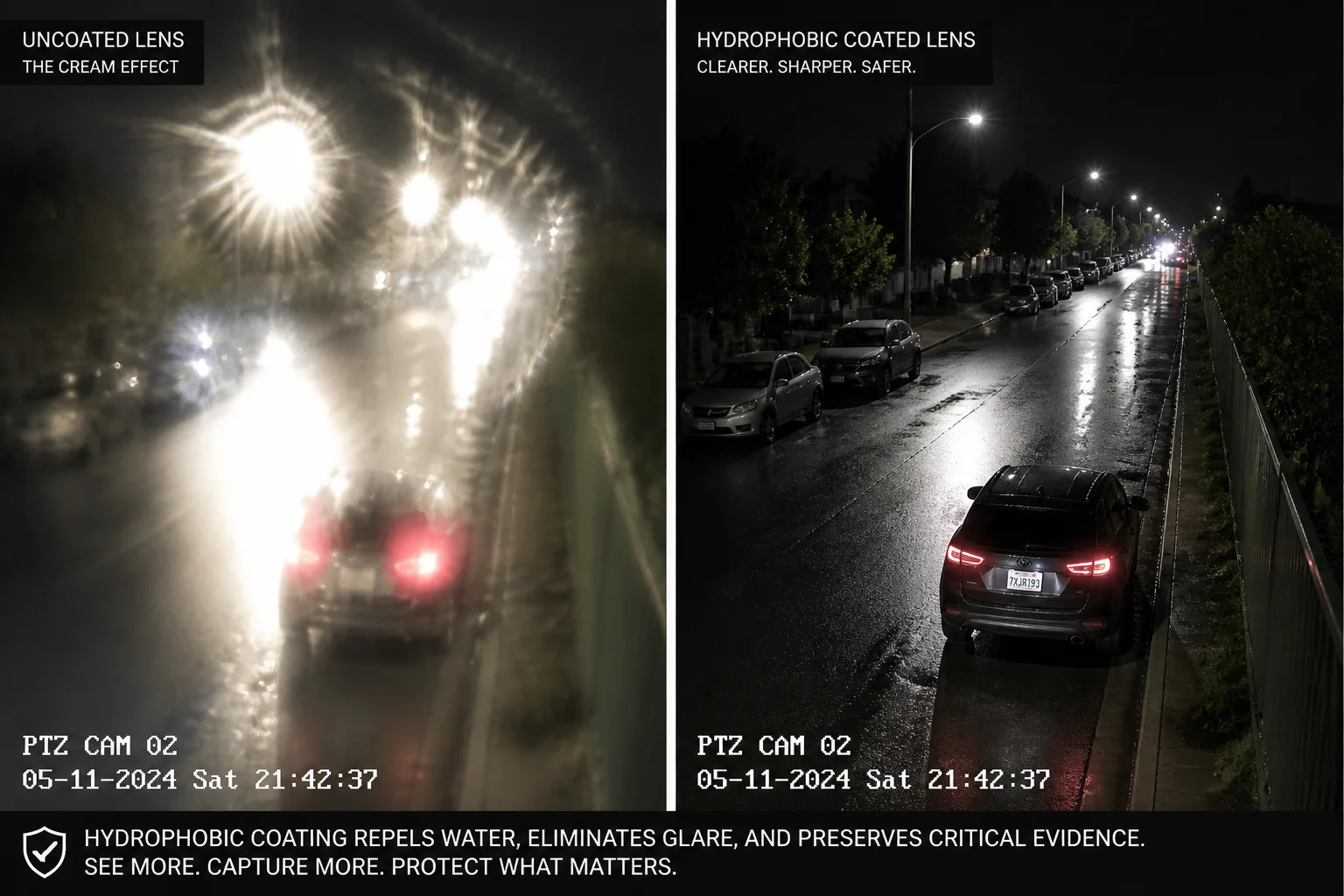
On a standard uncoated lens cover, rain creates irregular streaks and a persistent water film that scatters light, producing glare halos around every light source and washing out fine details like license plates. On a coated lens cover, rain forms discrete beads that roll off quickly, leaving most of the optical path clear. The difference is immediately visible — especially at night under streetlights or vehicle headlights.
Daytime Comparison: What You Actually See
During the day in moderate rain, an uncoated dome shows a pattern of water streaks running down the glass. Each streak acts like a tiny prism, bending light and creating localized blur zones across the image. Text on signs becomes unreadable. Faces lose definition beyond about 15 meters. The overall image looks like you are viewing through a wet shower door.
With a hydrophobic coating, the same rain produces small, round beads that sit briefly on the glass and then slide off. Between the beads, the glass is dry. The camera sensor sees through these dry patches clearly. You lose maybe 5% to 10% of the image area to passing beads at any given moment, but the rest of the frame is sharp. License plates remain readable at 30 meters or more. Faces hold enough detail for identification.
Nighttime Comparison: Where the Coating Really Shines
The difference is even more dramatic at night. Every water droplet on an uncoated dome acts as a tiny lens. When a car headlight or streetlight hits these droplets, each one creates its own bright halo. The result is a frame full of overlapping light blooms — what technicians call “the cream effect.” The entire image turns into a bright, milky blur. You cannot see anything useful.
On a coated dome, the beads are fewer and they roll off faster. The light passes through dry glass most of the time. You still see some glare from the beads that are present, but it is localized and brief. The background scene — road markings, vehicle shapes, pedestrian outlines — stays visible. For a real-world visual reference, this side-by-side rain test video 9 shows the difference clearly.
The Auto-Focus Factor
Here is a technical detail that most people miss. Modern PTZ cameras use phase-detection autofocus (PDAF) or contrast-detection autofocus (CDAF) 10 to lock onto targets. Both systems analyze the light pattern hitting the sensor to determine focus distance.
When water droplets cover the dome, the autofocus system gets confused. It sees the droplets as high-contrast objects close to the lens and tries to focus on them instead of the actual target 50 meters away. The result is constant “focus hunting” — the lens motors keep adjusting back and forth, and the image never settles.
The hydrophobic coating solves this by keeping the optical path mostly clear. The autofocus algorithm sees the real scene, not a layer of water interference. It locks on faster and stays locked. This is critical for PTZ cameras that need to track moving vehicles or people across a wide area.
Why You Should Ask for Demo Footage
If you are evaluating a Chinese PTZ supplier, ask them for side-by-side rain footage. A serious manufacturer will have this ready. Look for:
- A split-screen or A/B comparison showing the same scene in rain with and without the coating.
- Night footage under artificial lighting — this is where the difference is most obvious.
- Post-rain footage showing how quickly the coated dome returns to full clarity versus the uncoated dome with dried water spots.
If the supplier only has sunny-day demo videos, that tells you something about their confidence in the coating’s real-world performance.
Combining Coating with Other Rain Solutions
For the best possible rain performance, the top-tier PTZ cameras combine multiple approaches:
- Hydrophobic coating as the first line of defense for light and moderate rain.
- Mechanical wiper that activates automatically via a rain sensor for heavy rain.
- Heater element built into the dome housing to prevent fogging and condensation in cold, humid conditions.
- Angled dome design that uses gravity and aerodynamics to shed water faster.
When you source from China, look for models that offer at least two of these features together. The coating alone handles 70% to 80% of rainy conditions. Adding a wiper gets you to 95%. Adding a heater covers the fog and condensation edge cases.
Conclusion
A quality hydrophobic coating makes a clear, measurable difference in rain — but it works best as part of a complete system, not a standalone solution. Choose suppliers who back their coating claims with real data and demo footage.
1. Comparison of mechanical wipers vs. air curtains for camera dome cleaning. ↩︎ 2. Industry data on MTF50 sharpness retention on coated vs. uncoated lenses. ↩︎ 3. Scientific explanation of the lotus effect and self-cleaning surfaces. ↩︎ 4. Breakdown of labor and fuel costs for remote security site truck rolls. ↩︎ 5. How hydrophobic treatments prevent mineral deposits from hard water. ↩︎ 6. Guide to salt spray corrosion resistance ratings for outdoor enclosures. ↩︎ 7. Official maintenance guide for i-PRO security camera dome coatings. ↩︎ 8. How to field-reapply nano hydrophobic coatings on optical glass surfaces. ↩︎ 9. Real-world video comparison of rain streaking on coated vs. standard domes. ↩︎ 10. Technical comparison of PDAF and CDAF autofocus methods in imaging. ↩︎