
I’ve seen too many 4K cameras fail at night. The spec sheet says “4K ultra HD,” but the footage looks like a grainy mess after dark.
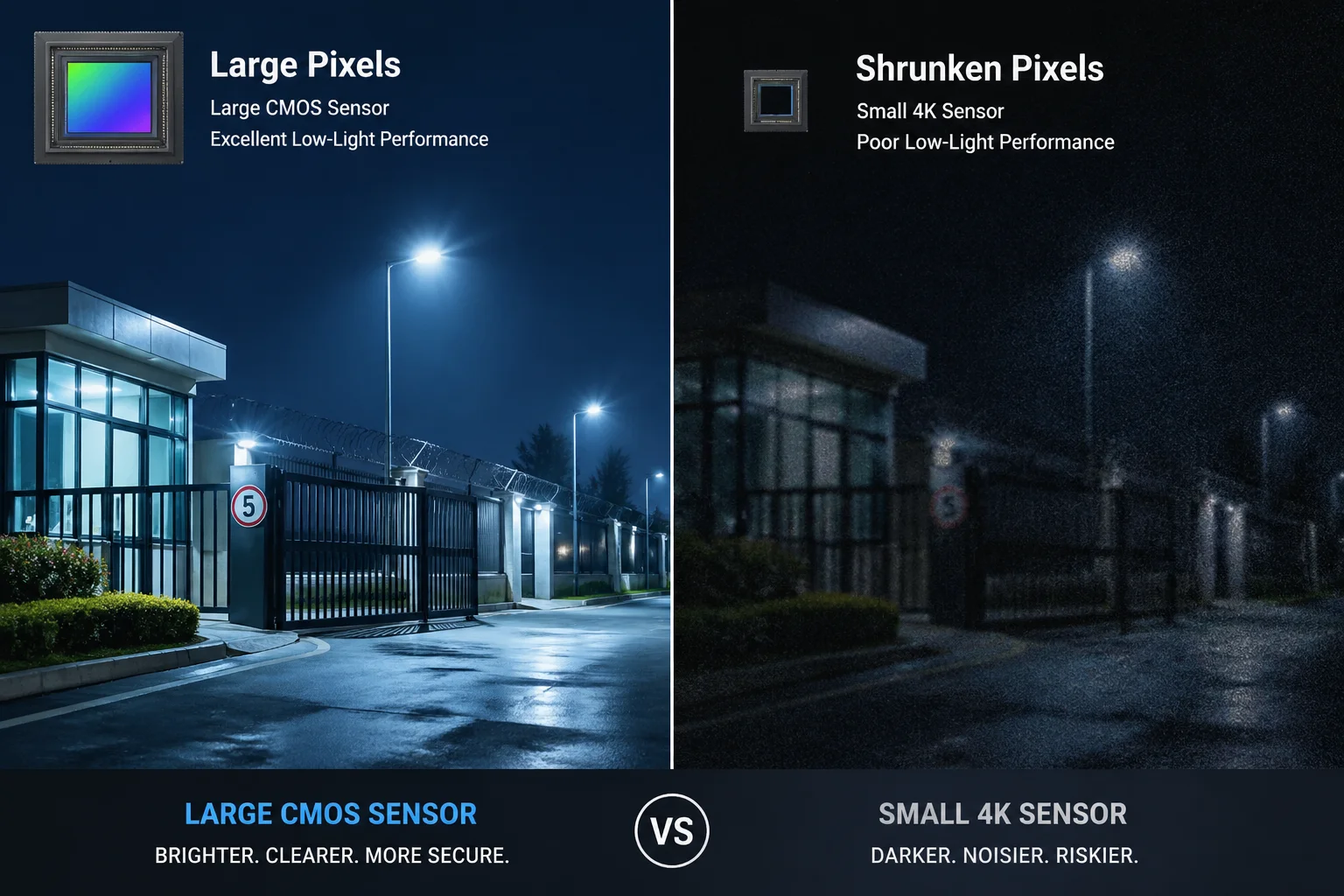
Pixel size is the single most important factor in your 4K camera’s low-light performance. Each pixel on the sensor acts like a tiny bucket that collects light. Bigger pixels collect more light, produce stronger signals, and deliver cleaner images at night. When a 4K sensor crams 8 million pixels onto a small chip, each pixel shrinks, and low-light quality drops fast.
 4K PTZ camera sensor pixel size low-light performance
In this article, I break down exactly how pixel size works, what micron numbers you should look for, and how to pick a 4K PTZ camera that actually performs when the sun goes down. If you’re sourcing cameras from China for professional security projects, this will save you from expensive mistakes.
Table of Contents
Is a Higher Megapixel Count Making My Night Vision Images Noisier in Dark Areas?
I used to think more megapixels always meant better images. Then I deployed a batch of 8MP cameras on a ranch with zero street lights. The daytime footage was razor sharp. The nighttime footage was almost useless.
Yes, a higher megapixel count can absolutely make your night images noisier. When you pack more pixels onto the same sensor, each pixel gets smaller. Smaller pixels capture fewer photons in the dark. The camera then boosts the weak signal electronically, and that boost adds visible grain and noise to your footage.
 higher megapixel count night vision noise dark areas
The Bucket Analogy: Why Smaller Pixels Struggle
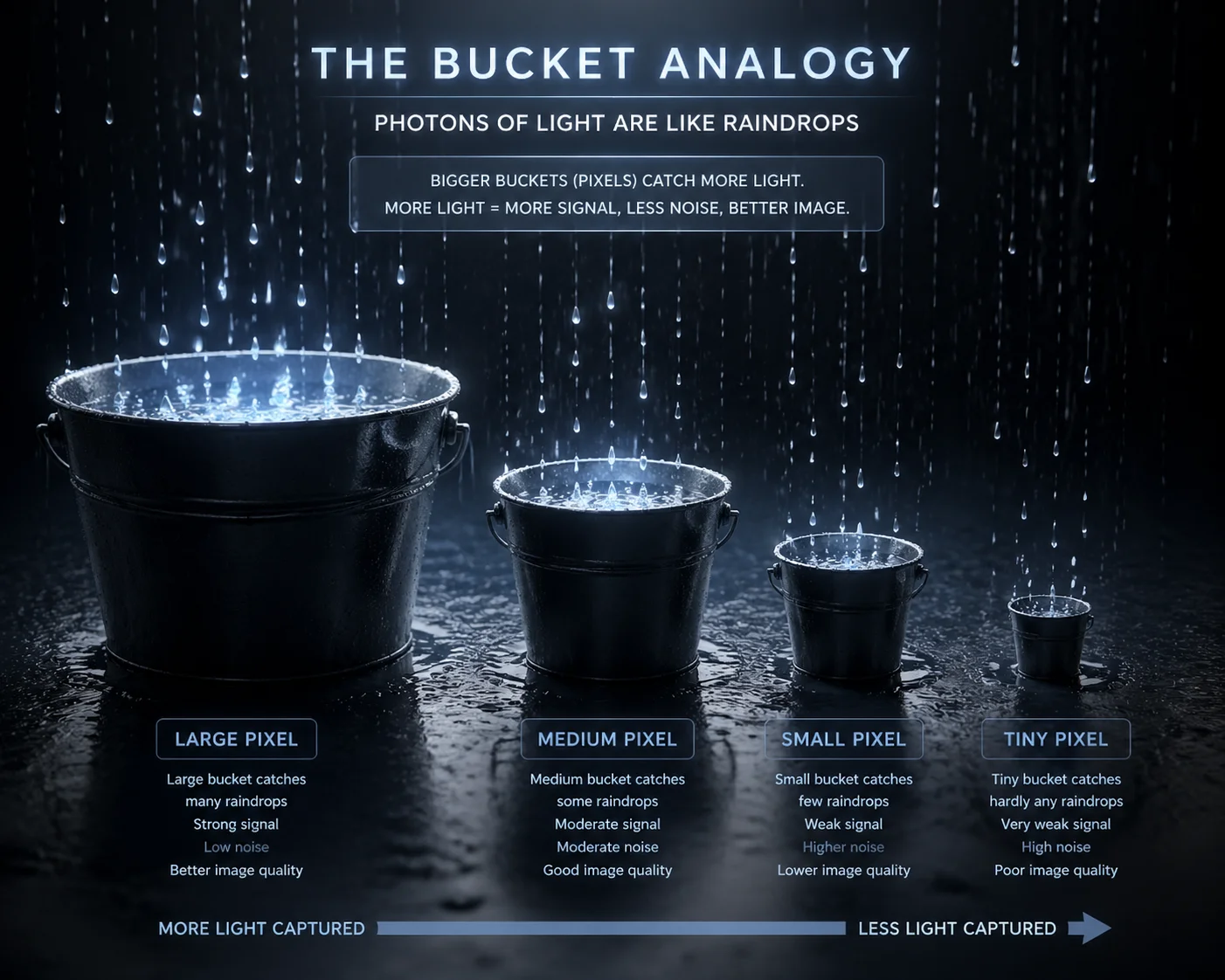
Think of each pixel as a small bucket sitting in the rain. A big bucket catches more raindrops. A small bucket catches fewer. In photography and surveillance, the “rain” is photons — tiny particles of light.
During the day, there are plenty of photons. Even small buckets fill up quickly. The image looks great. But at night, photons are scarce. Small buckets barely collect anything. The camera’s processor sees a very weak signal and tries to amplify it. This amplification is called “gain.” And gain brings noise — those ugly, dancing specks you see in dark footage.
How the Numbers Work
Here is a simple comparison. Imagine two sensors with the same physical size — say, 1/2.8 inches. One is a 2MP sensor. The other is an 8MP (4K) sensor.
| Specification | 2MP Sensor | 8MP (4K) Sensor |
|---|---|---|
| Total Pixels | 2,000,000 | 8,000,000 |
| Pixel Size | ~2.9 µm | ~1.45 µm |
| Pixel Area | ~8.41 µm² | ~2.10 µm² |
| Relative Light Capture | 4× more | 1× (baseline) |
The 2MP pixel has roughly 4 times the light-collecting area of the 4K pixel. That is not a small difference. It is massive.
Signal-to-Noise Ratio (SNR) in Plain Terms
Signal-to-noise ratio 1 is just a fancy way of saying “how much real image data vs. how much garbage.” When a pixel collects 100 photons, the noise is about 10 (the square root of 100). So your SNR is 10. When a smaller pixel collects only 25 photons, the noise is about 5. Your SNR drops to 5. The image looks twice as noisy.
What This Means for Your Project
If you are installing cameras in a well-lit parking lot in Dallas, an 8MP camera on a 1/2.8″ sensor will give you stunning daytime detail. But if you are covering a dark perimeter fence on a Texas ranch, that same camera will disappoint you at night. The megapixel count on the box tells you nothing about low-light ability. You need to look deeper — at the actual pixel size.
This is why many experienced integrators still choose high-quality 2MP or 4MP cameras for dark environments instead of blindly chasing 4K. Resolution means nothing if the image is buried in noise.
What Is the Ideal Micron-Pixel Size I Should Look for in a Professional 4K PTZ Camera?
I get this question a lot from system integrators who are sourcing PTZ cameras from China. They want 4K. They also want clean night footage. The answer comes down to one number: the micron size of each pixel.
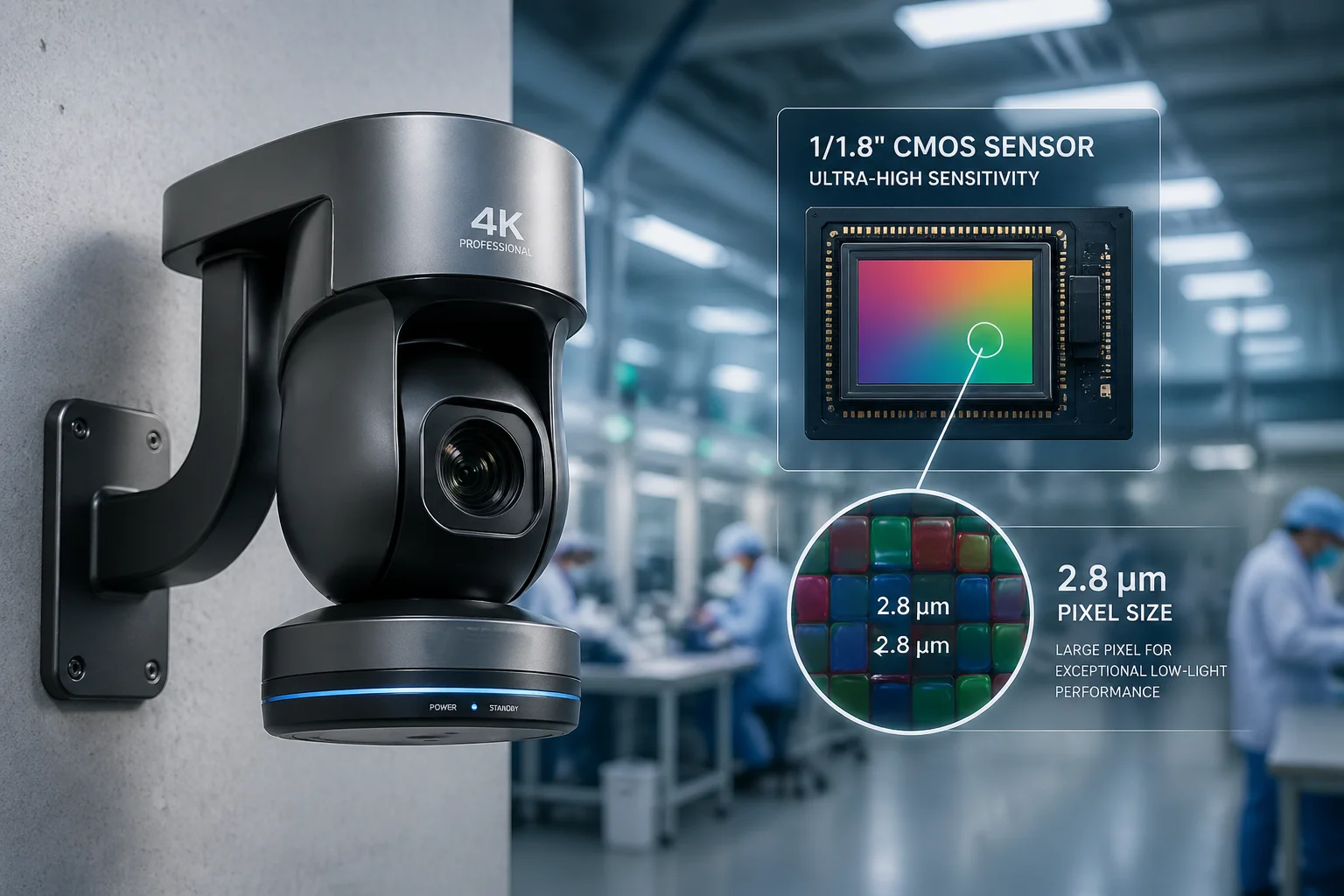
For professional 4K PTZ cameras used in low-light security, look for a pixel size of at least 2.8 µm. This typically means a sensor size of 1/1.2 inches or larger. Sensors like the Sony IMX485 2 hit this mark and deliver true Starlight-level performance at 4K resolution. Anything below 2.0 µm will struggle in the dark.
 ideal micron pixel size professional 4K PTZ camera
The Sensor Landscape: What Chinese OEMs Actually Use
Most 4K PTZ cameras coming out of China — whether branded by Hikvision, Dahua, or white-label OEM factories like ours — use Sony CMOS sensors. The sensor model determines the pixel size, and the pixel size determines the low-light performance. Here is the real-world breakdown:
| Sensor Model | Sensor Size | Pixel Size | Low-Light Rating | Typical Use Case |
|---|---|---|---|---|
| Sony IMX274 | 1/2.5″ | 1.62 µm | Poor | Daytime only, needs IR at night |
| Sony IMX334 | 1/1.8″ | 2.0 µm | Medium | Indoor or areas with some lighting |
| Sony IMX485 | 1/1.2″ | 2.8 µm | Excellent (Starlight) | Outdoor low-light, full-color night |
| 1″ Exmor R CMOS | 1″ | ≥3.5 µm | Exceptional | Broadcast, critical infrastructure |
Why 2.8 µm Is the Sweet Spot
At 2.8 µm, a 4K pixel has the same light-collecting area as the best 2MP sensors from a few years ago. This is the threshold where 4K stops being a daytime-only resolution and becomes a true 24/7 solution.
The Sony IMX485 is the most popular sensor in this class. It uses a 1/1.2″ chip, which gives each of its 8 million pixels enough room to breathe. IP Cam Talk’s in-depth review of Dahua cameras confirmed that the jump from IMX274 (1.62 µm) to IMX334 (2.0 µm) was noticeable, but the jump to IMX485 (2.8 µm) was transformational. That was the first time a 4K security camera truly earned the “Starlight” label.
Don’t Forget BSI Architecture
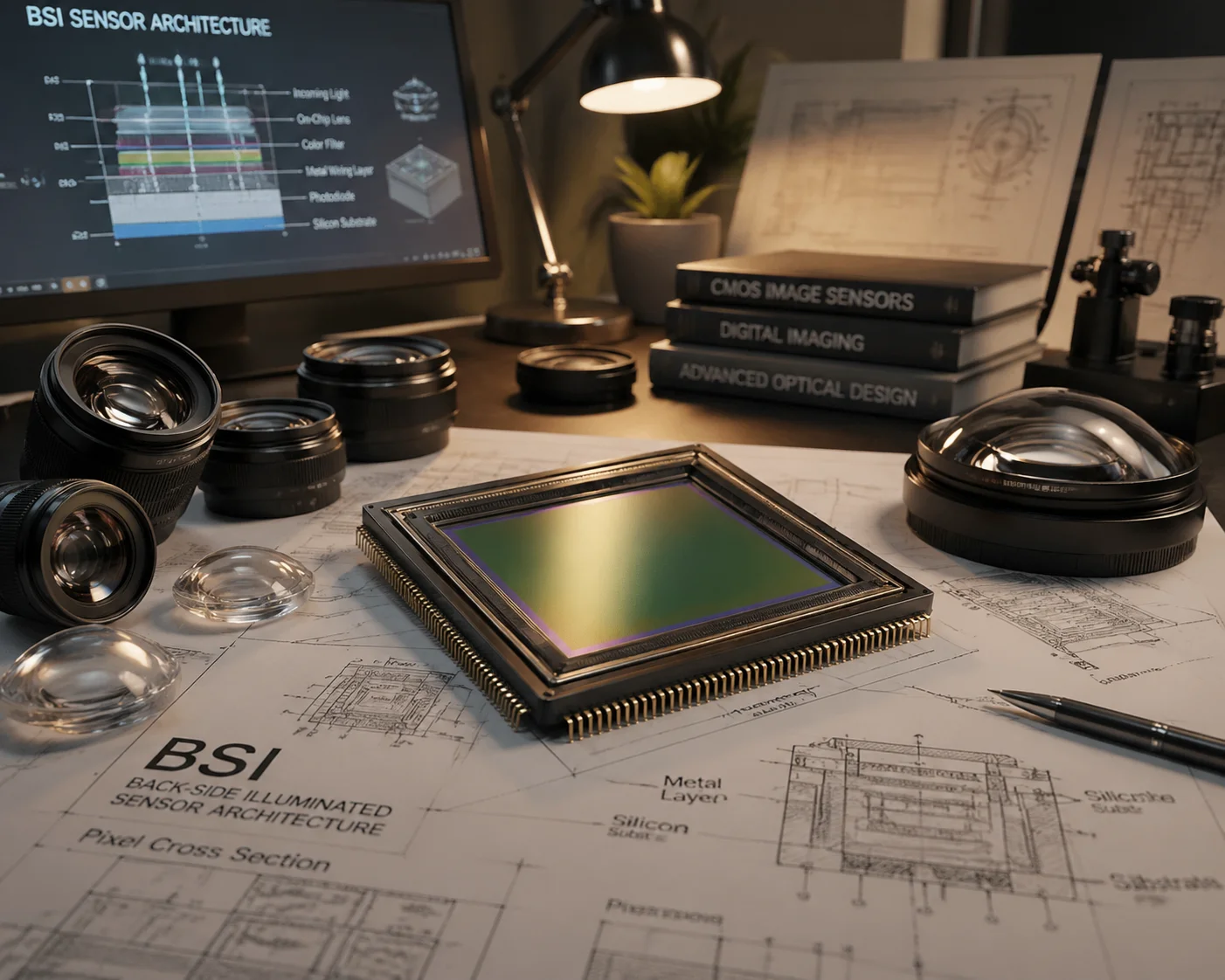
Pixel size is not the only thing that matters. The sensor’s internal architecture plays a big role too. Traditional sensors use a front-side illuminated (FSI) design, where the wiring sits on top of the light-sensitive layer. This blocks some incoming light.
Back-side illuminated (BSI) 3 sensors flip the design. The wiring goes underneath. Light hits the photodiode directly. Sony’s STARVIS and STARVIS 2 lines all use BSI. Tests show that a BSI sensor can be 24–40% more sensitive than an FSI sensor with the same pixel size. So a 2.0 µm BSI sensor can actually outperform a 2.4 µm FSI sensor.
My Practical Advice
When you request a quote from any Chinese PTZ manufacturer, ask for three things:
- The exact sensor model (e.g., IMX485, not just “Sony sensor”)
- The sensor size (1/1.2″ or larger for serious low-light work)
- Whether it is BSI or FSI (BSI is what you want)
If the factory cannot answer these questions, that is a red flag. At Loyalty-Secu, we list the sensor model and architecture on every product spec sheet because we know our customers — integrators like you — make decisions based on real data, not marketing fluff.
How Does My Camera Balance 4K Resolution with the Need for High Sensitivity at Night?
This is the engineering trade-off that keeps camera designers up at night — literally. You want sharp 4K detail during the day. You also want clean, bright images after dark. These two goals fight each other on a small sensor.
Camera manufacturers balance 4K resolution and night sensitivity using three main strategies: larger sensor chips (like 1/1.2″ or 1″), back-side illuminated (BSI) pixel architecture, and fast lenses with wide apertures (F1.0 or F1.2). Together, these let a 4K camera collect enough light per pixel to produce usable footage in near-darkness.
 4K resolution high sensitivity night balance camera sensor
Strategy 1: Use a Bigger Sensor
This is the most straightforward solution. If you need 8 million pixels and you want each pixel to be large, you simply use a bigger chip. Axis Communications published a white paper that states this clearly: a 4K camera with a large sensor has both high resolution and large pixels, and it performs significantly better in low light than a 4K camera with a small sensor.
Here is how sensor size affects pixel size at 4K resolution:
| Sensor Size | Approximate Pixel Size at 4K | Low-Light Capability |
|---|---|---|
| 1/2.8″ | ~1.45 µm | Weak — heavy noise below 5 Lux |
| 1/2.5″ | ~1.62 µm | Weak — needs strong IR supplement |
| 1/1.8″ | ~2.0 µm | Moderate — usable with some ambient light |
| 1/1.2″ | ~2.8 µm | Strong — Starlight full-color capable |
| 1″ | ~3.5 µm+ | Excellent — broadcast-grade low-light |
The cost goes up with sensor size. A 1/1.2″ sensor costs significantly more than a 1/2.8″ sensor. But for professional deployments where failure is not an option, the investment pays for itself. One truck roll to a remote site to swap a bad camera costs more than the price difference between sensors.
Strategy 2: BSI Pixel Architecture
I covered this above, but it is worth repeating because it is that important. Back-side illuminated sensors let more light reach each pixel. Sony’s STARVIS 2 4 technology pushes this even further. The quantum efficiency — the percentage of photons that actually get converted into electrical signal — is significantly higher on BSI chips.
In practical terms, a BSI sensor with 2.0 µm pixels can match or beat an older FSI sensor with 2.4 µm pixels. This is why you cannot judge a camera by pixel size alone. You need to know the architecture.
Strategy 3: Fast Lenses with Wide Apertures
The sensor is only half the equation. The lens determines how much light reaches the sensor in the first place. The aperture is measured by the F-number. A lower F-number means a wider opening and more light.
- F2.0: Standard. Lets in a baseline amount of light.
- F1.4: Lets in about 2× more light than F2.0.
- F1.2: Lets in about 2.8× more light than F2.0.
- F1.0: Lets in about 4× more light than F2.0.
A 4K camera with a 2.8 µm BSI sensor and an F1.0 lens is a completely different animal from a 4K camera with a 1.45 µm FSI sensor and an F2.0 lens. The first one will give you full-color footage at 0.01 Lux. The second one will give you a noisy gray mess.
Strategy 4: ISP and AI-Based Noise Reduction
Modern cameras also use their image signal processor (ISP) to clean up noise digitally. Techniques like 3D noise reduction (3D-DNR) and AI-powered frame stacking can reduce visible grain. But these are band-aids, not cures. They work best when the sensor already captures a decent signal. If the raw signal is too weak — because the pixels are too small — no amount of software processing can save the image. You will get a smooth, smeared-out picture that has lost all the fine detail you bought 4K for in the first place.
The bottom line: hardware comes first. Start with a large sensor, BSI architecture, and a fast lens. Then let the ISP polish what is already a strong image.
Will a Larger Pixel Size Help Me Reduce the Motion Blur in My Nighttime Security Footage?
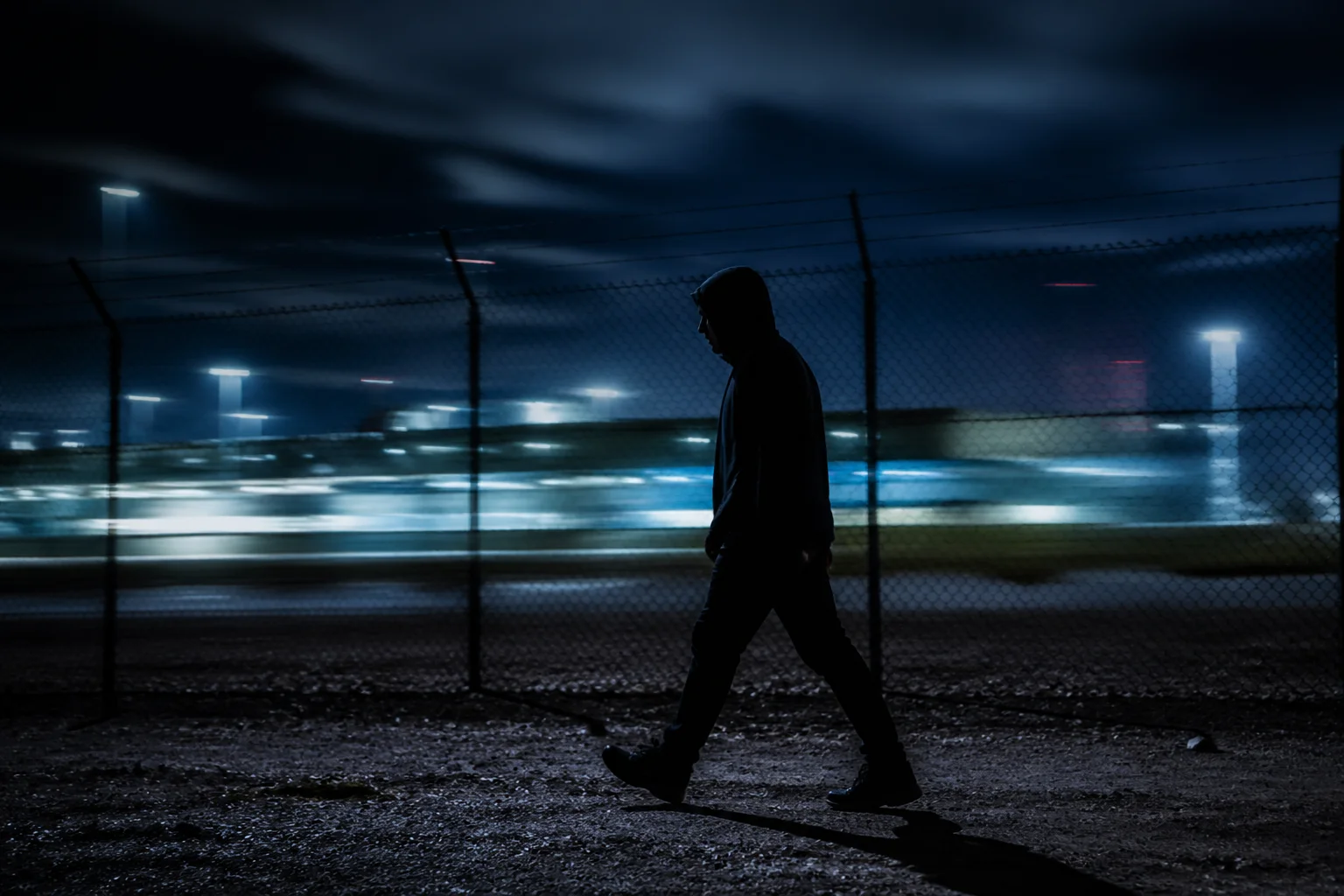
Motion blur at night is one of the most frustrating problems in security. A person walks through the frame, and their face turns into a smeared blob. You have the footage, but you cannot identify anyone. I have heard this complaint from dozens of integrators.
Yes, larger pixels directly help reduce motion blur at night. Bigger pixels collect more light in less time, so the camera can use a faster shutter speed without making the image too dark. A faster shutter speed freezes motion. With small pixels, the camera must use a slow shutter to gather enough light, and that slow shutter is exactly what causes motion blur.
 larger pixel size reduce motion blur nighttime security footage
How Shutter Speed and Pixel Size Are Connected
At night, your camera’s automatic exposure system faces a tough choice. It needs enough light to make a visible image. It has three tools: aperture, gain, and shutter speed.
- Aperture is usually fixed or limited by the lens design.
- Gain amplifies the signal but adds noise.
- Shutter speed controls how long each frame is exposed.
When pixels are small and the scene is dark, the camera slows down the shutter to let more light in. A shutter speed of 1/15 second or even 1/8 second is common on cheap 4K cameras at night. At 1/15 second, any person walking at normal speed will be blurred. At 1/8 second, even a slowly moving vehicle becomes unreadable.
Now put a large-pixel sensor in the same scene. The bigger pixels collect more photons per millisecond. The camera can keep the shutter at 1/30 or even 1/60 second and still get a bright enough image. At 1/60 second, a walking person is frozen. You can see their face, their clothing, their gait. That is the difference between evidence and a useless blur.
The Real-World Impact on Identification
For security applications, the whole point of recording video is identification. License plates, faces, clothing details — these are what matter when an incident happens. Motion blur destroys all of them.
A camera with 2.8 µm pixels on a 1/1.2″ sensor, paired with an F1.2 lens, can maintain a 1/30s shutter speed in conditions as low as 0.1 Lux. That is a moonlit night with no street lights. A camera with 1.45 µm pixels on a 1/2.8″ sensor will need to drop to 1/8s or crank the gain to maximum. Either way, you lose.
Gain vs. Shutter Speed: The Trade-Off
Some cameras try to keep the shutter fast by cranking up the gain instead. This avoids motion blur but introduces heavy noise. You trade one problem for another. The image is sharp but covered in grain, and fine details like license plate numbers disappear into the static.
Large pixels solve both problems at once. More light per pixel means you do not need excessive gain AND you do not need a slow shutter. You get a clean, sharp image. This is not marketing theory. This is physics.
What to Ask Your Supplier
When you evaluate a 4K PTZ camera for nighttime use, ask the manufacturer: “What is the minimum illumination at 1/30s shutter speed, with gain at a reasonable level?” Many spec sheets list minimum illumination at 1/1s shutter speed with maximum gain. That number is meaningless for real security work. Nobody wants a 1-second exposure on a security camera. Demand the spec at 1/30s. That tells you the truth about the camera’s real-world night performance.
At Loyalty-Secu, we test our cameras at realistic shutter speeds and publish those numbers. Because we know that our customers — integrators deploying systems in the field — need specs they can trust, not specs that look good on paper.
Conclusion
Pixel size is the foundation of low-light performance. For professional 4K PTZ cameras, prioritize sensors with pixels ≥2.8 µm, BSI architecture, and fast lenses to get footage you can actually use at night.
1. Signal-to-noise ratio explained for image sensor performance. ↩︎ 2. Sony IMX485 4K sensor specifications and pixel size. ↩︎ 3. How back-side illuminated (BSI) sensors improve light capture. ↩︎ 4. Sony STARVIS 2 technology for security cameras. ↩︎ 5. Quantum efficiency in CMOS image sensors explained. ↩︎ 6. F-number and aperture light-gathering calculations. ↩︎ 7. 3D noise reduction (3D-DNR) technology in IP cameras. ↩︎ 8. Minimum illumination specifications at realistic shutter speeds. ↩︎ 9. IP Cam Talk forum IMX485 low-light image samples. ↩︎ 10. Axis Communications white paper on 4K sensor selection. ↩︎