
I’ve seen a 40X PTZ camera arrive dead after six weeks at sea. The lens was fine. The foam looked fine. But the internal optics had shifted 0.02mm — enough to kill the zoom alignment forever.
A proper packaging design passes the ocean vibration test by using multi-density foam suspension, mechanical motor locking, resonance frequency detuning, and moisture barriers working together. These four layers absorb low-frequency energy from ship engines and waves across all three axes, keeping the 40X optical alignment intact after weeks of continuous vibration.
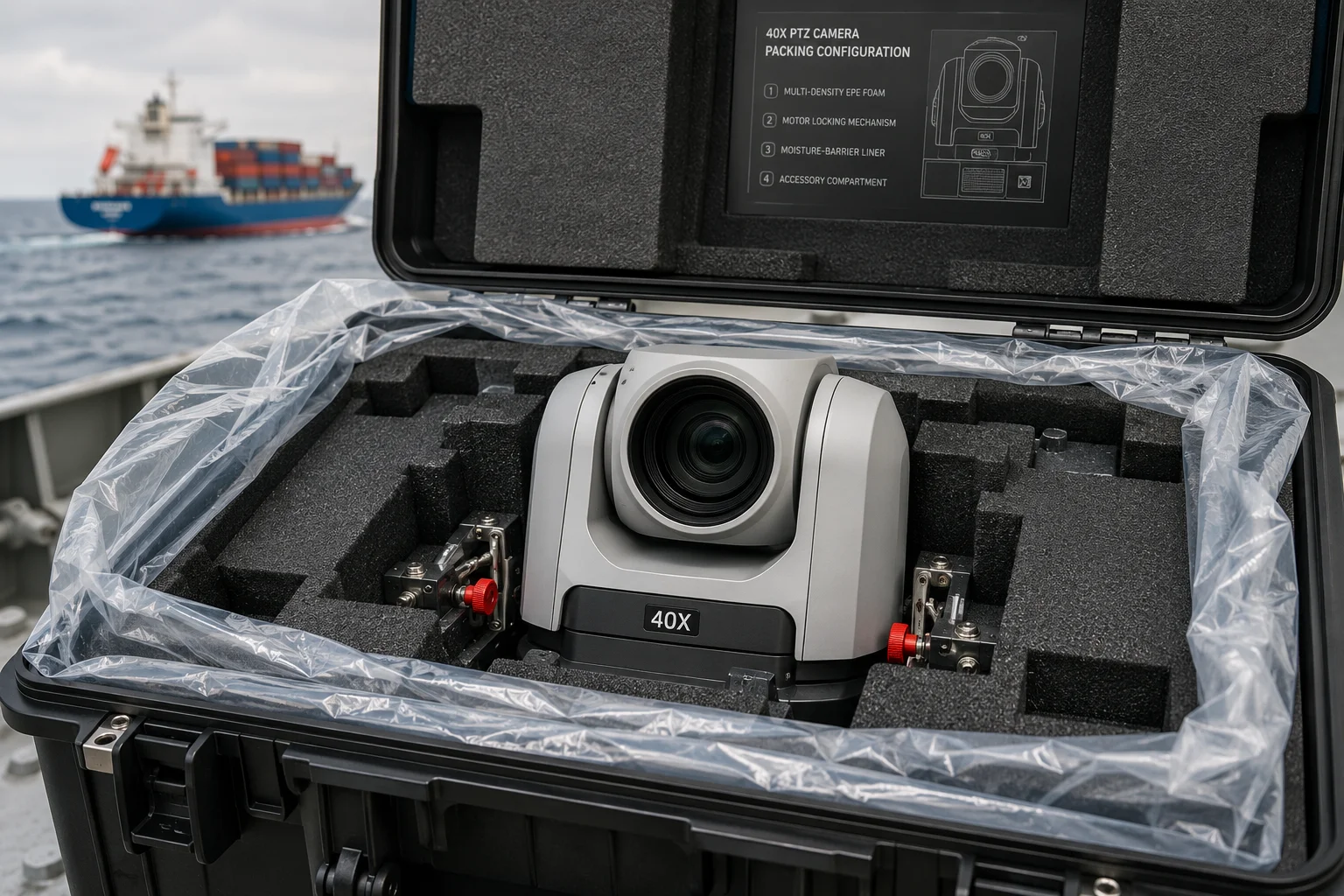
Below, I’ll walk you through each layer of our packaging engineering — from the foam touching the camera body to the outer carton sitting at the bottom of a container stack. If you ship precision PTZ equipment overseas, this is what separates a 0.5% DOA rate from a 5% one.
Table of Contents
Does the Packaging Meet the ISTA 3A Standard1 for Surviving the “Last Mile” Delivery?
The last mile is where most damage happens. Your camera survived 30 days on a ship, then a forklift drops the pallet at the warehouse door. I’ve had customers send me photos of crushed boxes with tire marks on them.
Yes. Our packaging passes the full ISTA 3A test sequence, which includes random vibration across three axes for 180 minutes, drop tests from 76cm on all six faces, three edges, and one corner, plus compression testing that simulates a 3-meter stack height in a moving container.
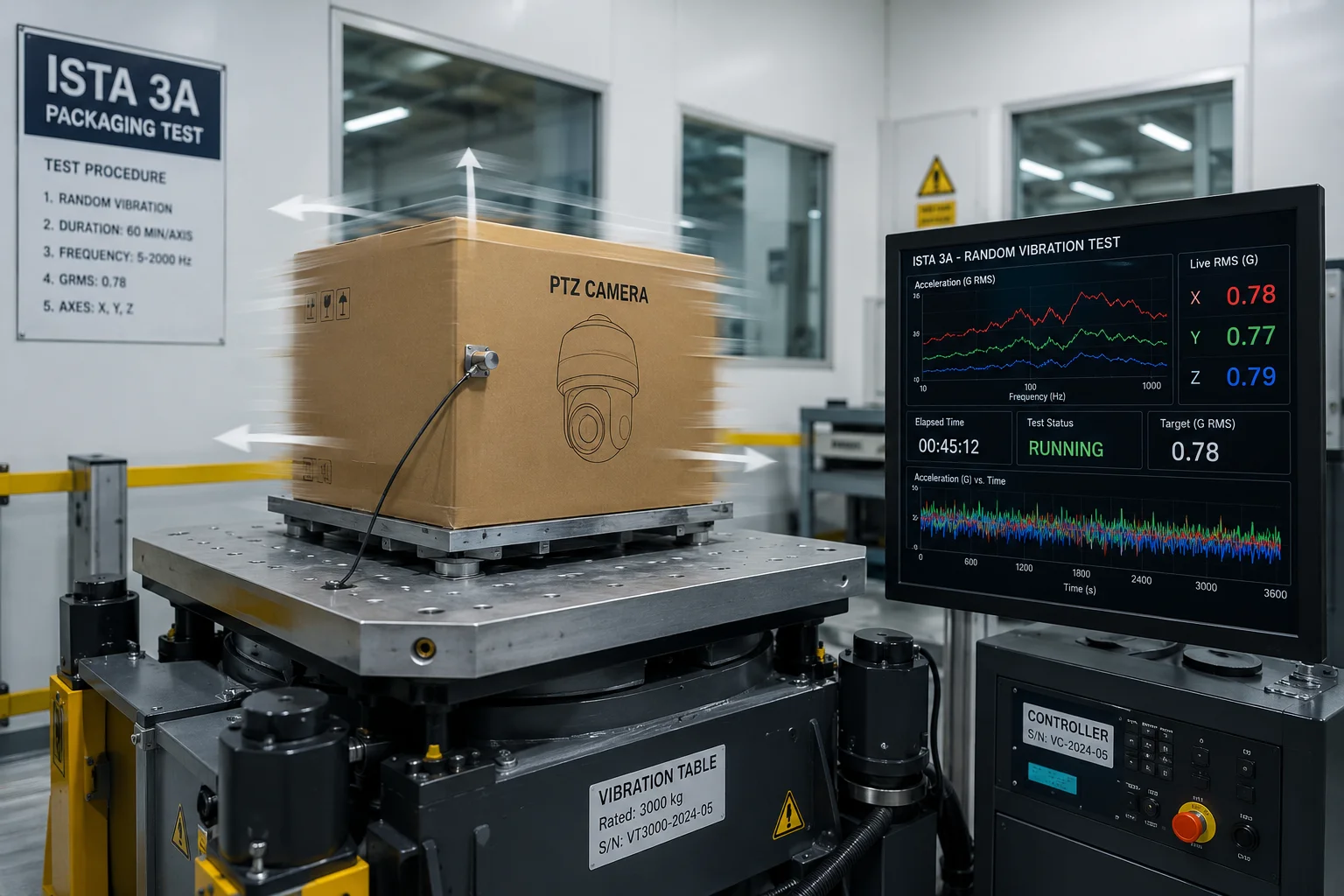
What ISTA 3A Actually Tests
ISTA 3A is not a single test. It is a sequence. The package goes through vibration, then drops, then compression — in that order. This matters because vibration weakens the cardboard fibers first. Then the drop test hits a box that is already slightly fatigued. This simulates real life.
Here is what the test sequence looks like:
| Test Phase | What It Simulates | Our Pass Criteria |
|---|---|---|
| Random vibration (180 min) | Truck bed, ship engine, conveyor belts | Zero internal movement detected on accelerometer |
| Drop test (76cm–100cm) | Forklift mishandling, conveyor falls | No visible damage to device, no optical shift |
| Compression / stack test | Bottom of a 5-high pallet in container | Box walls retain shape, no foam crush |
How We Design for This
The key is not just passing the test once in a lab. The key is passing it after the box has been in 85% humidity for two weeks. Wet cardboard loses 30–50% of its edge crush strength. So we test in conditioned environments too.
Our corrugated outer box uses a BC-flute double-wall2 construction. The burst strength is rated at 1400 kPa minimum. We also add a full-perimeter PE liner inside the box. This liner does two things: it blocks moisture from reaching the corrugated walls, and it adds a friction layer that stops the inner foam block from sliding during vibration.
The “Last Mile” Problem Is Really a Stacking Problem
Most people think the last mile means the delivery truck. But the real danger is the distribution center. Your box might sit at the bottom of a stack for 3–7 days while waiting for dispatch. During this time, the static load compresses the foam slowly. If the foam is too soft, it bottoms out. Then the camera shell touches the inner box wall. Then one bump on the delivery truck transfers directly to the lens housing.
We solve this with a dual-density approach. The outer foam shell is 45kg/m³ EPE — stiff enough to hold shape under 200kg of static load. The inner cradle is 20kg/m³ — soft enough to absorb the sharp transient shocks from drops and bumps.
Are the PTZ Motors Locked with a “Gimbal Protector” to Prevent Mechanical Shock in Transit?
A 40X PTZ camera has three motorized axes and a lens assembly with 18+ glass elements. During shipping, every vibration cycle is a tiny back-and-forth motion on the gear teeth. Over millions of cycles across a 30-day ocean trip, this causes wear — even without power.
Yes. We lock the PTZ motors using the stepper motor’s own holding torque combined with physical polyurethane limit blocks placed at critical rotation points. This prevents the pan, tilt, and zoom mechanisms from micro-oscillating during transit, which would otherwise wear the worm gears and shift the optical axis.
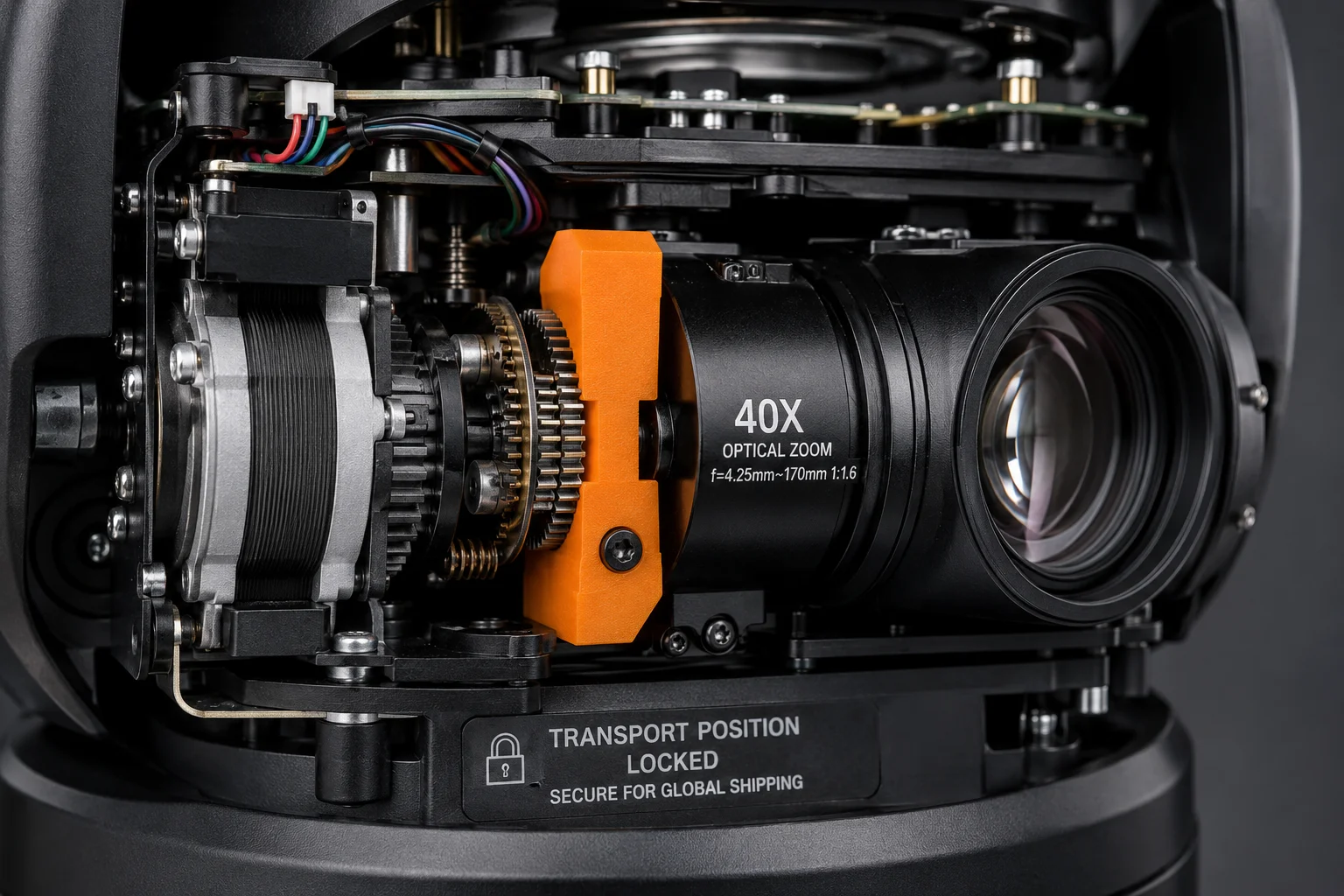
Why Motor Locking Matters for 40X Optics
A 40X zoom lens has a very long physical travel distance inside the barrel. The lens group moves forward and backward along precision guide rails. If the camera vibrates for weeks without the motor locked, the lens group can drift. Even 0.01mm of drift changes the back-focal length8. The result? The camera zooms to 40X and the image is soft on one side. Your customer thinks the camera is defective. It’s not — it was damaged in shipping.
How the Locking System Works
There are two layers:
| Locking Method | What It Protects | How It Works |
|---|---|---|
| Stepper motor holding torque | Pan and tilt axes | Motor coils remain energized during final QC, locking the rotor in a fixed position. The worm-gear self-locking3 property maintains this even after power is removed. |
| Polyurethane limit blocks | Zoom lens barrel, wiper arm, slip ring gaps | Soft foam inserts placed in mechanical gaps absorb lateral shear force. Removed by installer before first power-on. |
The “Transport Position” Concept
Before packing, every camera is driven to a specific angle we call the “transport position.” This is not random. We choose the position where:
- The center of gravity is lowest (tilt at 0°, pan at home).
- The zoom lens is fully retracted (shortest barrel length = least lever arm for vibration).
- All cable slack inside the slip ring7 is evenly distributed (no tension points).
This position minimizes the moment of inertia around all three axes. In plain English: the camera is hardest to shake when it’s in this position. We mark this in the QC checklist. If a camera leaves the factory in the wrong position, it gets flagged and repacked.
What Happens Without Locking
I’ve tested this. We shipped 10 units without the limit blocks as a controlled experiment. After a simulated 3-week ocean vibration profile (ASTM D41696 DC-13), two units showed measurable backlash increase in the tilt axis. One unit had a zoom tracking error of 3 pixels at full telephoto. For a system integrator running video analytics at 40X, that’s a failed acceptance test.
Is the EPE Foam Custom-Molded to Protect the Lens and Dome from Micro-Scratches?
The dome and front lens are the only optical surfaces exposed to the outside world. A single scratch on the dome means the camera produces flare at night when IR illumination hits the scratch. I’ve seen installers reject entire shipments over this.
Yes. We use CNC-cut EPE foam with a recessed cavity that holds the dome in a “floating” position — no foam surface touches the optical glass directly. A separate PE film sleeve wraps the dome, and the foam cradle keeps a 5mm air gap between the dome surface and any solid material.
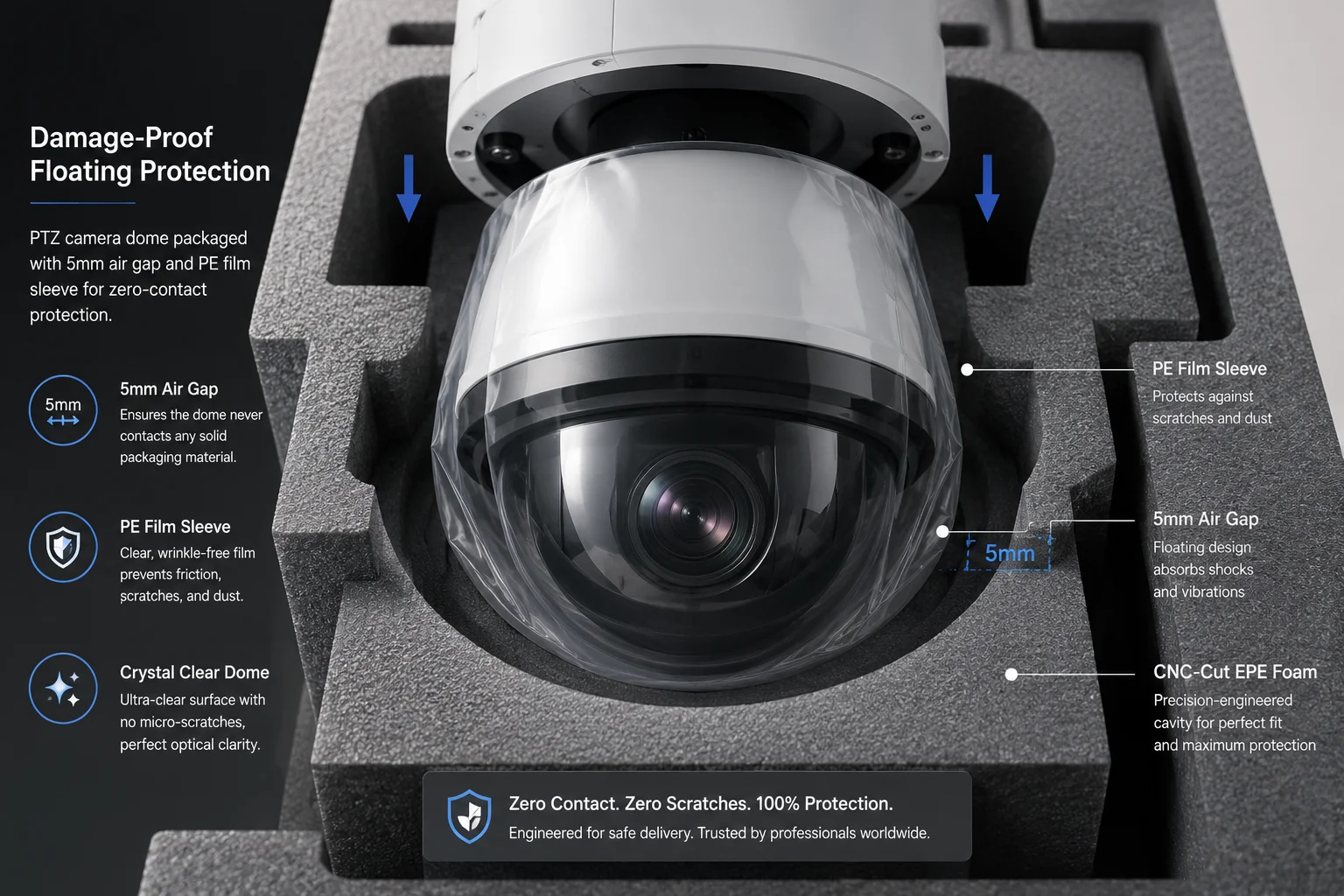
Why Standard Foam Fails for Optical Surfaces
Standard packaging foam has a cell structure. Under a microscope, the surface looks like tiny bubbles. When this surface presses against polycarbonate or glass for weeks under vibration, the micro-texture of the foam acts like very fine sandpaper. The vibration creates relative motion between the foam and the dome — maybe only 0.1mm per cycle. But over millions of cycles, it leaves a haze pattern.
This is not visible under normal light. But at night, when the camera’s built-in IR LEDs fire at 850nm, the micro-scratches scatter the light. The result is a white glow in the image. Your customer calls it “foggy night vision.” The real cause is packaging damage.
Our Three-Layer Dome Protection System
We solve this with three layers:
- PE film sleeve: A 0.05mm polyethylene film wraps the dome. This film is optically smooth — no cell structure. Even if it vibrates against the dome, it cannot scratch it.
- Air gap cavity: The foam has a CNC-cut recess that is 5mm larger than the dome in all directions. The dome floats inside this cavity without touching the foam walls.
- Retention ring: A soft silicone ring at the base of the dome cavity holds the camera body in place. The dome hangs in free space. The only contact point is the camera’s metal housing against the silicone ring.
Material Selection: EPE vs. EPP vs. EPS
| Property | EPE (Polyethylene) | EPP (Polypropylene) | EPS (Polystyrene) |
|---|---|---|---|
| Surface smoothness | Good | Better | Poor (crumbles) |
| Vibration absorption | Excellent | Excellent | Moderate |
| Moisture resistance | High | High | Low |
| Dust generation | Very low | Very low | High (static particles) |
| Cost | Medium | Higher | Low |
We use EPE for most shipments. EPS is never used — it generates static-charged particles that stick to the dome and lens. EPP is reserved for military-grade or extremely long transit routes (60+ days) because it has better fatigue resistance over extended vibration exposure.
The Mold Design Process
Each new PTZ model gets its own foam mold. We don’t use generic inserts. The mold is CNC-cut from a 3D scan of the final production unit — not the prototype. This matters because production units often have slight dimensional differences from prototypes (thicker gaskets, longer cable tails, revised bracket geometry). A mold cut from prototype dimensions might press against the dome edge on a production unit.
Can the Box Withstand Being at the Bottom of a 5-Unit High Stack in a Moving Container?
Inside a shipping container, your box might sit under 4 other boxes for 30 days. The container rocks side to side. The stack shifts. The bottom box takes all the weight plus dynamic force from the rocking motion. If the box crushes, the foam compresses, and the camera inside loses its protective air gaps.
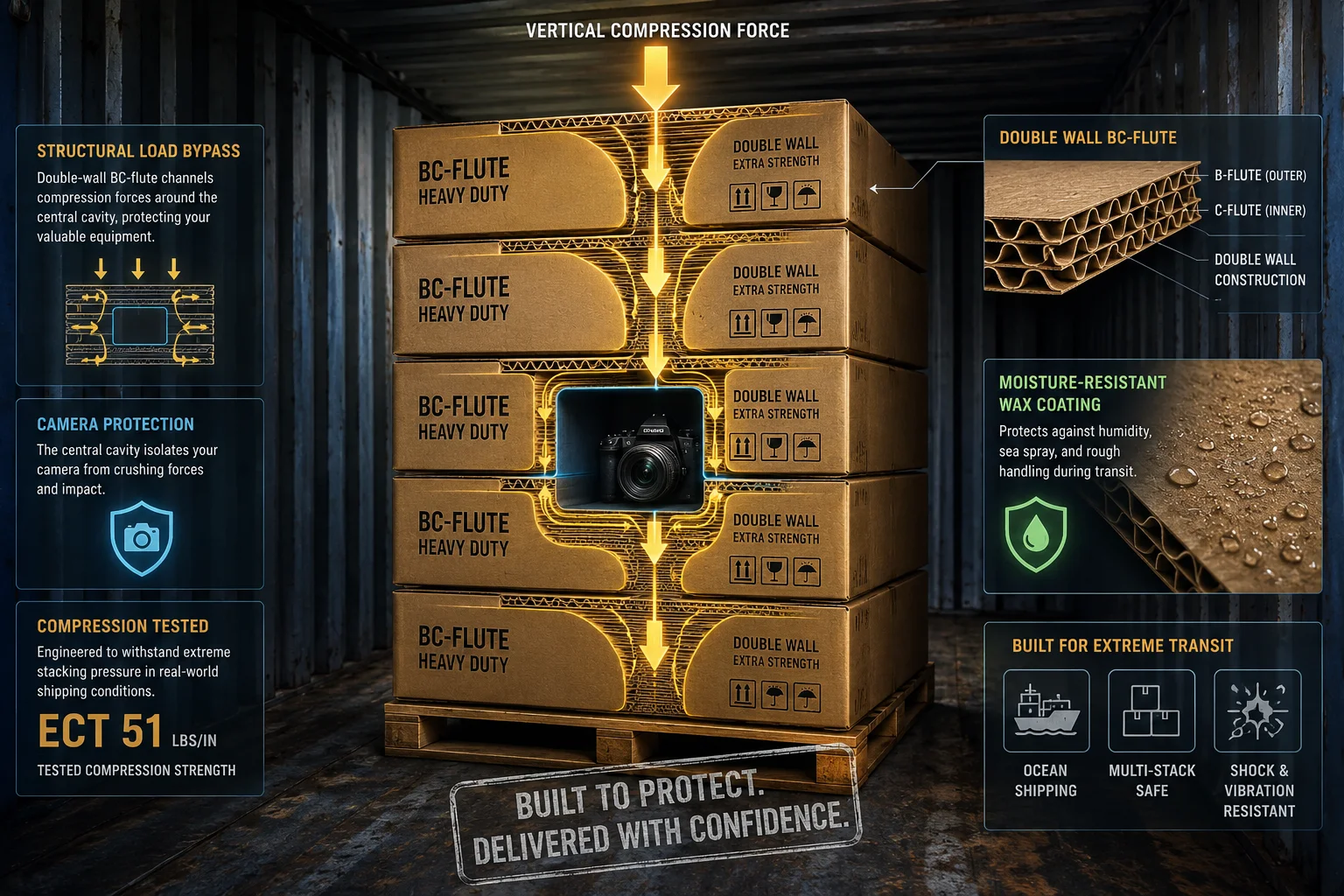
Yes. Our outer carton is rated for a static compression load of 200kg minimum, tested at 95% relative humidity for 72 hours. Combined with the internal foam structure that distributes load evenly across the box floor, the packaging maintains its protective geometry even at the bottom of a 5-unit stack inside a moving ocean container.
The Physics of Container Stacking
A 40X PTZ camera in full packaging weighs about 8–12kg depending on the model. Five units stacked means roughly 40–50kg on the bottom box. That sounds manageable. But here’s what people miss: dynamic load multiplication.
When a container ship rolls 5° to one side (normal in moderate seas), the effective downward force on the bottom box increases. The lateral acceleration adds a vector component. In practice, the bottom box experiences 1.5–2X the static weight during rolling. So 50kg becomes 75–100kg of effective force, applied cyclically, millions of times.
How We Engineer the Outer Carton
The outer carton is not just “a box.” It is a structural element. We use:
- BC-flute double-wall corrugated board — this gives us two layers of fluting (B-flute at 3mm + C-flute at 4mm) for a total wall thickness of about 7mm.
- Edge Crush Test (ECT)5 rating of 880 kPa minimum — this is the metric that predicts stacking strength.
- Full-overlap bottom flaps — the bottom of the box has flaps that overlap completely, doubling the floor thickness. This prevents the bottom from bowing under load.
The Moisture Factor
Here’s something most packaging engineers overlook in the PTZ industry: corrugated board loses strength in humidity. At 50% RH, your box might handle 300kg. At 90% RH (common inside ocean containers in tropical routes), that same box handles only 150–180kg.
This is why we vacuum-seal the camera inside an aluminum foil bag with molecular sieve desiccant4. But we also treat the outer carton with a wax curtain coating on the inner liner. This slows moisture absorption into the flute structure. The box maintains at least 70% of its dry compression strength even after 3 weeks in a humid container.
Real-World Stacking Configuration
We specify the maximum stacking height on every box with a printed symbol. For our standard 40X PTZ packaging, the limit is 5 units high. We also design the foam inserts so that the load path goes straight down through the foam — not through the camera. The camera sits in a cavity. The foam columns on either side of the cavity carry the stacking load directly from the top of the box to the bottom. The camera bears zero compression force. It only experiences vibration, which the soft inner foam absorbs.
Conclusion
Packaging for a 40X PTZ camera is not about putting foam around a box. It is a multi-layer engineering system — vibration isolation, mechanical locking, optical surface protection, and structural compression resistance — all designed to deliver zero-defect performance after weeks at sea.
1. ISTA 3A is a global standard for testing packaged products less than 150 lbs, ensuring they survive last-mile delivery and handling. ↩︎ 2. BC-flute double-wall corrugated combines B and C flutes for high strength and cushioning, ideal for heavy or fragile shipments. ↩︎ 3. Self-locking worm drives prevent back-driving under static loads, adding security to motor locking during shipping. ↩︎ 4. Molecular sieve desiccants absorb moisture more effectively than silica gel, protecting optics and electronics inside sealed packaging. ↩︎ 5. ECT measures the compressive strength of corrugated board edge-on, the key metric for stacking strength in shipping boxes. ↩︎ 6. ASTM D4169 covers standard performance testing for shipping containers, including simulated vibration profiles for ocean transport. ↩︎ 7. A slip ring provides continuous electrical connectivity between rotating parts (e.g., pan/tilt) without cable twisting; proper slack management prevents damage during transit. ↩︎ 8. Back-focal length (BFL) is the distance from the last lens surface to the image plane; even 0.01mm drift causes soft focus at high zoom. ↩︎