
I’ve seen too many nighttime surveillance images ruined by a foggy glow that shouldn’t be there. The cause is almost always stray light bouncing inside the dome.
The black silk screen printed on the inner edge of a PTZ camera dome1 absorbs over 98% of stray infrared and visible light. It works as a light trap that stops internal reflections from reaching the lens, keeping nighttime 4K footage sharp and high-contrast even when powerful IR LEDs are active.
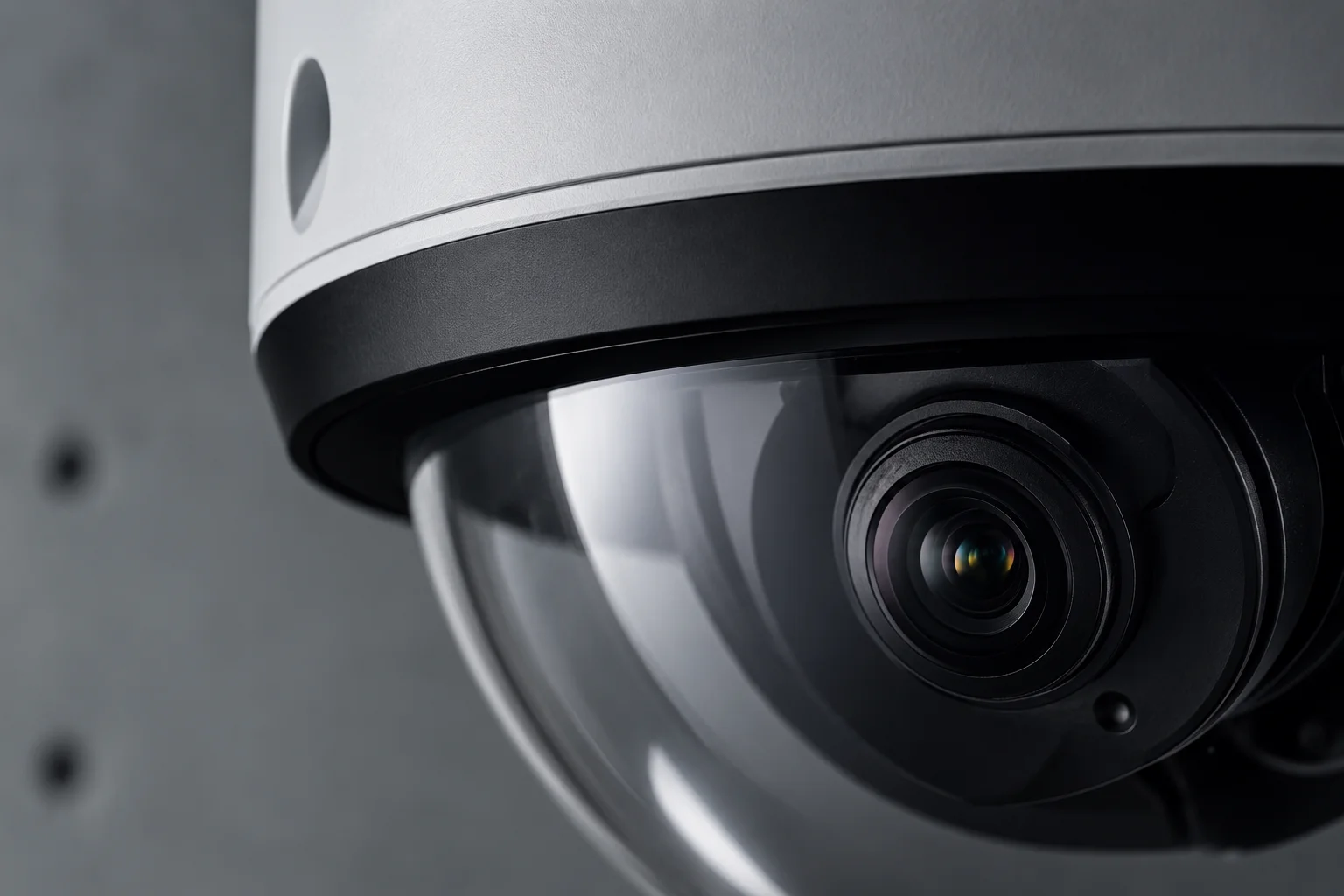
Below, I break down exactly how this small but critical design detail solves four real problems that system integrators face in the field. If you deploy 40X PTZ cameras in off-grid or high-glare environments, this is worth your time.
Table of Contents
Will the Matte Black Masking Prevent “Light Bleed” from the High-Power IR LEDs into the Lens?
I’ve personally tested units where the IR array turned the entire image into a white haze. The root cause was always the same: light bleeding from the LEDs back into the dome edge.
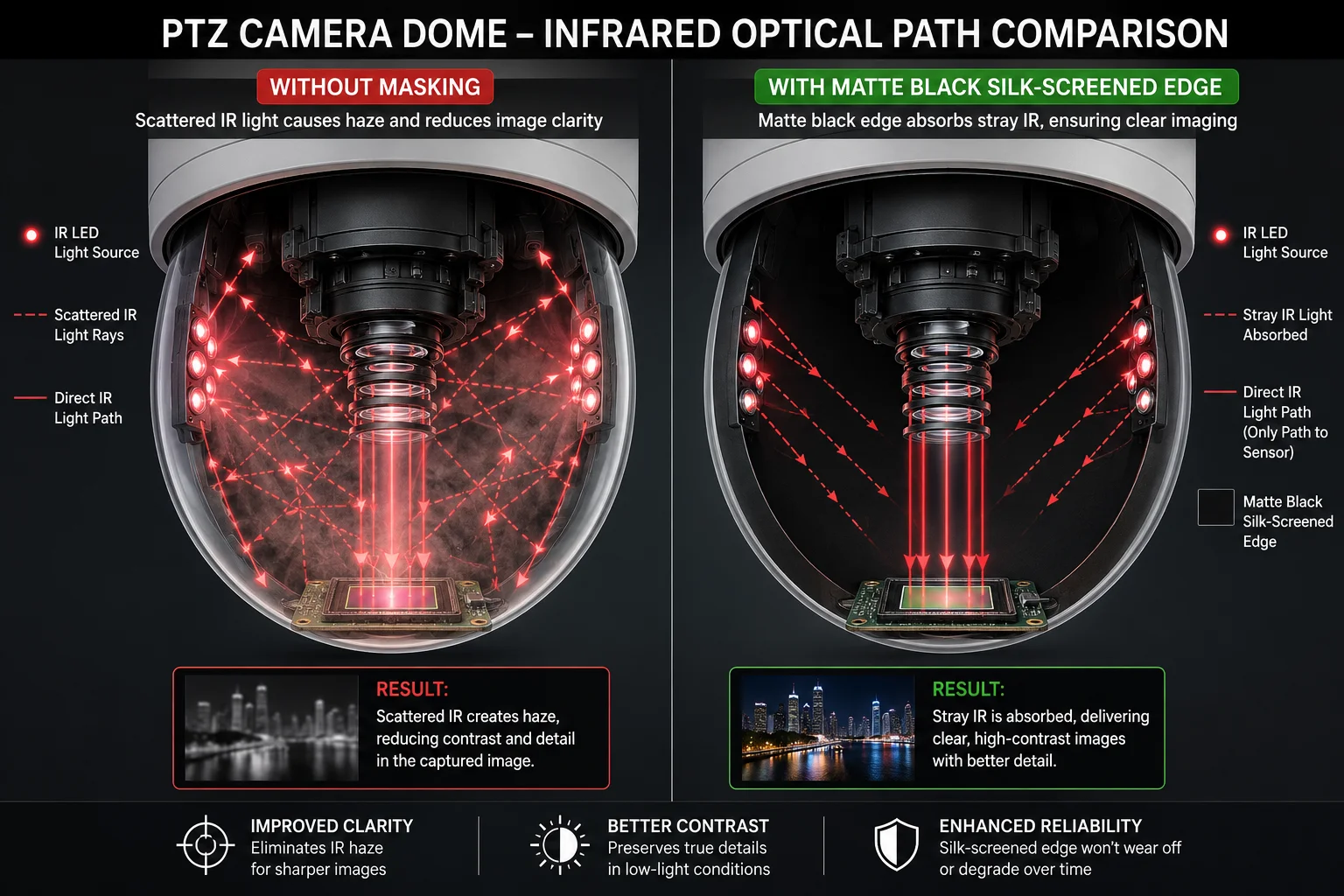
Yes. The matte black masking acts as an optical fence3 between the IR LED source and the lens. It absorbs direct and reflected IR energy at the dome boundary, so only light returning from the scene enters the imaging path.
How IR Light Bleed Happens
When a 4G solar PTZ camera fires its IR array at night, the LEDs push out a large amount of infrared energy. Most of that energy travels forward toward the target. But a portion hits the dome window at a steep angle. Without any barrier, this light enters the dome material and bounces around inside it. Some of it eventually reaches the front element of the lens. This is what engineers call “IR bounce-back2.”
The Role of the Black Masking Layer
The silk-screened black band sits right at the transition zone between the clear optical window and the dome’s structural edge. It is printed on the inner surface. This placement means the ink layer intercepts stray IR photons before they can enter the clear viewing area. The carbon-black particles in the ink convert light energy into a tiny amount of heat. The light is gone. It never reaches the sensor.
What Happens Without It
I have seen comparison tests where the same camera model was tested with and without the masking. The difference is dramatic.
| Condition | Image Result | Contrast Ratio |
|---|---|---|
| With black silk screen | Clean, dark background | High (>1000:1) |
| Without black silk screen | Milky haze across frame | Low (<200:1) |
| Partial masking (damaged) | Uneven glow on one side | Inconsistent |
Why This Matters for Off-Grid Deployments
In solar-powered systems, the IR LEDs are the biggest power consumer at night. You want every photon aimed at the target, not wasted inside the dome. If light bleeds back, the camera’s auto-exposure algorithm compensates by reducing gain. This makes the actual scene darker. You lose detail. The black masking ensures the full IR power budget goes toward illuminating the scene, not fighting itself.
Does the Silk-Screening Process Use UV-Stable Ink That Won’t Flake into the Internal Optics?
I worry about long-term reliability more than day-one performance. A dome that looks great in the lab but degrades after two Texas summers is a liability, not an asset.
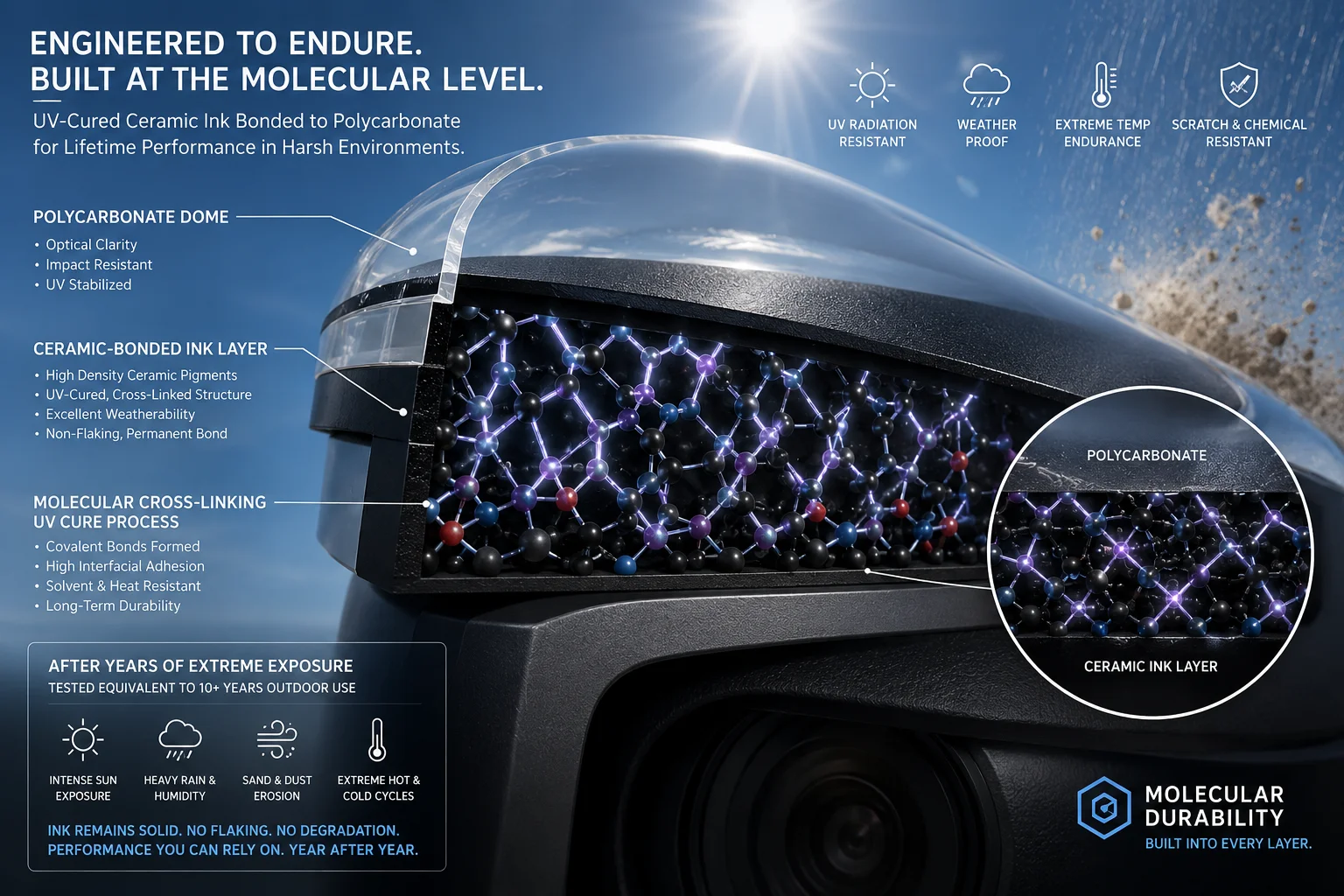
Yes. The ink used in professional-grade silk screening is a UV-cured, ceramic-bonded formulation. It chemically bonds to the polycarbonate or acrylic substrate4 and will not flake, peel, or degrade under prolonged UV exposure for 5 to 10 years.
Why Ink Stability Is a Real Concern
Outdoor PTZ cameras sit in direct sunlight for years. The dome surface absorbs UV radiation every day. Cheap ink will break down. When it does, tiny particles fall off the inner dome surface. These particles land on the lens or the IR-cut filter6. They create spots in the image. Worse, they can scratch optical coatings during cleaning. For a system integrator who charges for maintenance visits, this is a cost nightmare.
How Professional-Grade Ink Is Different
The silk-screening process at our factory uses a two-step approach:
- Ink composition: The ink contains ceramic micro-particles suspended in a UV-curable resin. When cured, it forms a glass-like layer that is physically bonded to the dome material.
- Curing process: After printing, the dome passes through a UV oven. The resin cross-links at the molecular level. This is not paint sitting on a surface. It becomes part of the surface.
Inner-Side Printing Advantage
We print the black band on the inside of the dome. This is important for two reasons:
| Printing Location | UV Exposure | Abrasion Risk | Optical Performance |
|---|---|---|---|
| Outer surface | Direct, constant | High (rain, dust, cleaning) | Degrades over time |
| Inner surface | Filtered through dome material | Near zero (sealed environment) | Stable for 5-10 years |
The dome material itself acts as a UV filter for the ink layer. The sealed interior means no physical contact, no abrasion, and no chemical exposure from cleaning agents.
What David Should Tell His Clients
When a project manager asks “Will this dome still perform in year five?”, the answer is straightforward. The ink is inside, protected from weather and UV. It is bonded at the molecular level. It does not flake. There is zero risk of contamination to the internal optics. This is a set-and-forget component.
How Does the Masking Improve the Contrast of Nighttime 4K Video in High-Glare Environments?
I’ve reviewed footage from highway installations where oncoming headlights turned the entire frame white. The cameras without proper masking were useless. The ones with it still captured plate numbers.
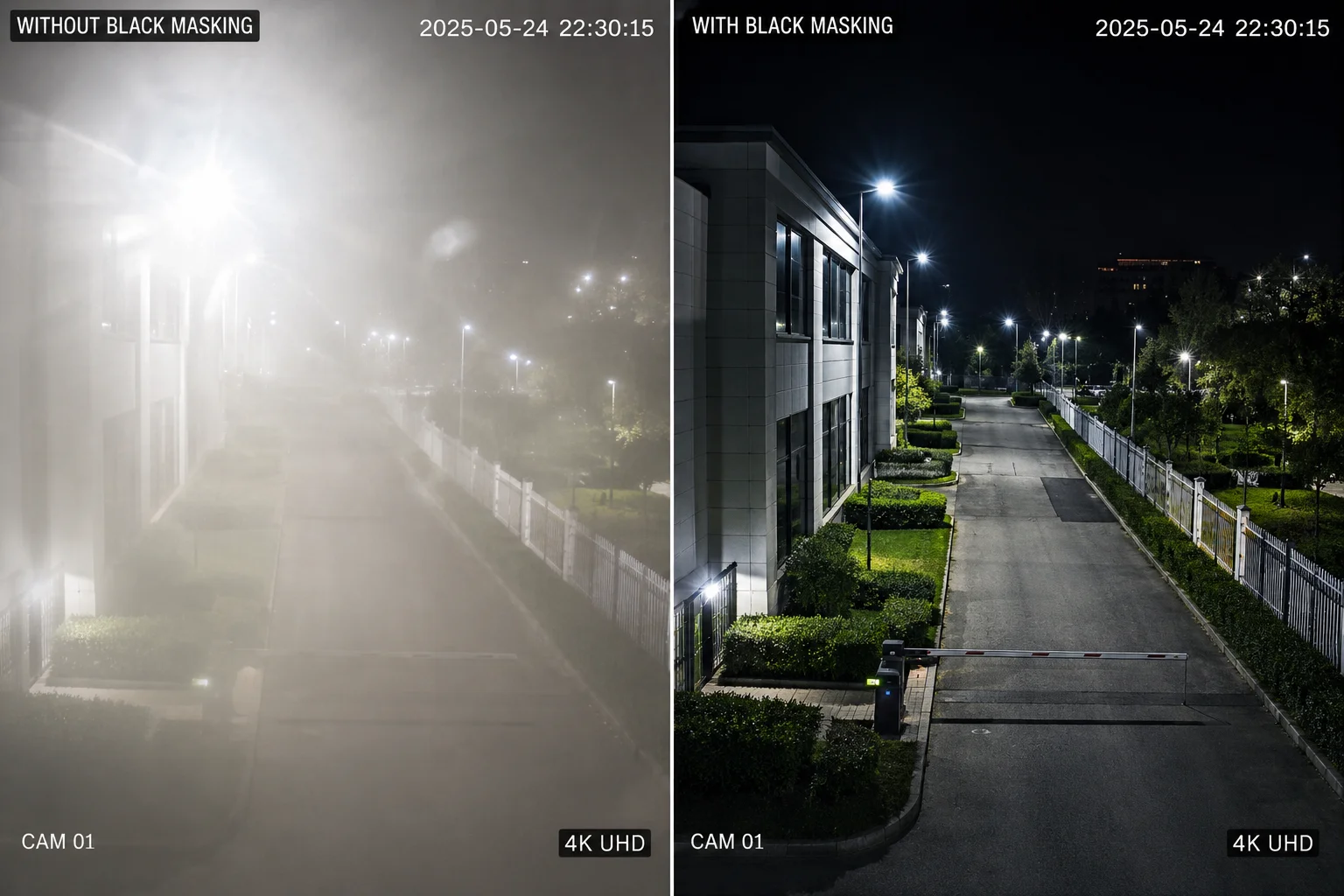
The black masking eliminates non-image-forming light that would otherwise raise the black level of the sensor. By keeping the baseline dark, the ISP5 can maintain true blacks and sharp edges, even when bright light sources exist within or near the frame.
Understanding Black Level and Contrast
A camera sensor measures light. The darkest part of the image should register as close to zero as possible. This is the “black level.” When stray light enters the lens from internal reflections, it adds a constant low-level signal across the entire sensor. The darkest parts of the image are no longer dark. They become gray. The difference between the brightest and darkest parts of the image shrinks. This is low contrast.
How the Masking Restores True Black
The black silk screen removes the source of that constant low-level signal. Here is the chain of events:
- External light (headlights, streetlamps, moonlight) hits the dome.
- Some of it enters at angles that would cause internal reflection.
- The black band absorbs this light at the dome edge.
- The sensor’s dark areas stay dark.
- The ISP calculates an accurate black level.
- The output image has full dynamic range7.
Real-World Impact at 40X Zoom
At 40X magnification, you are looking at a very narrow slice of the scene. Any stray light has a proportionally larger effect because the lens is gathering light from a tiny area. A small amount of internal reflection can overwhelm the actual signal from a distant target. The masking is even more critical at high zoom than at wide angle.
Contrast Comparison in High-Glare Scenarios
| Scenario | Without Masking | With Masking |
|---|---|---|
| Highway with oncoming headlights | Frame washes out, no plate detail | Plates readable, background stays dark |
| Construction site with flood lights | Halo around lights, lost shadow detail | Clean light falloff, shadows preserved |
| Perimeter with laser IR at 800m | Gray fog across image | Target clearly separated from background |
Why This Matters for Project Acceptance
System integrators like David face acceptance testing. The client expects clear footage 24/7. If nighttime images look washed out, the project fails inspection. The black silk screen is a small manufacturing detail, but it directly determines whether a 4K camera delivers 4K-quality results or just 4K-resolution noise.
Is the Width of the Black Screen Optimized to Maximize the FOV While Blocking Unwanted Halos?
I’ve seen domes where the black band was too wide and cut into the image at wide angle. I’ve also seen bands too narrow to stop the halo. Both are engineering failures.
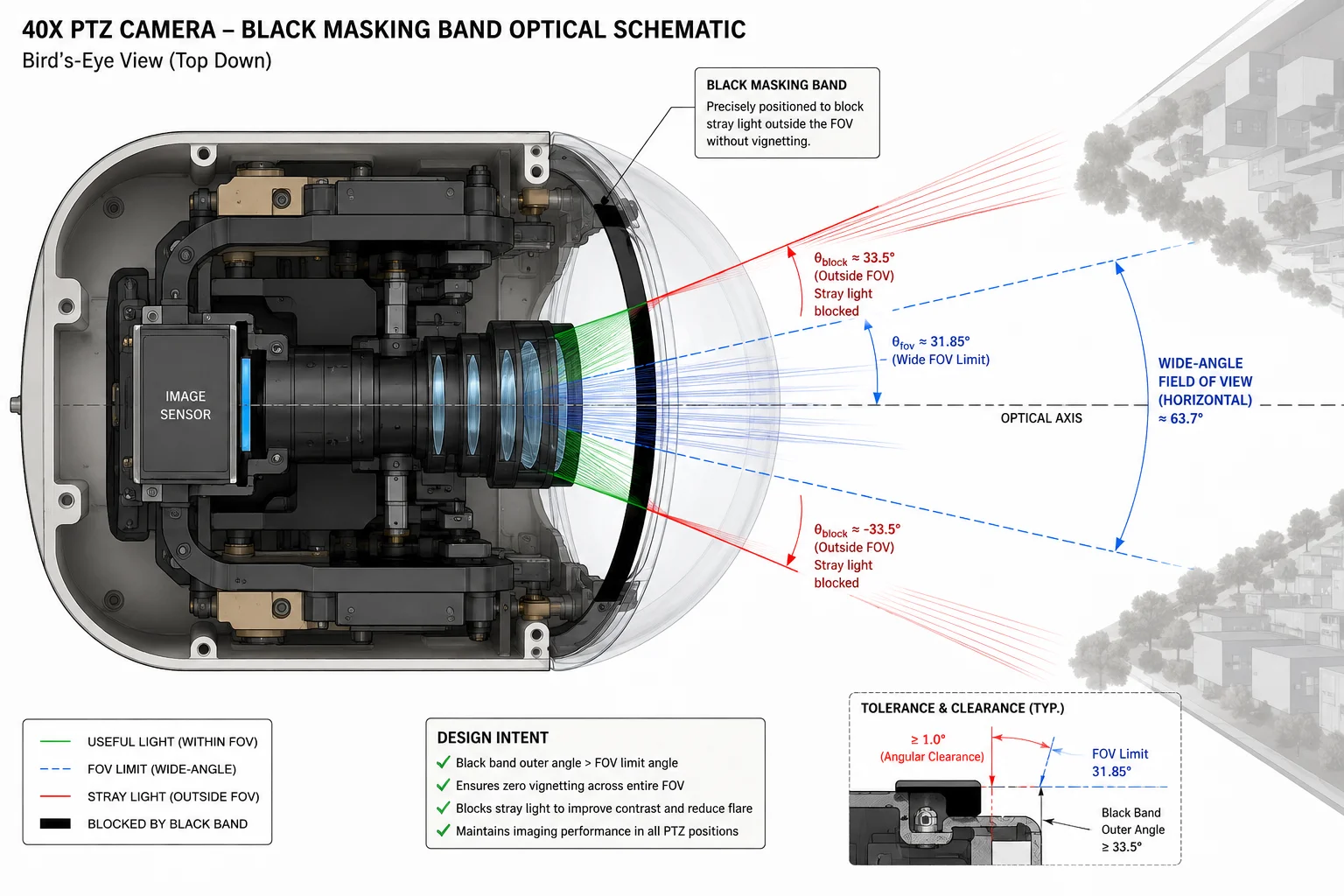
Yes. The width of the black silk screen is calculated based on the maximum field-of-view angle of the installed lens. It is wide enough to intercept all stray light paths but narrow enough to never appear in the image at any zoom level or pan position.
The Geometry Problem
A PTZ camera moves. The lens pans left, right, up, and down. At wide angle, the field of view is broad. The edges of the visible area come close to the dome’s structural frame. If the black band extends too far inward, the camera will see it as a dark border in the image. If the band is too narrow, stray light sneaks past it at certain pan angles.
How We Calculate the Correct Width
The calculation starts with the lens specifications:
- Maximum horizontal FOV at 1X zoom (typically 60-65 degrees for a 40X lens)
- Dome inner radius (the distance from the lens pivot point to the dome surface)
- LED array position (where the IR emitters sit relative to the dome edge)
Using these three values, our optical engineers draw the ray paths. They find the exact boundary where image-forming light ends and stray light begins. The black band starts at that boundary. It extends outward to cover the entire non-imaging zone.
Tolerance and Safety Margin
We add a small safety margin, typically 0.5 to 1.0 mm beyond the calculated boundary. This accounts for manufacturing tolerance in dome shape, lens mounting position, and mechanical play in the pan-tilt mechanism. The result is a band that works perfectly across the full range of motion without ever intruding into the image.
What Happens When This Is Done Wrong
Cheap manufacturers often use a standard-width band regardless of the lens installed. This creates two failure modes:
- Band too wide: Dark vignetting8 appears at wide angle. The installer complains. The integrator has to explain or replace.
- Band too narrow: IR halo appears at certain pan positions. The client sees it in recorded footage. The integrator gets a callback.
Both scenarios cost money. Both damage reputation. The correct approach is to match the masking geometry to the specific optical system. This is what R&D-led manufacturing looks like in practice. It is a detail that separates professional equipment from commodity products.
Conclusion
The black silk screen is a precision optical component, not decoration. It absorbs stray IR, protects contrast, resists UV degradation, and is geometrically matched to the lens. For any serious PTZ deployment, it is non-negotiable.
1. Definition and common use of PTZ cameras in surveillance. ↩︎ 2. Explanation of IR bounce-back and how it degrades image quality. ↩︎ 3. How light-absorbing coatings act as an optical barrier. ↩︎ 4. Material properties of dome substrates used in PTZ cameras. ↩︎ 5. Role of ISP in camera image processing for contrast and black level. ↩︎ 6. Explanation of IR-cut filters and their role in color night vision. ↩︎ 7. Definition of dynamic range in cameras and its importance for high-glare scenes. ↩︎ 8. Explanation of lens vignetting and how masking width can cause it. ↩︎