
I lost a project once because the camera looked great at wide angle but turned almost blind at full zoom. That mistake cost me thousands.
When a PTZ camera zooms to its maximum focal length, the F-number increases and the lens lets in far less light. A typical 30X PTZ drops from F1.6 at wide angle to F4.8 at full telephoto. This means only about 1/9 of the original light reaches the sensor at maximum zoom.
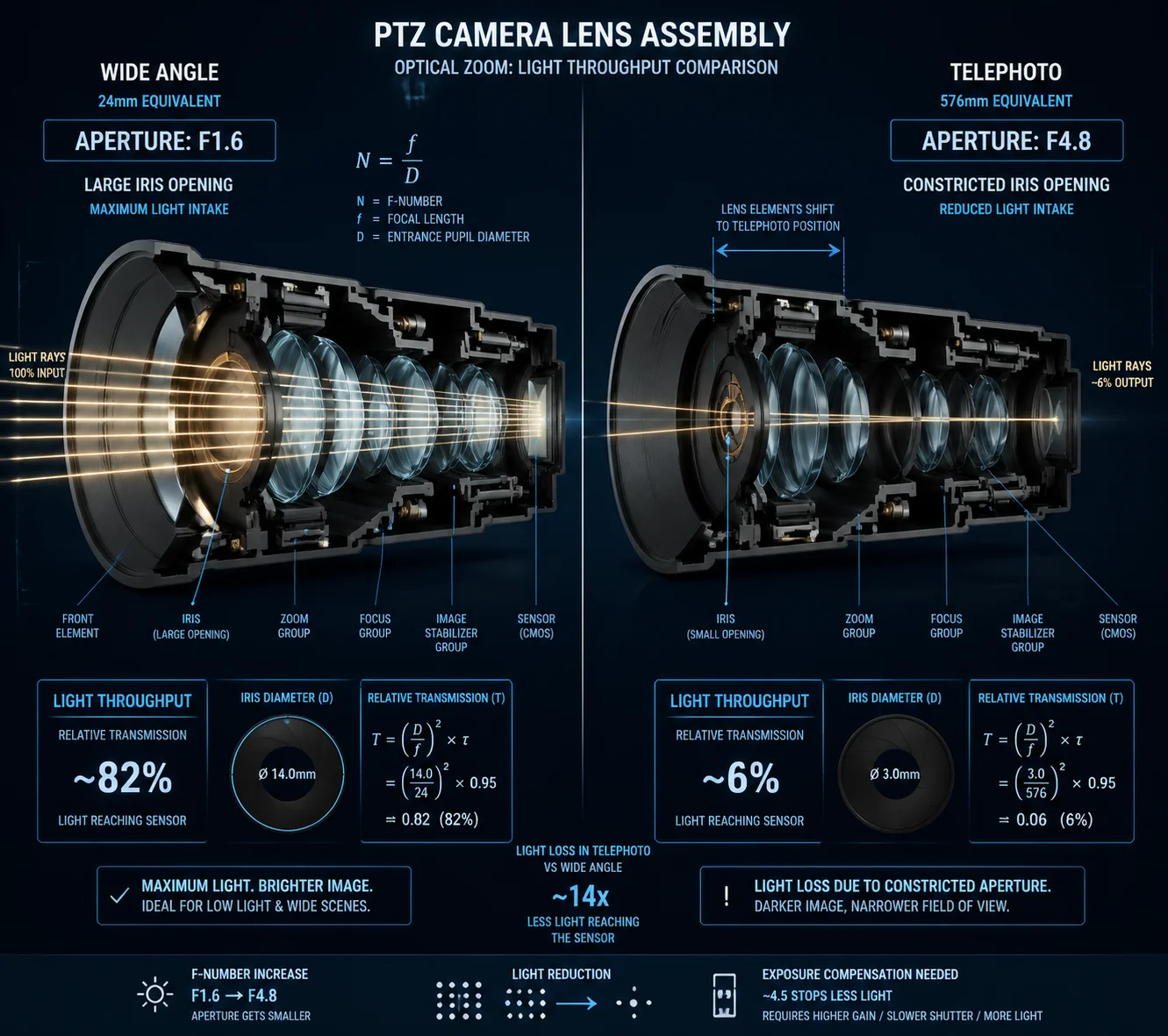
This is one of the most overlooked specs in PTZ camera selection. Most data sheets show you the best-case aperture at the wide end. But the real performance that matters for your project happens at the telephoto end. Below, I break down each piece of this problem so you can make a smarter buying decision.
Table of Contents
Why Does My Image Get Significantly Darker When I Zoom Into the Full 40X Range?
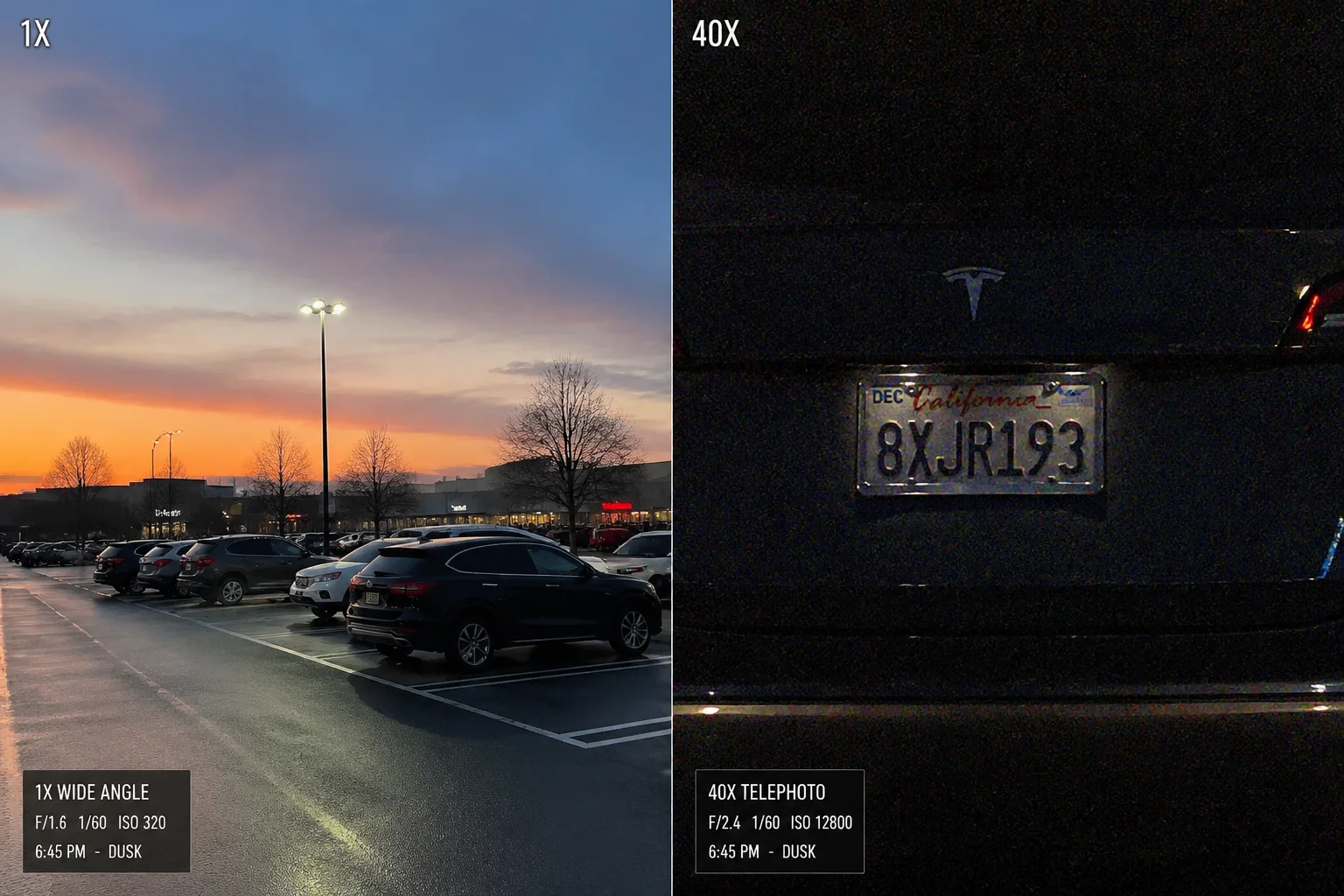
I remember the first time I pushed a 40X PTZ to its limit at night. The image just fell apart. It went from clear to a dark, noisy mess in seconds.
The image gets darker because the effective aperture shrinks as focal length increases. The lens barrel has a fixed physical diameter, so it cannot gather enough light to keep up with the longer focal length. This causes a significant drop in brightness at full zoom.
The Physics Behind the Darkening
The core reason is simple math. The F-number of a lens equals the focal length divided by the diameter of the entrance pupil. Here is the formula:
F = f / D
Where f is the focal length and D is the entrance pupil diameter. When you zoom from wide to tele, f might increase 30 or 40 times. But the physical glass at the front of the lens does not grow 30 times wider. The lens barrel stays the same size. So D grows only a little, while f grows a lot. The result is a much larger F-number at the telephoto end.
What Does This Look Like in Real Numbers?
Let me show you with a real example. Take a common 30X PTZ lens with a 4.5–135mm focal length range and an aperture range of F1.6–F4.4.
| Zoom Position | Focal Length | Max Aperture (F-number) | Relative Light Intake |
|---|---|---|---|
| Wide (1X) | 4.5 mm | F1.6 | 100% |
| Mid (15X) | ~67 mm | ~F3.0 | ~28% |
| Tele (30X) | 135 mm | F4.4 | ~13% |
At the wide end, F1.6 lets in a lot of light. At the telephoto end, F4.4 lets in only about 13% of that light. That is a massive drop.
Why the Camera Tries to Compensate (and Often Fails)
When the light drops, the camera’s ISP (Image Signal Processor) tries to fix things automatically. It does two things. First, it increases the gain. This amplifies the signal but also amplifies the noise. Second, it slows down the shutter speed. This lets more light in per frame but causes motion blur. Neither solution is free. You either get a noisy image or a blurry image. At night, with F4.4 or F4.8, there is simply not enough photons hitting the sensor. No amount of software processing can create detail from nothing. This is why I always tell my clients to test their cameras at full zoom in low light before they commit to a purchase order. The wide-angle demo looks great. The telephoto reality is what matters.
What Is the F-Number of My Lens at the Telephoto End Versus the Wide-Angle End?
I used to focus only on the first number in the aperture spec. That was a mistake. The second number is the one that determines your night performance at distance.
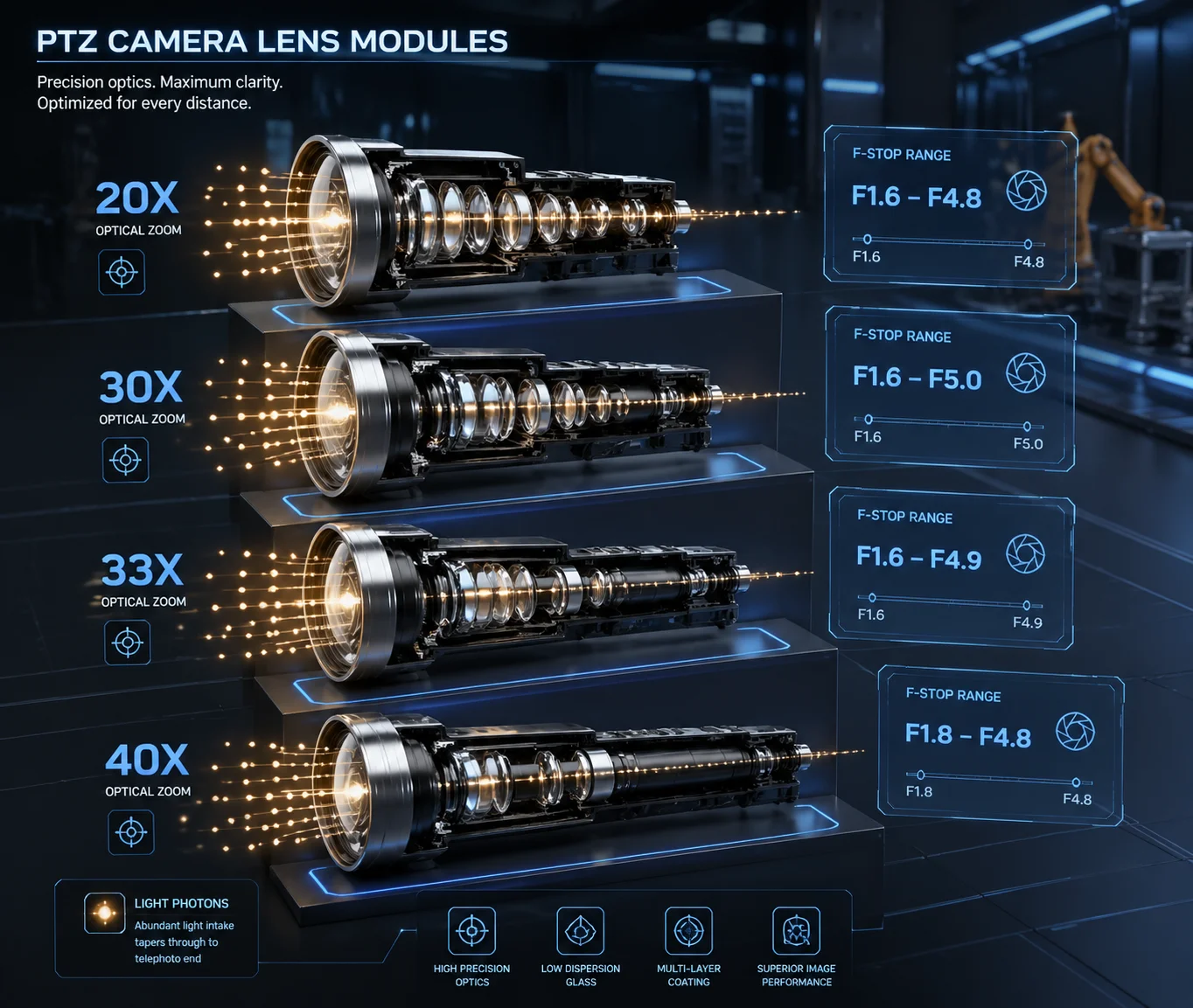
Most 20X–30X PTZ lenses have a wide-end aperture of F1.6 and a telephoto-end aperture between F4.0 and F5.0. This means the lens loses about 3 full stops of light from wide to tele, cutting the light intake to roughly 1/8 of the original amount.
How to Read the Spec Sheet Correctly
When you see a PTZ camera spec like “4.5–148.5mm, F1.6–F4.8,” the two F-numbers tell two very different stories. F1.6 is the best case. F4.8 is the worst case. And the worst case is exactly the scenario you care about most: maximum zoom, at night, on a target 300 meters away.
Real-World Aperture Comparisons Across Popular PTZ Models
Here is a comparison of typical PTZ camera modules I have worked with over the years:
| Camera Model Type | Zoom Range | Wide-End Aperture | Tele-End Aperture | Light Loss (Stops) | Light Remaining |
|---|---|---|---|---|---|
| 20X Standard PTZ | 4.7–94 mm | F1.6 | F3.5 | ~2.3 stops | ~20% |
| 30X Mid-Range PTZ | 4.5–135 mm | F1.6 | F4.4 | ~2.9 stops | ~13% |
| 33X High-Zoom PTZ | 4.5–148.5 mm | F1.6 | F4.8 | ~3.2 stops | ~11% |
| 40X Long-Range PTZ | 4.3–170 mm | F1.8 | F5.4 | ~3.2 stops | ~11% |
What “Stops” Mean in Plain Language
Each “stop” of light means the light is cut in half. So 1 stop less = 50% light. Two stops less = 25% light. Three stops less = about 12% light. When I explain this to clients like David, I put it simply: “At full zoom, your camera is seeing with only one-eighth of the light it had at wide angle. That is like going from a well-lit office to a dim hallway.”
Why the Tele-End Number Is Your True Benchmark
The wide-end aperture is easy to make large. It is cheap. The telephoto-end aperture is where the engineering gets expensive. To keep the F-number low at the tele end, you need larger diameter glass elements. You need aspherical lens 1 designs. You need more precise coatings. All of this adds cost. When I design our camera modules at Loyalty-Secu, I push our optical engineers to keep the tele-end aperture as low as possible, even if it means using larger, more expensive glass. Because I know that my clients are buying these cameras for what they can see at maximum zoom, not at wide angle. A 30X PTZ with F1.6–F3.5 at the tele end will always beat a 40X PTZ with F1.8–F5.4 in real night conditions.
How Can I Maintain a Clear Image at Night When the Aperture Narrows During Zooming?
I have deployed PTZ cameras on remote oil fields where the nearest streetlight is 10 miles away. If the camera cannot see at full zoom in total darkness, it is useless.
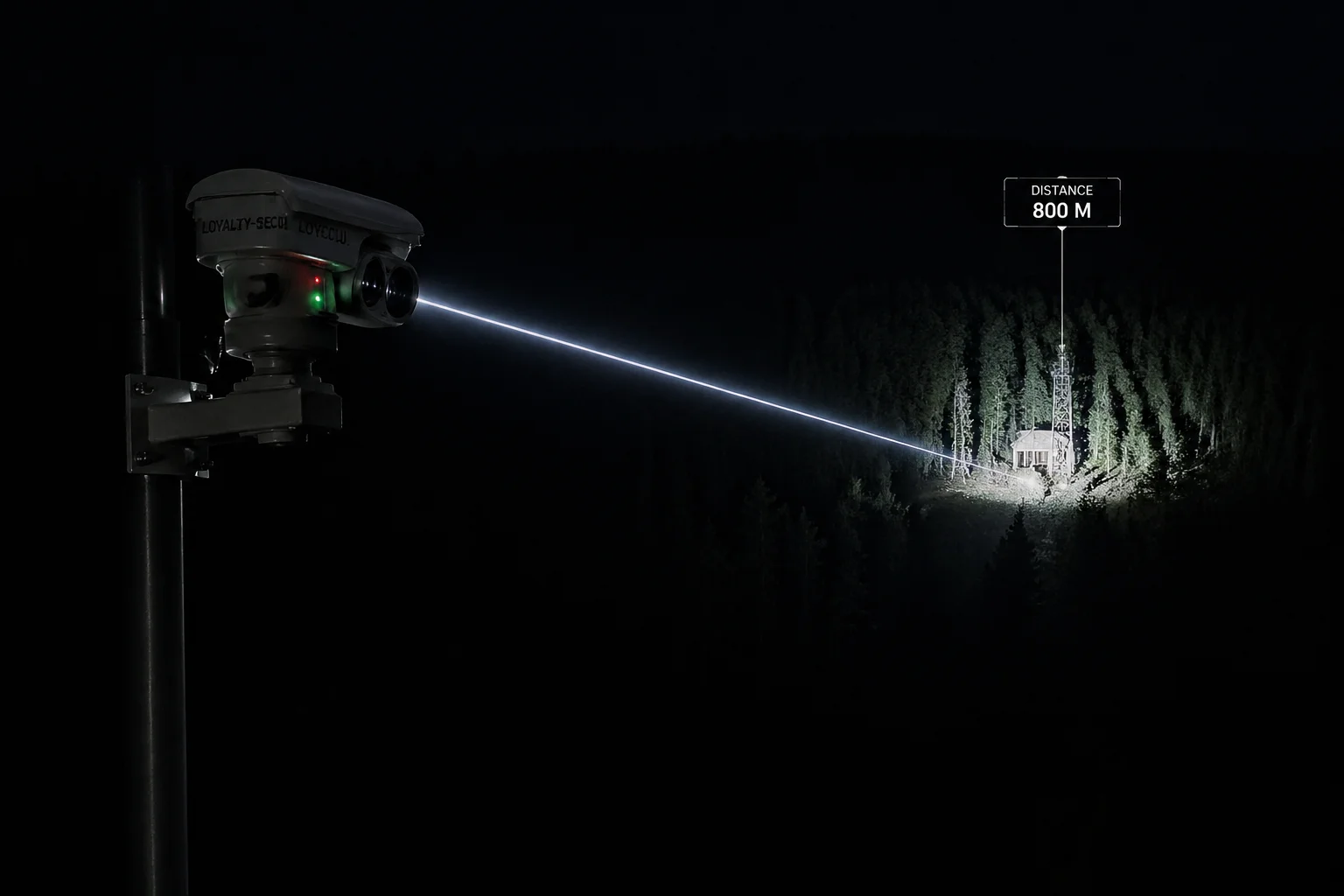
To maintain a clear image at night during full zoom, you need synchronized IR or laser illumination that narrows its beam angle to match the lens field of view. You also need a large image sensor (1/1.8″ or bigger) to capture more photons per pixel at the reduced aperture.
The Three Pillars of Night Performance at Full Zoom
There are three things that work together to give you a usable image at maximum zoom in the dark. I call them the three pillars.
Pillar 1: Synchronized Illumination
A good PTZ camera does not just have IR LEDs stuck on the front. It has IR or laser illumination that zooms with the lens. When the lens is at wide angle, the IR light spreads wide. When the lens zooms to tele, the IR beam narrows into a tight spotlight. This concentrates the infrared energy on the small area the camera is actually looking at. Without this, the IR light wastes its power lighting up areas outside the field of view.
At Loyalty-Secu, our long-range PTZ models use high-power laser illuminators 2 rated for 800 meters. The laser beam angle adjusts automatically as you zoom. This means at 40X zoom, all the laser energy is focused on the exact area the camera sees. This is the single biggest factor in getting a clear night image at full zoom.
Pillar 2: Sensor Size Matters
A larger sensor has bigger pixels. Bigger pixels collect more light. A 1/1.8″ sensor collects roughly 2X more light per pixel than a 1/2.8″ sensor, all else being equal. When your aperture drops to F4.8, every bit of extra light-gathering ability matters. I always recommend 1/1.8″ or larger sensors for any project that needs serious night performance at long range.
Pillar 3: Smart ISP Processing
Modern ISPs use temporal noise reduction (3D-DNR) and frame stacking to clean up noisy images. But these algorithms have limits. They work best when they have a reasonable signal to start with. If the image is too dark, no ISP can save it. So the ISP is the last line of defense, not the first.
What to Ask Your Supplier
When you talk to a Chinese PTZ manufacturer, ask these questions:
- What is the IR or laser illumination distance at maximum zoom?
- Does the IR beam angle synchronize with the lens zoom?
- What sensor size do you use?
- Can you provide real night sample footage at maximum zoom, not just wide angle?
If they cannot answer these questions clearly, move on.
Does My Camera’s Gain Control Compensate Effectively for Light Loss at High Zoom?
I have seen too many cameras that crank the gain to maximum and call it “starlight performance.” The result is a bright image full of noise that is completely useless for identification.
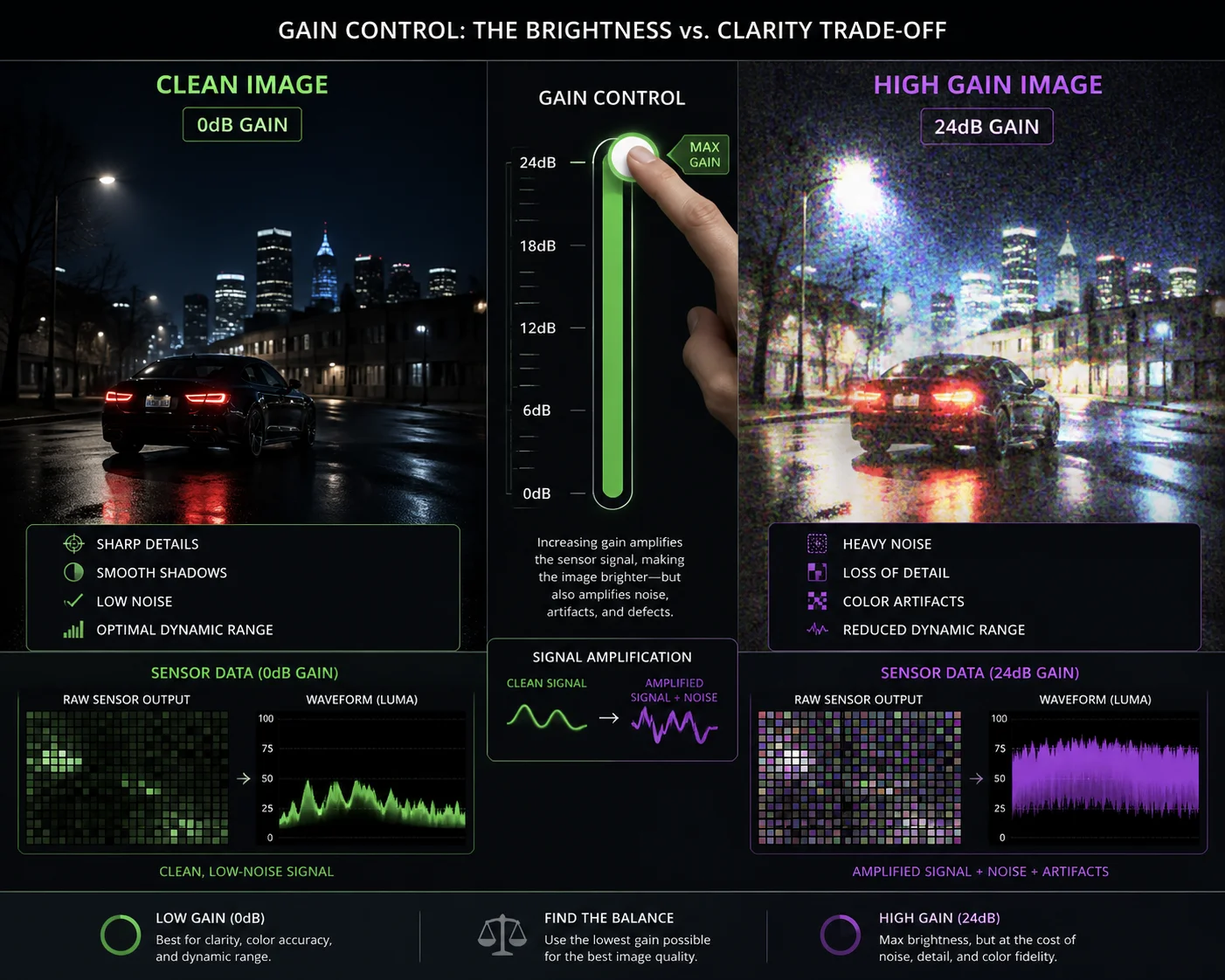
Gain control can partially compensate for light loss at high zoom, but it introduces noise that degrades image quality. Every 6 dB of gain roughly doubles the brightness but also doubles the visible noise. Beyond a certain point, the image becomes too noisy for useful identification or recording.
How Gain Works (and Where It Breaks Down)
Gain is electronic amplification. The sensor captures a weak signal, and the ISP multiplies it to make the image brighter. This is similar to turning up the volume on a radio. If the original signal is clean, turning up the volume works fine. But if there is static, turning up the volume makes the static louder too.
In camera terms, the “static” is sensor noise. Every image sensor has a noise floor. When the light level drops at full zoom, the actual image signal gets closer to this noise floor. Adding gain amplifies both the signal and the noise equally. The result is a bright but grainy image.
The Gain vs. Image Quality Trade-Off
| Gain Level | Brightness Boost | Noise Level | Usability for ID |
|---|---|---|---|
| 0 dB (base) | 1X | Low | Excellent |
| 6 dB | 2X | Moderate | Good |
| 12 dB | 4X | High | Fair |
| 18 dB | 8X | Very High | Poor |
| 24 dB+ | 16X+ | Extreme | Unusable |
At the telephoto end with F4.8, the camera has already lost about 3 stops of light. To compensate, the AGC (Automatic Gain Control) needs to add roughly 9 dB of gain just to match the wide-end brightness. That pushes you into the “High noise” zone before you even account for the low ambient light at night.
Why “Starlight” Specs Can Be Misleading
Many Chinese manufacturers advertise “0.001 lux starlight” performance. But this number is measured at the wide-angle end with maximum gain and slow shutter. At full zoom with F4.8, the effective minimum illumination is 5–8 times worse. So that “0.001 lux” camera actually needs about 0.005–0.008 lux at maximum zoom to produce the same image quality. This is still impressive, but it is not what the headline number suggests.
What I Recommend to My Clients
I always tell clients like David: “Do not trust the minimum illumination spec alone. Ask for the spec at the telephoto end specifically. And always request night sample video at full zoom.” At Loyalty-Secu, we provide separate minimum illumination figures for both the wide end and the tele end. We also share real night footage shot at maximum zoom so our clients can judge the image quality for themselves before ordering. This transparency saves everyone time and avoids project failures.
The Role of Slow Shutter
Some cameras use slow shutter (also called long exposure) to gather more light. This works for static scenes. But if your target is a moving vehicle or a walking person, slow shutter creates motion blur. For security applications, I generally recommend keeping the shutter speed at 1/30s or faster. Anything slower than that, and you lose the ability to capture faces or license plates in motion. This means you cannot rely on slow shutter to fix the aperture drop problem. You need real optical solutions: better glass, bigger sensors, and proper IR illumination.
Conclusion
Always check the tele-end aperture, not just the wide-end number. Pair your PTZ with synchronized IR illumination and a large sensor for real night performance at maximum zoom.
1. Aspherical lens design for improved telephoto light transmission. ↩︎ 2. Loyalty-Secu laser PTZ for synchronized illumination at range. ↩︎ 3. Entrance pupil and F-number relationship in zoom lenses. ↩︎ 4. AGC gain noise penalty in low-light imaging. ↩︎ 5. 1/1.8″ vs 1/2.8″ sensor pixel size comparison. ↩︎ 6. 3D-DNR temporal noise reduction at high gain levels. ↩︎ 7. Minimum illumination spec interpretation at telephoto end. ↩︎ 8. Laser illumination beam angle synchronization with PTZ zoom. ↩︎ 9. Motion blur limitations at shutter speeds below 1/30s. ↩︎ 10. Optical glass coatings for improved transmission at telephoto. ↩︎