
I’ve watched too many integrators lose money because their cameras “worked great” in demos but failed at night on real job sites.
In full daylight, a quality PTZ camera can trigger on a human at 100–150m. Switch to IR mode in total darkness, and that drops to 30–80m. But with a laser illuminator, you can push night detection back out to 200–300m or more, closing the gap with daytime performance.
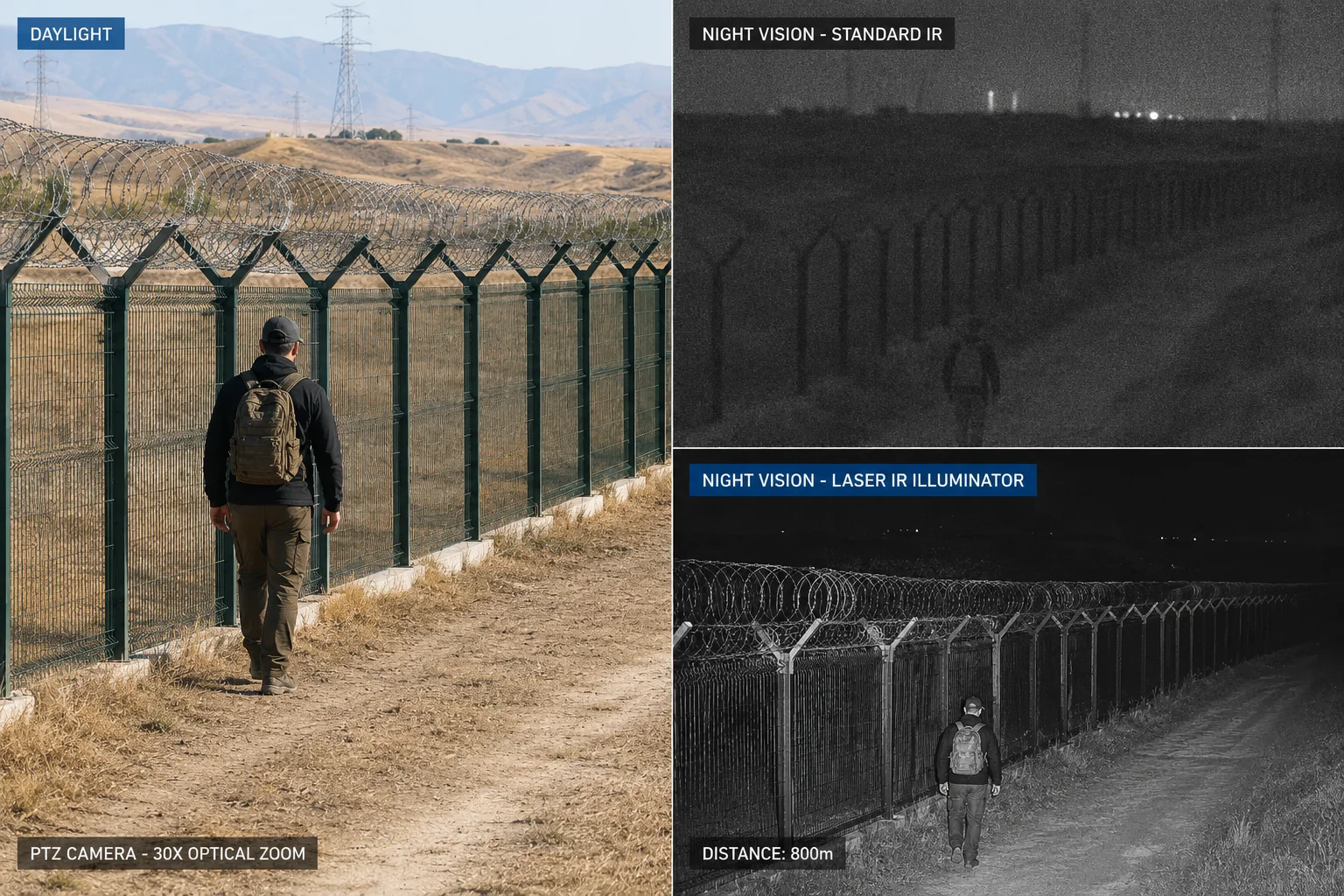
Below, I break down exactly why these numbers shift so much, what physics drive the difference, and how to pick the right mode for your project. Let’s get into it.
Table of Contents
Will the AI Detect a Human at 500m in Daylight but Only 300m Under Laser Illumination?
I get this question a lot from integrators planning perimeter jobs. They see “500m detection” on a spec sheet and assume it works the same at night.
In daylight, AI detection at 500m is possible with a 40X optical zoom and good contrast. Under laser illumination, expect reliable AI triggering closer to 200–300m. The gap exists because even focused laser light cannot fully replicate the rich contrast of natural sunlight.
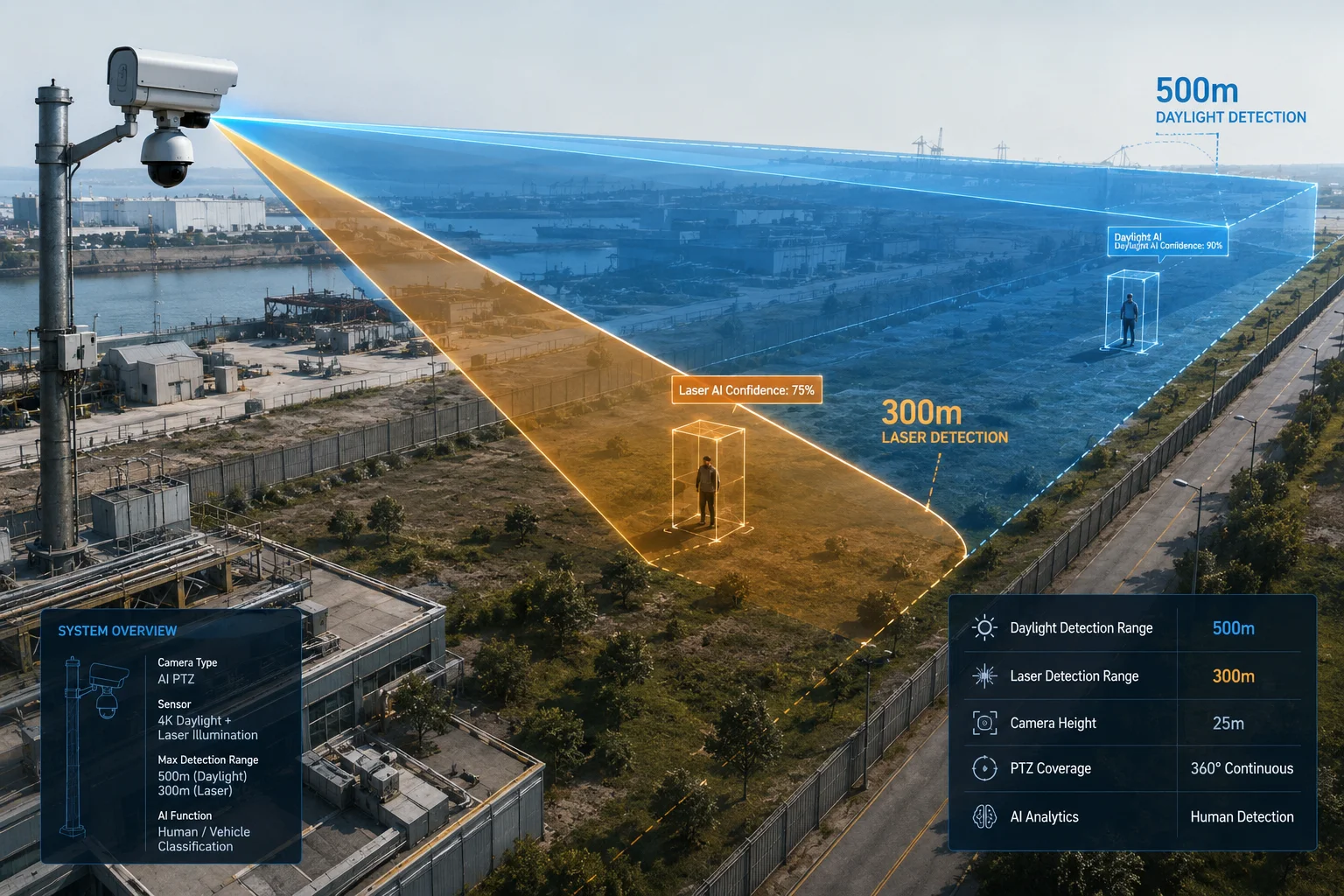
Why Daylight Always Wins on Raw Distance
During the day, your sensor captures the full visible spectrum. That means color differences, shadow edges, and texture details all feed the AI algorithm. A person wearing a dark jacket against a sandy background is easy to pick out, even at extreme range.
At night with laser, you lose all color data. The image becomes monochrome. The AI must rely only on shape, motion, and brightness contrast against the background. This is harder work for the algorithm.
The Physics Behind the Gap
| Factor | Daylight | Laser (Night) |
|---|---|---|
| Light source | Sun (unlimited power) | Laser module (finite watts) |
| Spectrum | Full visible (400–700nm) | Single wavelength (~808nm or 940nm) |
| Contrast type | Color + luminance | Luminance only |
| Background detail | Rich | Flat, low detail |
| AI confidence at 400m | High (85%+) | Medium (60–75%) |
What “Detection” Actually Means in Practice
There is a big difference between “the camera can see something” and “the AI can confirm it is a human.” At 500m in daylight, a 40X optical zoom1 fills enough pixels with the human body for the algorithm to classify it. Under laser at the same distance, the target may only reflect enough light to appear as a bright blob — not enough shape data for the AI to say “that is a person.”
How to Close the Gap
To push laser-mode detection closer to daylight performance, you need three things working together:
- High-power laser module — at least 3W output for 500m+ illumination.
- Zoom-linked beam control — the laser narrows its angle as you zoom in, concentrating energy on the target.
- Lowered AI threshold — but this increases false alarm risk, so it must be balanced carefully.
In my experience, a well-configured system with our 800m laser module can reliably trigger AI at 300m in total darkness. That is roughly 60% of its daylight capability. For most perimeter projects, this is more than enough.
How Does the “Infrared Reflection” from Clothing Impact the AI’s Night Vision Recognition Rate?
This one catches people off guard. I’ve seen systems miss targets completely because of what the person was wearing.
Clothing material and color dramatically affect IR reflection. Dark cotton absorbs NIR light and makes a person nearly invisible to IR cameras beyond 50m. Synthetic fabrics and lighter colors reflect more IR energy, boosting recognition rates by 20–40% at the same distance.
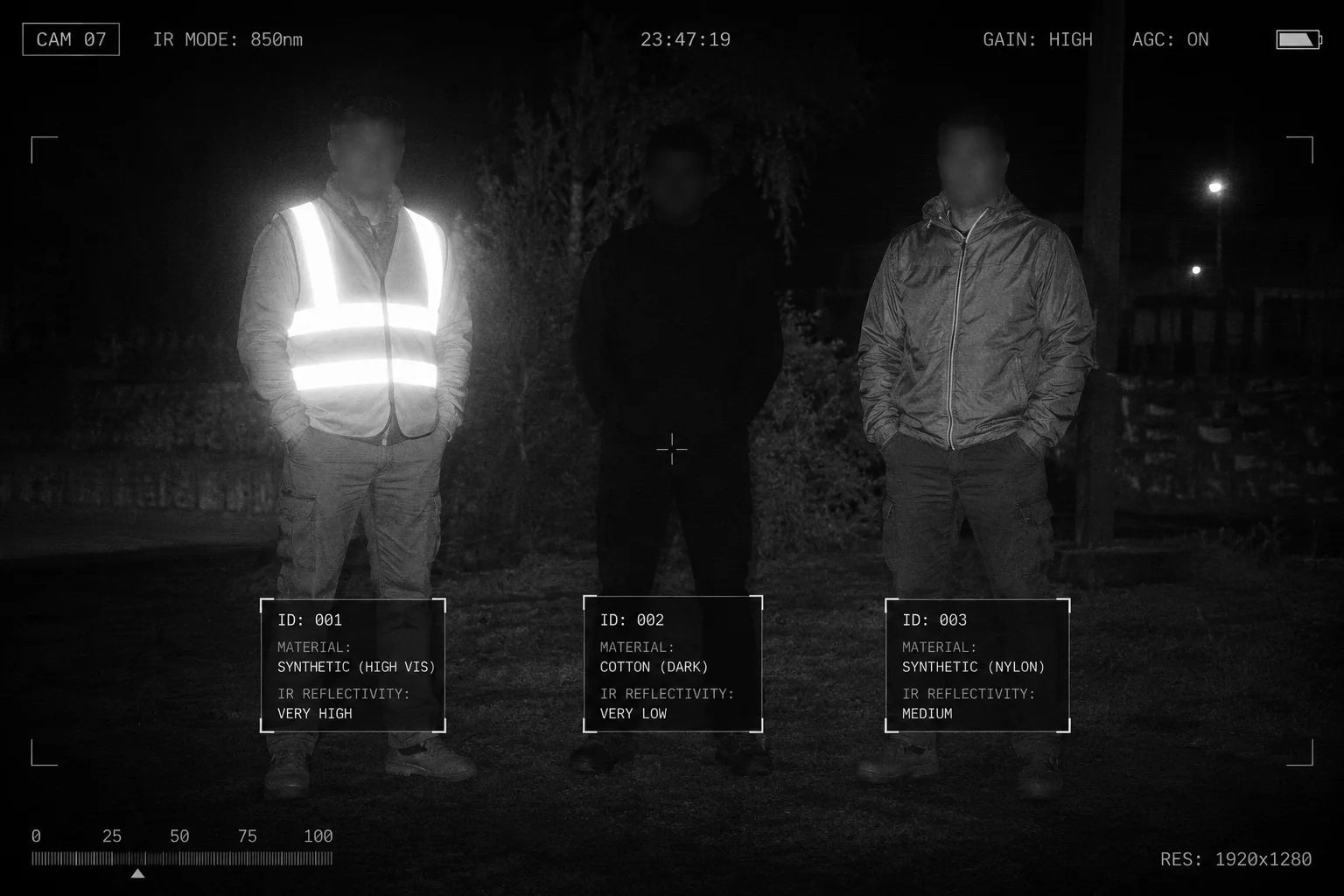
Why Fabric Matters More Than You Think
In visible light, a black shirt looks dark and a white shirt looks bright. Simple. But in near-infrared (NIR)4, the rules change. Some black synthetic fabrics actually reflect NIR strongly. Some white cotton fabrics absorb it. The camera does not see “color” at night — it sees reflectivity at 850nm or 940nm.
Reflectivity by Material Type
| Clothing Type | NIR Reflectivity (850nm) | Effect on Detection |
|---|---|---|
| White polyester | High (70–85%) | Strong return signal, easy detection |
| Black nylon jacket | Medium-High (50–70%) | Surprisingly visible in IR |
| Dark cotton | Low (15–30%) | Very hard to detect beyond 50m |
| Denim (blue jeans) | Medium (40–55%) | Moderate detection reliability |
| Military IR-suppressed fabric | Very Low (<10%) | Nearly invisible to IR |
Real-World Impact on Your Projects
For a construction site or farm, workers usually wear high-vis vests made of synthetic material. These reflect IR very well. Your trigger distance stays close to maximum.
But for a perimeter security job where you are trying to detect intruders — people who may wear dark, natural-fiber clothing on purpose — your effective trigger distance can drop by 30–50%.
What This Means for System Design
When I spec a system for a client, I always ask: “Who are you trying to detect, and what are they likely wearing?”
For industrial sites with uniformed workers, standard IR works fine. For security applications where targets may be wearing low-reflectivity clothing, I recommend:
- Switching to laser mode for distances beyond 60m
- Using thermal imaging6 as a complementary trigger source
- Setting the AI to motion-priority mode rather than shape-priority mode
The combination of laser illumination and smart algorithm tuning can recover most of the lost performance. But you need to plan for it during system design, not after installation.
Can the 800m Laser Module Provide Enough Contrast for AI Identification at Its Maximum Range?
I’ll be honest — “800m” on a laser spec sheet does not mean “800m AI detection.” I’ve tested this extensively.
An 800m-rated laser module can illuminate a human target at that range, but AI identification typically maxes out at 300–400m. Beyond that, the returned light is too weak for the algorithm to extract enough body-shape data for confident classification.
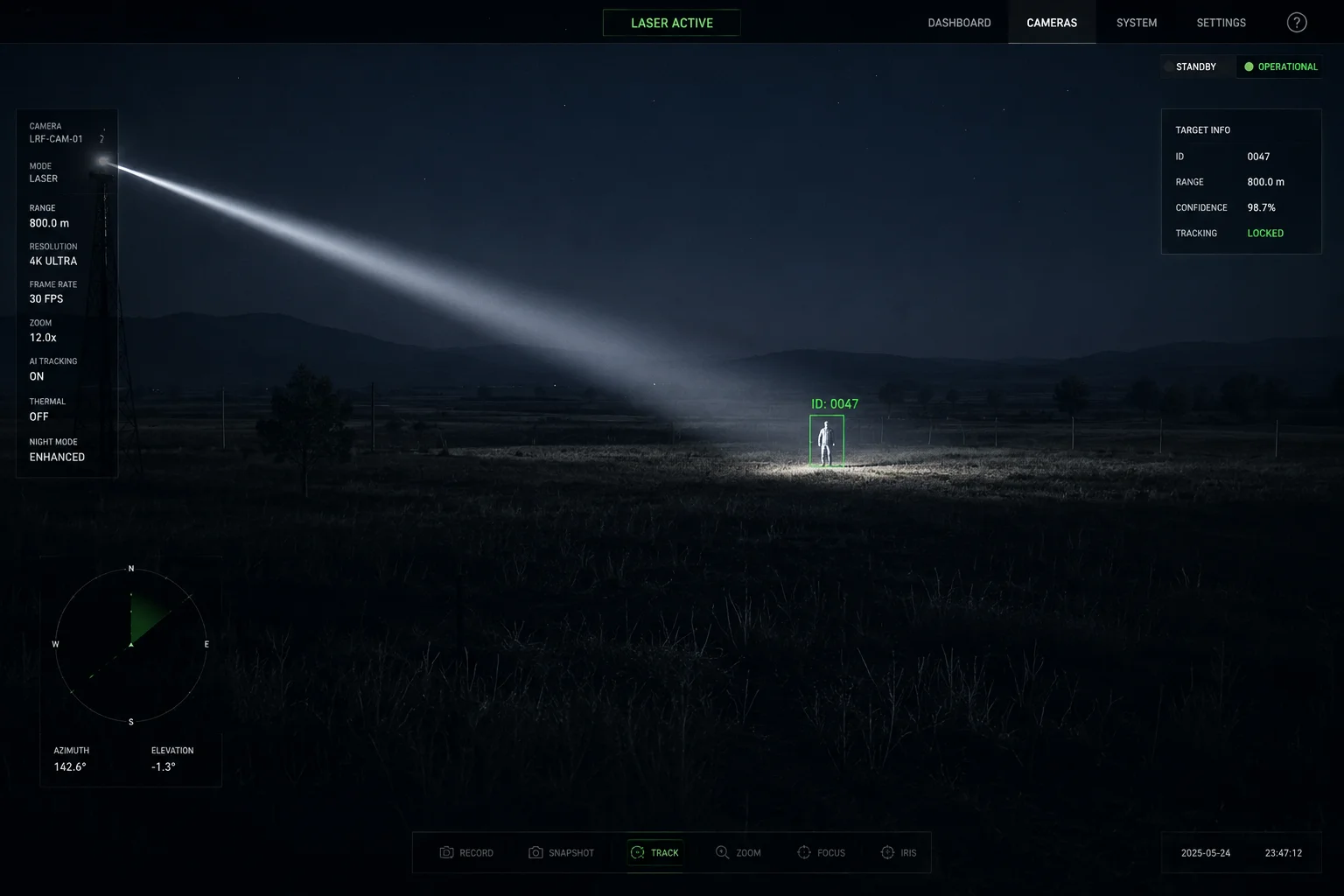
Understanding the “800m” Rating
When we rate a laser module at 800m, that means the beam can reach 800m and produce a visible image on the sensor. You will see something on screen. But “seeing something” and “AI confirming it is a human” are two different standards.
The Inverse Square Law Problem
Even with a highly focused laser beam, the light that bounces off the target and returns to the camera follows the inverse square law2. Double the distance, and you get roughly one-quarter the return signal. At 800m, the return is extremely weak.
Distance vs. AI Confidence Breakdown
Here is what I typically see in field testing with our 800m laser module on a 40X PTZ:
| Distance | Image Quality | AI Human Detection | Practical Use |
|---|---|---|---|
| 0–100m | Excellent, risk of overexposure | 95%+ confidence | Use Smart IR5 to prevent face washout |
| 100–200m | Very good, clear body outline | 90%+ confidence | Ideal operating range |
| 200–400m | Good, visible silhouette | 75–85% confidence | Reliable with proper settings |
| 400–600m | Fair, shape visible but soft | 50–65% confidence | Motion detection only recommended |
| 600–800m | Marginal, blob visible | Below 40% confidence | Visual verification only, not AI trigger |
How to Maximize Useful Range
Three factors determine how much of that 800m you can actually use for AI triggering:
Beam Angle Synchronization
Our system links the laser beam angle to the zoom level. At 40X, the beam narrows to under 1°, concentrating all energy on a small area. This is critical. A wide beam at long range wastes most of its power illuminating empty ground.
Sensor Sensitivity
The camera sensor’s quantum efficiency3 at the laser wavelength matters enormously. Our sensors are optimized for 808nm response, which means they convert more of the returned photons into usable signal.
Algorithm Tuning for Low-Light Conditions
At extended range, I recommend enabling the “low contrast enhancement” mode in the AI engine. This tells the algorithm to accept lower confidence thresholds for initial detection, then use motion tracking to confirm the target over multiple frames. It adds 1–2 seconds of latency to the alert, but extends reliable trigger distance by 50–100m.
The bottom line: plan your project around 300m AI trigger distance at night with an 800m laser. Anything beyond that is a bonus, not a guarantee.
Does the Sensor’s “Near-Infrared” (NIR) Sensitivity Boost the Night Detection Distance?
I’ve had clients ask me why two cameras with the same laser module perform so differently at night. The answer is almost always the sensor.
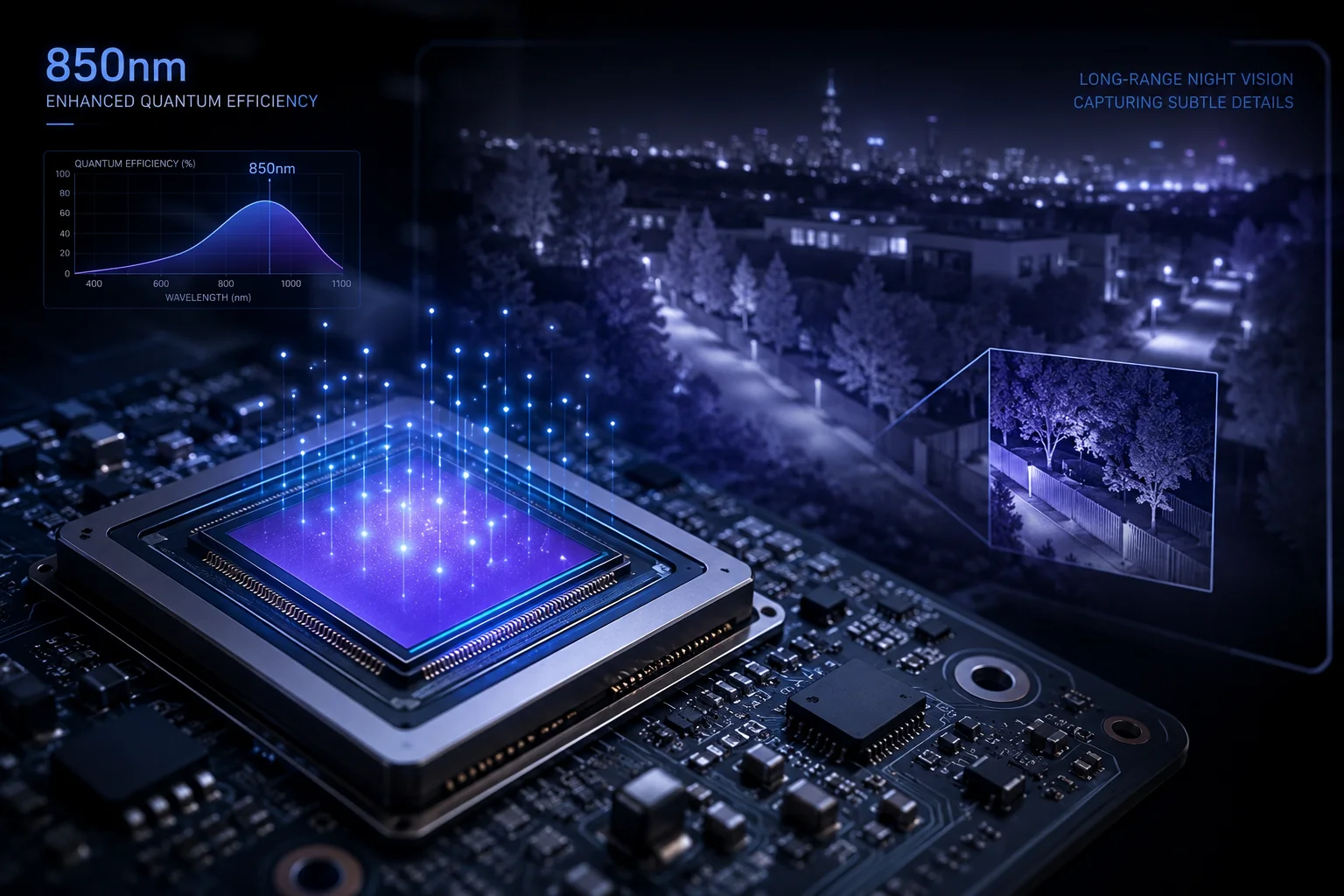
Yes, a sensor with enhanced NIR sensitivity at 850nm can boost night detection distance by 20–30% compared to a standard sensor. This is because it converts more of the weak returned IR photons into usable image data, giving the AI more to work with.
What NIR Sensitivity Actually Means
Every image sensor has a spectral response curve. It tells you how efficiently the sensor converts photons at each wavelength into electrical signal. Standard sensors are optimized for visible light (400–650nm). Their efficiency drops sharply above 700nm.
An NIR-enhanced sensor maintains higher quantum efficiency (QE) out to 850nm or even 940nm. This means when your IR LEDs or laser send out 850nm light and it bounces back, the sensor captures more of it.
The Practical Difference
Think of it this way: if a standard sensor captures 30% of returned 850nm photons, and an NIR-enhanced sensor captures 50%, you get roughly 67% more signal from the same scene. That extra signal translates directly into:
- Better contrast between the target and background
- Lower image noise at the same gain setting
- More pixels with usable data for the AI to analyze
How This Translates to Distance
In my testing, switching from a standard 1/2.8″ sensor to an NIR-optimized 1/1.8″ sensor (with the same laser module) extended reliable AI trigger distance from approximately 200m to 260–280m. That is a meaningful improvement for perimeter projects.
Sensor Size Also Matters
Larger sensors collect more light per pixel. A 1/1.8″ sensor has roughly 60% more surface area than a 1/2.8″ sensor. Combined with NIR optimization, this creates a compounding effect:
- More photons hit the sensor (larger area)
- More of those photons get converted to signal (higher NIR QE)
- Result: significantly cleaner image at long range
What to Look for When Specifying a System
When you are evaluating PTZ cameras8 for long-range night detection, ask the manufacturer these questions:
- What is the sensor’s QE at 850nm? (Look for >40%)
- What sensor format are they using? (1/1.8″ or larger is preferred for laser applications)
- Is the IR-cut filter optimized for dual-band operation? (It should pass 850nm cleanly when switched to night mode)
These details rarely appear on a standard spec sheet. But they make the difference between a system that works on paper and one that works in the field at 2 AM when it matters.
Our cameras use NIR-optimized Sony STARVIS7 sensors specifically selected for high QE at 808–850nm. Combined with our 800m laser module and zoom-linked beam control, this gives integrators the best possible night trigger distance without oversizing the laser or inflating project cost.
Conclusion
Daylight trigger distance will always lead, but a properly configured laser system with an NIR-optimized sensor closes the gap to within 60–70% of daytime performance — making reliable 200–300m night detection a realistic, field-proven standard for your projects.
1. Optical zoom uses lens movement to magnify the image without losing resolution, allowing detailed views of distant objects. ↩︎ 2. The inverse square law describes how light intensity diminishes proportionally to the square of the distance from the source. ↩︎ 3. Quantum efficiency (QE) is the percentage of incident photons that a sensor converts into electrical signal, critical for low-light performance. ↩︎ 4. Near-infrared (NIR) is a wavelength range just beyond visible light, commonly used in night vision cameras and remote controls. ↩︎ 5. Smart IR is a feature that adjusts infrared LED intensity to prevent overexposure of nearby objects in night vision mode. ↩︎ 6. Thermal imaging detects heat radiation rather than visible light, making it useful for detecting humans regardless of lighting conditions. ↩︎ 7. Sony STARVIS is a back-illuminated CMOS sensor technology with enhanced near-infrared sensitivity for superior low-light video. ↩︎ 8. PTZ stands for pan-tilt-zoom, a camera type that can move horizontally, vertically, and zoom in on distant subjects. ↩︎