
I’ve seen too many “HD glass lens” claims fall apart — literally — after one Texas summer. If you’ve been burned by blurry footage from a camera that worked fine in the factory, you’re not alone.
You can tell if your supplier uses all-glass lenses or plastic hybrids by checking the lens datasheet for “G” and “P” markings (e.g., 6G means all-glass, 2G4P means plastic-glass hybrid), running a heat focus-shift test, and requesting a full BOM with lens material breakdown before signing any contract.
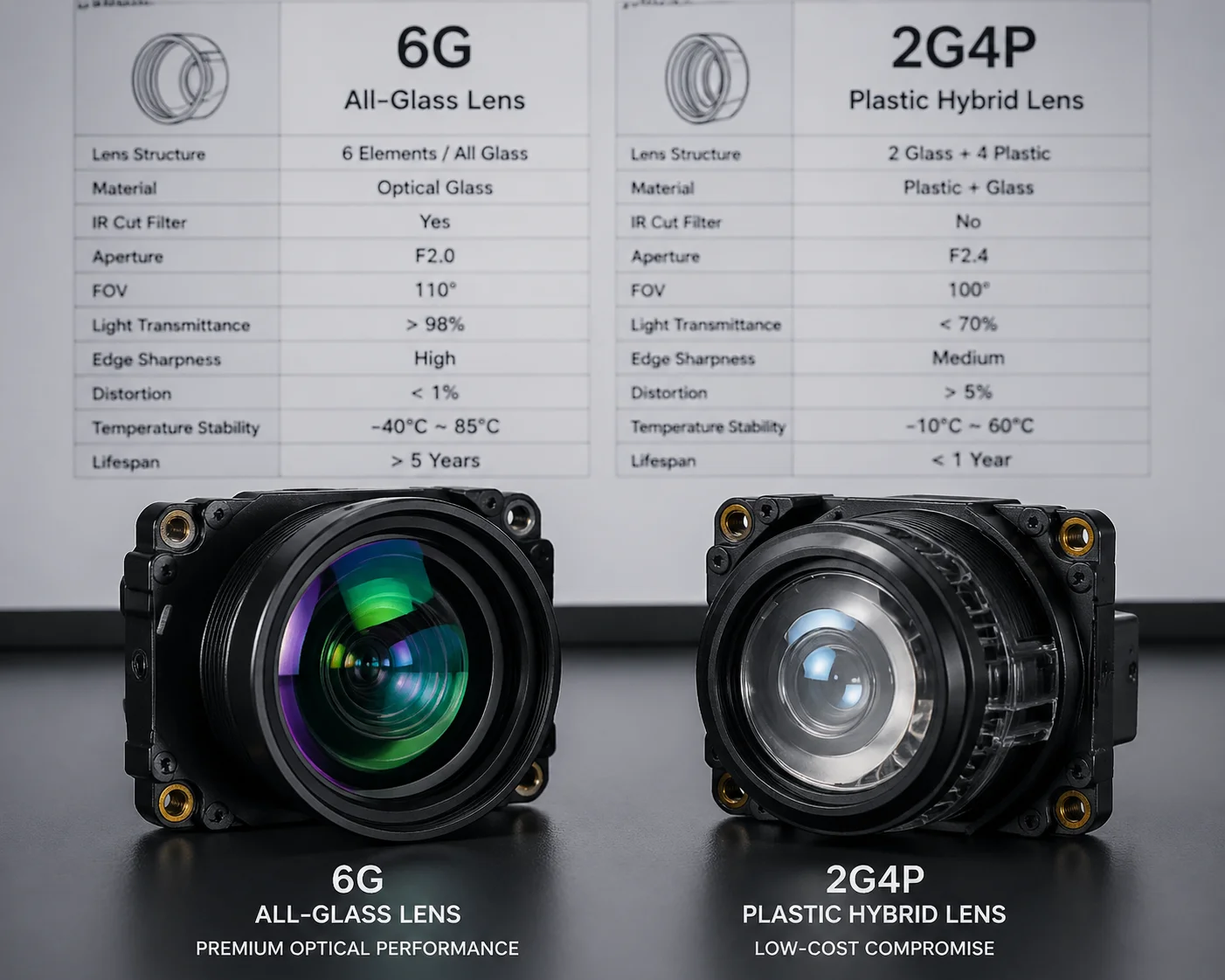
Below, I’ll walk you through the exact methods I use — and recommend to my clients — to verify lens material before you commit to a bulk order. These are practical, field-tested approaches. No guesswork.
Table of Contents
Will a Plastic Hybrid Lens Warp or Lose Focus Under the Intense Texas Summer Heat?
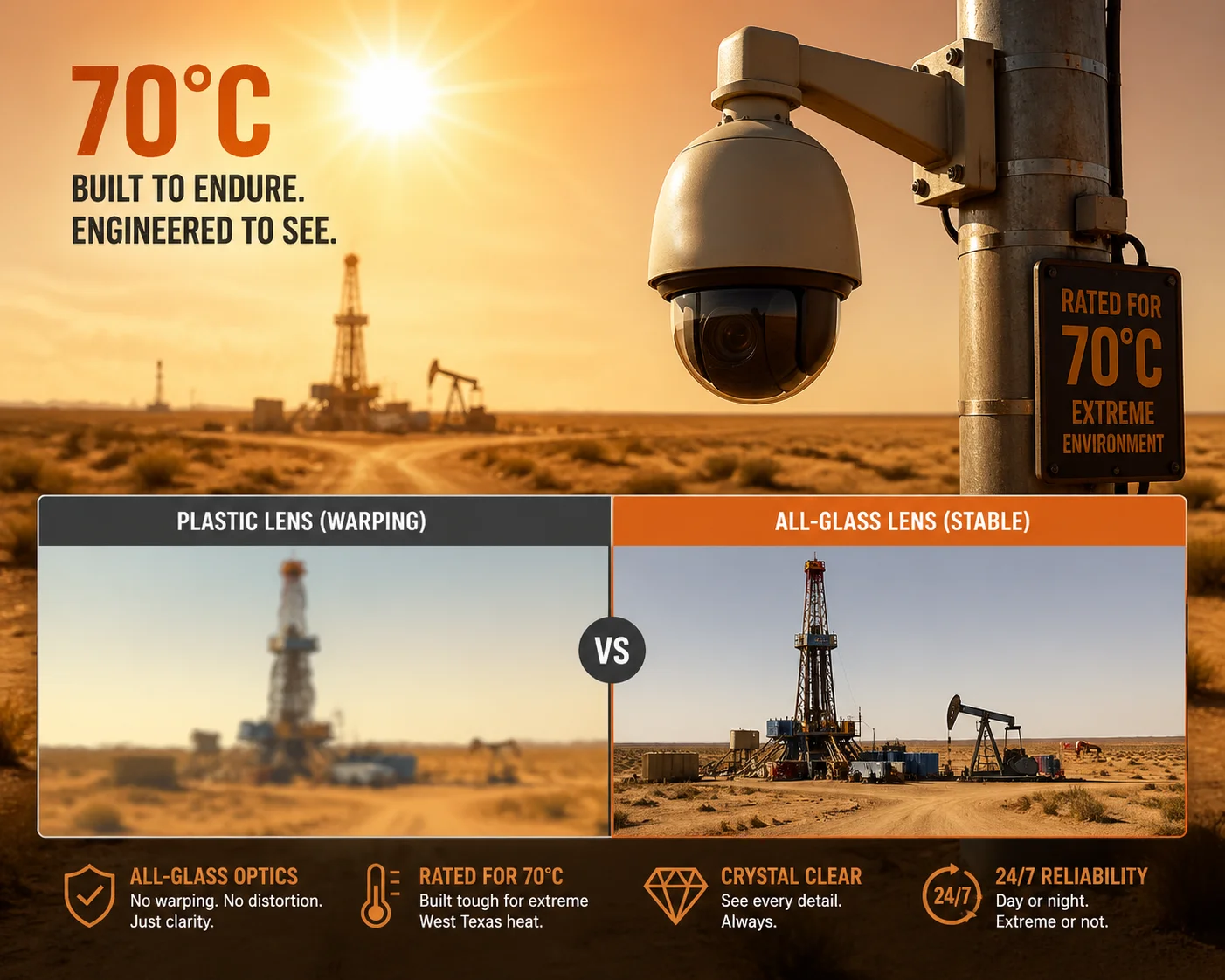
I had a client in West Texas who called me furious. His PTZ cameras were sharp in January. By July, every single unit looked like it was shooting through a dirty window. The culprit? Plastic lens elements expanding in the heat.
Yes, plastic hybrid lenses will warp and lose focus under intense heat. Plastic elements have a high thermal expansion rate, which causes the focal length to shift as temperatures rise. In environments like Texas summers — where surface temperatures can exceed 70°C — this leads to visible defocus, image softening, and unreliable surveillance footage.
Why Heat Destroys Plastic Lenses
The core issue is simple physics. Plastic and glass respond to heat very differently. When temperature goes up, plastic expands much more than glass. This changes the shape of the lens element. Even a tiny change — we’re talking microns — shifts the focal point. Your image goes soft.
Here’s a side-by-side comparison:
| Property | All-Glass Lens | Plastic-Glass Hybrid |
|---|---|---|
| Thermal expansion coefficient | Very low (~7 × 10⁻⁶/°C) | High (~60–70 × 10⁻⁶/°C) |
| Focus shift at 60°C | Negligible | Visible defocus |
| Refractive index stability | Stable across temp range | Shifts with temperature |
| Long-term UV resistance | Excellent | Yellowing after 1–2 years |
| Typical use case | Outdoor, industrial, long-range | Indoor, budget consumer |
How to Run a Focus Shift Test Yourself
This is the most reliable hands-on test you can do without any lab equipment. Here’s my method:
- Set up the PTZ camera indoors at room temperature (around 22°C). Focus on a resolution test chart or a printed checkerboard pattern. Take a screenshot.
- Move the camera to a hot environment. You can use a climate chamber if you have access. If not, place it in direct sunlight on a rooftop or use a heat gun to warm the lens barrel to around 55–60°C. Do not melt anything — just warm it up.
- Wait 15–20 minutes. Let the lens elements reach thermal equilibrium.
- Take another screenshot of the same target at the same zoom and focus settings.
- Compare the two images. If the second image is noticeably softer — especially at the edges — you’re looking at plastic elements shifting under heat.
An all-glass lens will hold its focus. The image will look nearly identical at both temperatures. A plastic hybrid will show clear degradation. I’ve done this test dozens of times with clients during sample evaluation. It takes less than an hour and saves you from a very expensive mistake.
The Real-World Cost of Ignoring This
For someone like David — deploying cameras on remote oil sites or construction yards in the American Southwest — a defocused camera is not just an annoyance. It’s a failed project. If the camera can’t read a license plate at 200 meters in August, the entire system fails its acceptance test. That means rework, truck rolls, and sometimes contract penalties. All because someone saved $3 per unit on a plastic lens.
How Can I Check for Lens Flare or Chromatic Aberration That Indicates Poor Lens Quality?
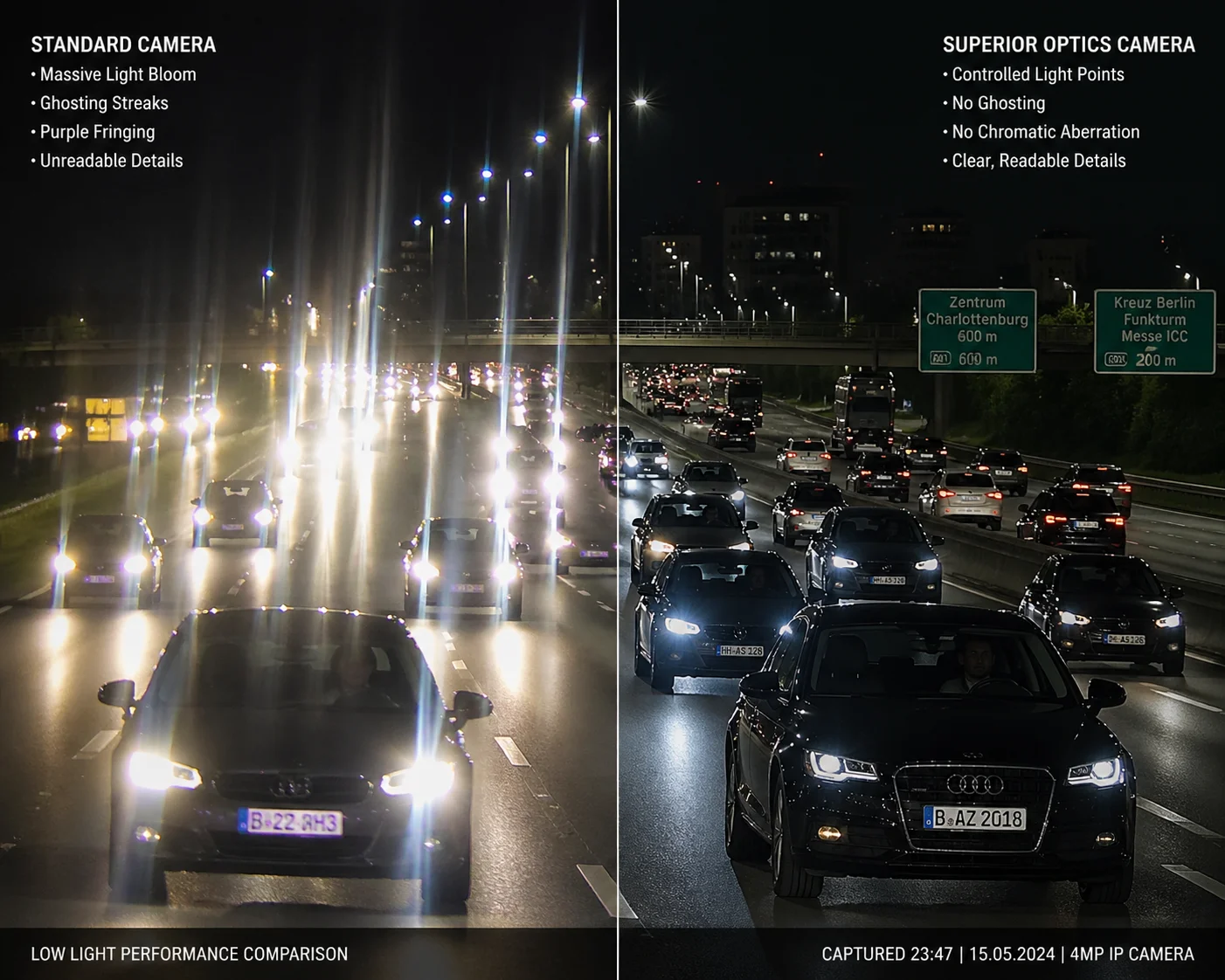
I used to think lens flare was just a cosmetic issue. Then a client sent me night footage from a highway project. Every headlight turned into a massive white blob that wiped out two lanes of detail. That’s not cosmetic. That’s a system failure.
You can check for lens flare and chromatic aberration by shooting test footage with strong point light sources — like streetlights or car headlights — and examining the edges of high-contrast objects for purple or green fringing. Poor-quality plastic lenses produce more flare, ghosting, and color fringing than properly coated all-glass optics.
What Chromatic Aberration Looks Like
Chromatic aberration 1 (CA) happens when a lens fails to focus all colors of light onto the same point. You see it as colored fringes — usually purple or green — along the edges of high-contrast objects. A tree branch against a bright sky. A white license plate against a dark car. The edge of a building against the sun.
Plastic lens elements are worse at controlling CA because their optical dispersion properties are less refined than glass. Glass manufacturers can choose from dozens of specialized glass types — like ED (Extra-low Dispersion) glass 2 — to correct for this. Plastic doesn’t offer that range.
How to Test for Flare and CA
Here’s my practical testing protocol:
-
Daytime CA test: Point the camera at a high-contrast scene. A black-and-white printed chart works well. Zoom in to the edges of the frame. Look for purple or green color bleeding along sharp edges. Take screenshots at multiple zoom levels — especially at the telephoto end, where CA gets worse.
-
Nighttime flare test: Point the camera at a street with active traffic. Watch how the camera handles headlights and streetlamps. With a good all-glass lens, you’ll see tight, controlled light points. With a plastic hybrid, you’ll see large halos, streaks, or a general “washing out” of the area around each light source.
-
Coating inspection: Hold the lens under a bright light and look at the front element from an angle. High-quality all-glass lenses have multi-layer anti-reflective (AR) coatings that show deep green, purple, or amber reflections. Plastic elements can’t survive the high-temperature vacuum deposition process used for premium AR coatings. So their reflections look pale, whitish, or uneven.
Why This Matters for Your Projects
| Scenario | All-Glass Lens Performance | Plastic Hybrid Performance |
|---|---|---|
| Highway LPR at night | Clean plate capture, minimal flare | Plates washed out by headlight bloom |
| Perimeter fence at dusk | Sharp edges, accurate color | Purple fringing on fence lines |
| Construction site with spotlights | Controlled highlights | Ghost images and veiling glare |
| Solar farm monitoring | Consistent clarity | Degraded contrast from internal reflections |
If you’re bidding on a government or enterprise project, image quality isn’t optional. A system integrator who delivers blurry, flare-ridden footage will not get the next contract. I always tell my clients: test under the worst conditions first. If the camera passes a nighttime highway test, it’ll handle everything else.
The Coating Connection
One more thing worth knowing. The reason all-glass lenses handle flare better isn’t just the glass itself — it’s the coatings. Multi-layer AR coatings 3 reduce internal reflections between lens elements. Each reflection creates a ghost image or reduces contrast. Glass can handle the 300°C+ temperatures needed for vacuum-deposited coatings. Plastic cannot. So even if a plastic element has some coating, it’s usually a lower-quality dip coating or spray coating that doesn’t perform as well. This is why, when you look at a premium all-glass lens from the side, you see those deep, rich colored reflections. That’s your visual confirmation of proper AR coating — and by extension, glass elements.
Can I Request a “Glass-Only” Lens Specification for My High-End Industrial Projects?
I’ve had clients ask me this question almost word for word. The answer surprised some of them — not because it’s complicated, but because most people don’t realize they have the right to demand it.
Yes, you absolutely can — and should — request a “Glass-Only” lens specification for high-end industrial projects. At Loyalty-Secu, we support this as a standard practice. You should require the lens construction (e.g., 6G or 8G) to be written into your purchase contract, BOM, and technical agreement before any production begins.

How to Lock Down Lens Material in Your Contract
Asking for all-glass is easy. Making sure you actually get it — that’s where process matters. Here’s the step-by-step approach I recommend to every serious buyer:
Step 1: Write It Into Your RFQ
At the inquiry stage, don’t just say “I want good image quality.” Be specific. Write something like:
“Lens requirement: minimum 6G all-glass construction. No plastic elements (P) permitted. Lens structure and supplier must be disclosed in the quotation.”
This forces the supplier to commit on paper before you even start sampling.
Step 2: Demand the Lens Datasheet
Every reputable lens module manufacturer — Sunny Optical, Largan, Fujifilm, etc. — publishes datasheets that clearly state the G/P construction. Ask your camera supplier to provide:
- The lens module brand and model number
- The original datasheet showing lens construction (e.g., 6G, 8G, 4G2P)
- The MTF (Modulation Transfer Function) 4 curve
If a supplier says “we use high-quality optical glass” but refuses to share the lens model or datasheet, that’s a red flag. Walk away.
Step 3: Add a Material Compliance Clause
In your purchase order or contract, include a clause like:
“If the lens material in mass production units differs from the approved sample BOM, the buyer reserves the right to reject the shipment and claim damages.”
This gives you legal protection and raises the cost of cheating for the supplier.
Step 4: Verify During Pre-Shipment Inspection
Before the container ships, pull random samples and verify:
- The lens module model number matches the approved BOM
- The weight of the lens module is consistent with all-glass construction
- A quick focus-shift test shows thermal stability
You can do this yourself or hire a third-party inspection company. Just make sure “lens material verification” is on the inspection checklist.
Why Most Suppliers Won’t Push Back
Here’s something many buyers don’t realize: most mid-to-high-end PTZ manufacturers already use all-glass lenses in their better product lines. The cost difference between a 6G lens and a 2G4P lens might be $2–$5 per unit at scale. For a camera that sells for $200–$500, that’s a small percentage. The suppliers who resist disclosing lens material are usually the ones cutting corners. A factory like ours — where we control the R&D and the supply chain — has no reason to hide what’s inside. We want you to know, because it proves the value.
How Does the Light Transmission Rate of Your Lenses Compare to Premium Brands?
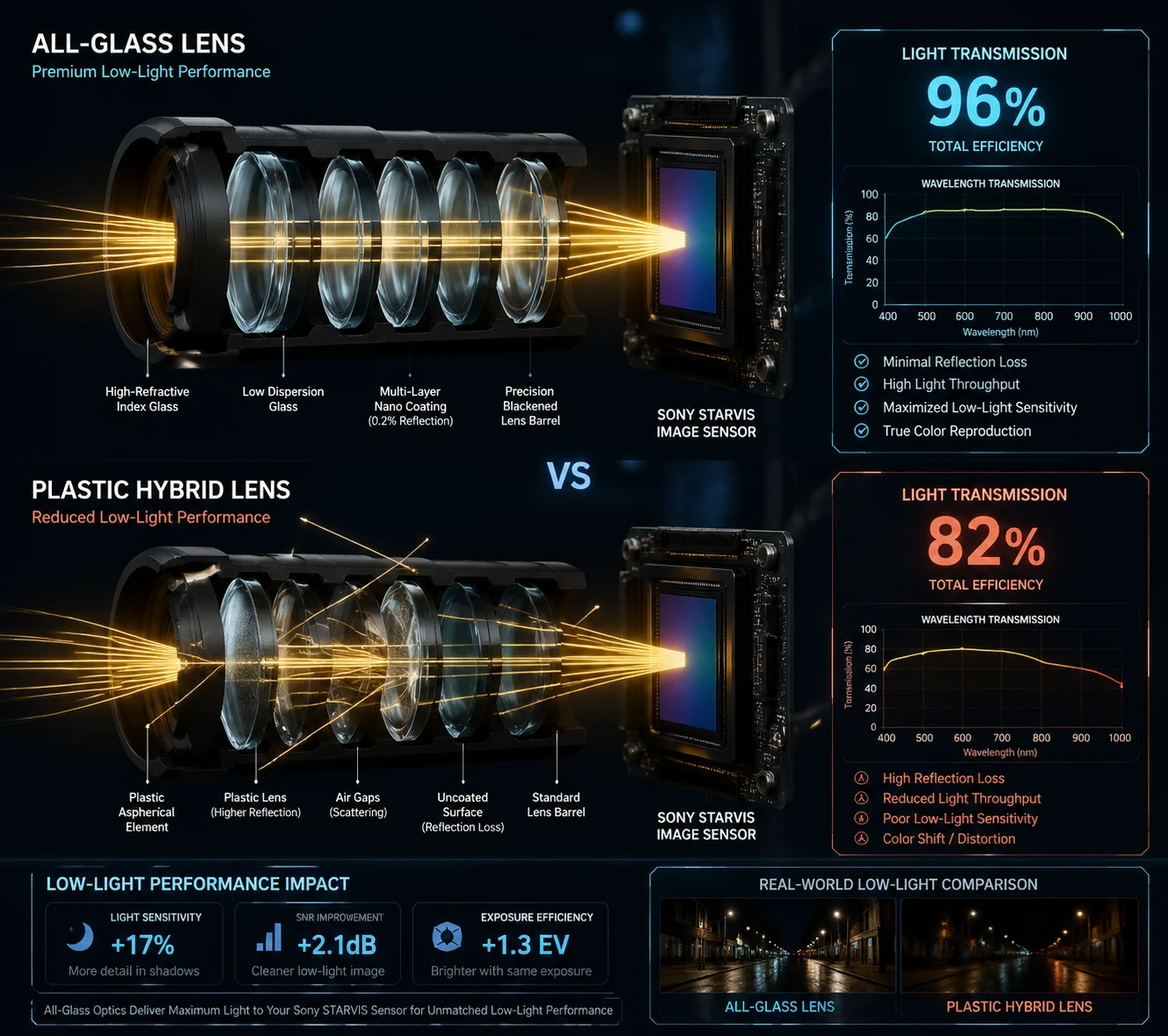
A client once asked me why his competitor’s cameras seemed to produce brighter, cleaner night images — even though both used the same sensor. The answer was in the glass. His supplier was using a plastic hybrid lens that was eating 15% of the light before it even hit the sensor.
All-glass lenses with multi-layer AR coatings typically achieve 92–96% light transmission, which is on par with premium brands like Fujifilm and Tamron. Plastic hybrid lenses usually fall in the 80–88% range due to inferior coatings and higher internal reflection rates. This difference directly impacts low-light performance and overall image clarity.
What Light Transmission Actually Means for Your Camera
Light transmission rate tells you how much of the light entering the lens actually reaches the image sensor. Every lens element — whether glass or plastic — absorbs or reflects a small amount of light. The more elements you have, and the worse your coatings are, the more light you lose.
For a PTZ security camera, this matters most at night. If your lens transmits only 82% of available light, your sensor is working with 18% less signal. That means more noise, less detail, and shorter effective night vision range. A camera with a 95% transmission lens will outperform a camera with an 82% lens — even if they use the exact same sensor and IR illuminator.
Transmission Rate Comparison
| Lens Type | Typical Light Transmission | Coating Type | Night Performance Impact |
|---|---|---|---|
| Premium all-glass (6G/8G) with multi-layer AR | 92–96% | High-temp vacuum deposited | Maximum sensor utilization, clean night image |
| Mid-range all-glass (4G) with basic AR | 88–92% | Standard vacuum deposited | Good performance, slight noise increase |
| Plastic-glass hybrid (2G4P) with dip coating | 80–88% | Low-temp dip or spray | Noticeable noise, reduced IR range |
| All-plastic (6P) with minimal coating | 75–82% | Spray or none | Poor night image, heavy noise, short range |
How We Handle This at Loyalty-Secu
At our factory, we test every lens module batch for transmission rate before it goes into production. We use a spectrophotometer 5 to measure transmission across the visible and near-infrared spectrum (400nm–950nm). This is important because security cameras don’t just work in visible light — they rely heavily on 850nm and 940nm IR. A lens that looks fine in daylight but drops off sharply at 850nm will give you terrible night vision.
We also match our lens selection to the specific sensor we’re using. For example, our 38X optical zoom PTZ uses a lens module that’s been optimized for the Sony Starvis 2 6 sensor’s spectral sensitivity curve. This means the lens and sensor work together as a system — not just two random parts bolted together.
How to Verify Transmission Claims
If a supplier tells you their lens has “95% light transmission,” ask for the test report. Specifically, ask for:
- Transmission curve across 400nm–950nm wavelength range
- The test equipment used (brand and model)
- Whether the measurement is for a single element or the complete lens assembly
A single glass element might transmit 99.5% of light. But a 6-element assembly with mediocre coatings might only transmit 88% total. The number that matters is the system transmission — the total light that makes it through all elements combined.
If the supplier can’t provide this data, you can do a rough comparison yourself. Set up two cameras side by side in a dark room with a controlled light source. Use the same sensor, same settings, same exposure. Compare the brightness and noise levels of the two images. The camera with the better lens will produce a brighter, cleaner image every time.
Conclusion
Don’t trust marketing claims — verify lens material through datasheets, BOM review, heat tests, and pre-shipment inspections. Your project’s image quality depends on what’s actually inside the barrel, not what’s printed on the box.
1. Chromatic aberration causes and correction in optical systems. ↩︎ 2. Extra-low dispersion glass for improved color correction. ↩︎ 3. Anti-reflective coating technology for lens transmission. ↩︎ 4. MTF curves for optical lens sharpness measurement. ↩︎ 5. Spectrophotometer testing for lens transmission rates. ↩︎ 6. Sony STARVIS 2 sensor spectral sensitivity characteristics. ↩︎ 7. Thermal expansion coefficient of optical plastics vs glass. ↩︎ 8. Veiling glare and ghosting in multi-element lens assemblies. ↩︎ 9. Dip coating vs vacuum deposition for lens AR coatings. ↩︎ 10. Pre-shipment inspection checklist for lens material verification. ↩︎