
I’ve seen too many PTZ cameras fail not because of bad sensors or firmware — but because a tiny plastic gear inside the pan mechanism cracked in half after six months of patrol duty.
Metal gears last significantly longer than plastic gears in PTZ cameras, especially under heavy-duty conditions like 24/7 patrol tours, auto-tracking, and extreme temperatures. Metal gears maintain tight positioning accuracy for 5–8 years, while plastic gears often degrade within 6–12 months of high-frequency use, leading to drift, stripped teeth, and costly field replacements.
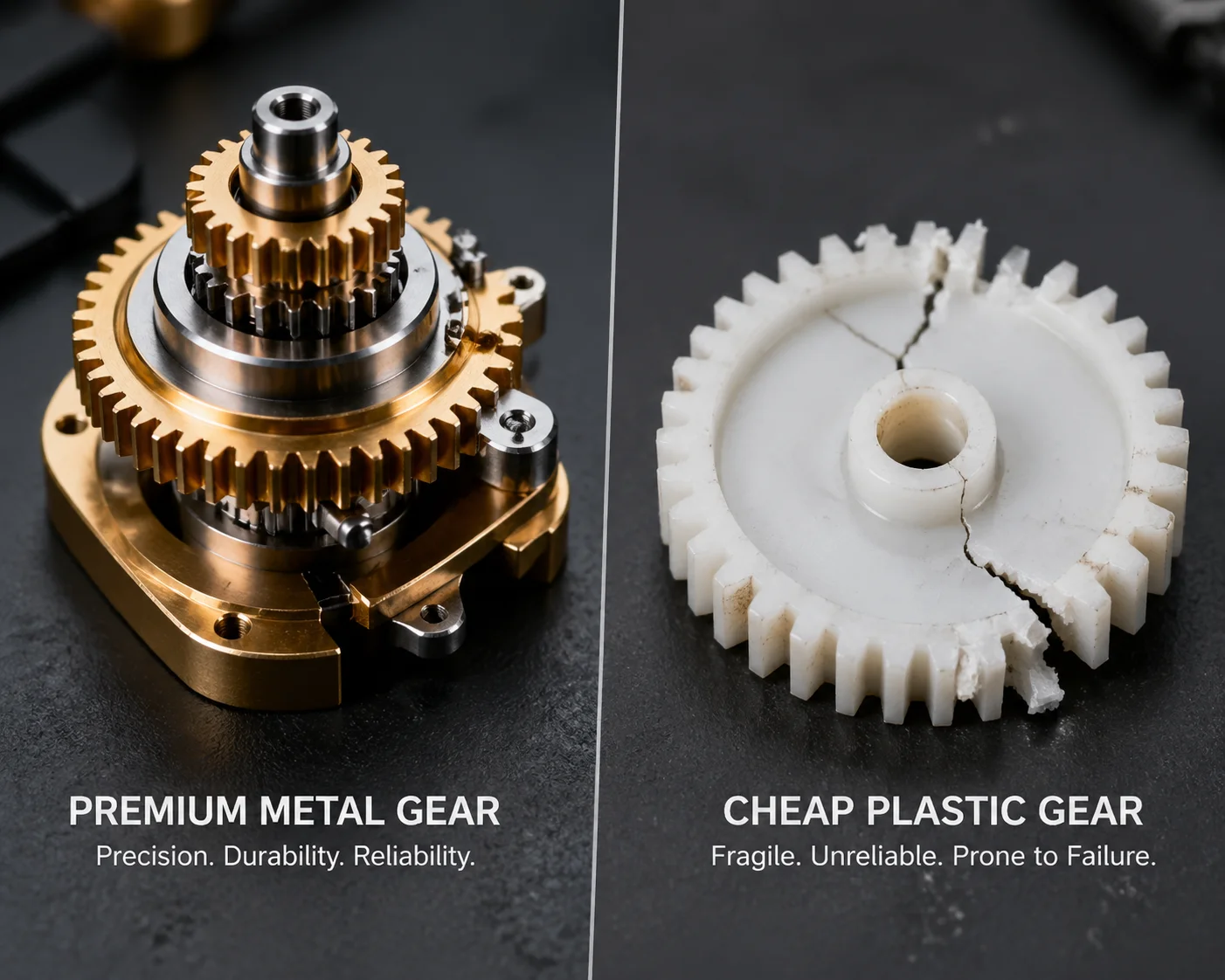 PTZ camera internal gear comparison metal vs plastic
Below, I break down the four most common questions I get from integrators and project managers about PTZ gear materials. Each answer comes from what we’ve learned building industrial-grade PTZ cameras at Loyalty-Secu since 2013 — and from the real-world failures we’ve helped customers avoid.
Will Plastic Gears Strip or Melt During a High-Speed Patrol in a 120°F Environment?
I get this question every summer from integrators in Texas and Arizona. Their PTZ cameras sit on poles in direct sunlight, running preset tours all day — and they want to know if the gears can handle it.
Yes, plastic gears can absolutely strip, deform, or even crack in sustained high-temperature environments. At 120°F (49°C) and above, common plastic gear materials like POM and nylon begin to soften, increasing the risk of tooth deformation, motor overload, and eventual gear failure during high-speed rotation.
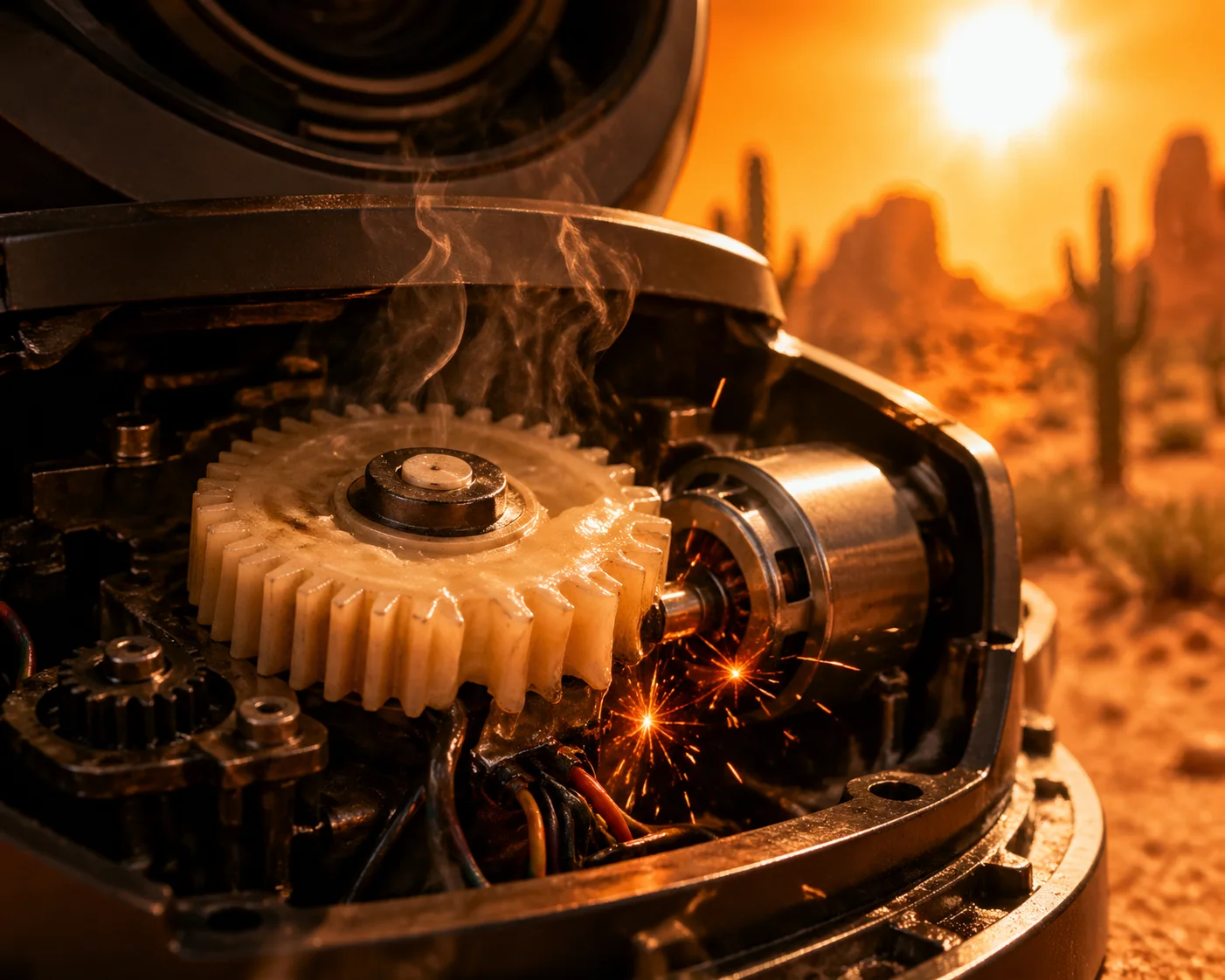 PTZ camera plastic gear failure high temperature environment
What Happens to Plastic Gears in Extreme Heat
Plastic has a high thermal expansion coefficient 1. That means when the temperature rises, the gear physically grows. Even a tiny change in size throws off the mesh between gears. Here’s what that looks like in practice:
- Gear teeth swell. The fit between the driving gear and the driven gear gets too tight. The motor has to push harder to turn the pan or tilt mechanism.
- Motor current spikes. The extra resistance draws more power. Over time, this can burn out the motor windings — a failure that’s expensive and impossible to fix in the field.
- Teeth deform permanently. Plastic under heat and load doesn’t bounce back. Once a tooth bends, the backlash increases, and your preset positions start drifting.
Now flip the scenario. In winter, that same plastic gear becomes brittle. I’ve seen teardown photos from a Hikvision DS-2DE4425 2 series where the main pan gear — made of hard plastic — shattered into 3 or 4 pieces like glass. It wasn’t gradual wear. It was a single sudden fracture during a cold startup.
Temperature Behavior: Plastic vs. Metal Gears
| Factor | Plastic Gears (POM/Nylon) | Metal Gears (Brass/Stainless Steel) |
|---|---|---|
| Thermal expansion | High — swells in heat, shrinks in cold | Very low — stays dimensionally stable |
| Brittleness in cold | Becomes brittle below 0°F (-18°C) | Retains toughness even at -40°F (-40°C) |
| Motor load in heat | Increases due to tight mesh | Stays consistent |
| Risk of sudden failure | High — cracking or stripping | Low — gradual, predictable wear |
| Effective operating range | Roughly 14°F to 140°F (-10°C to 60°C) | -40°F to 158°F (-40°C to 70°C) |
Why This Matters for Your Field Deployments
If you’re deploying PTZ cameras in the American Southwest, the Gulf Coast, or northern Canada, you’re dealing with temperature swings of 100°F or more across the year. A plastic gear that works fine in a climate-controlled warehouse will behave very differently on a pole in El Paso in July.
At Loyalty-Secu, we use metal gears in the core pan and tilt drive train specifically because our cameras are designed for these environments. Paired with industrial-grade grease rated for -40°C to +70°C, the drive system delivers consistent torque output regardless of season. That means your preset tours run the same in January as they do in August — no drift, no stalling, no emergency truck rolls.
How Do Precision-Machined Metal Gears Improve the Long-Term Reliability of My PTZ?
I’ve had customers tell me their old PTZ cameras “worked fine for the first year” — then slowly started missing their preset positions by a few meters at 500 meters out. That’s not a software bug. That’s gear wear.
Precision-machined metal gears maintain tight tooth-to-tooth tolerances over years of continuous use. This keeps backlash — the tiny gap between meshing teeth — extremely small, which directly preserves the ±0.1° repeatability that AI auto-tracking, license plate recognition, and long-range zoom applications depend on.
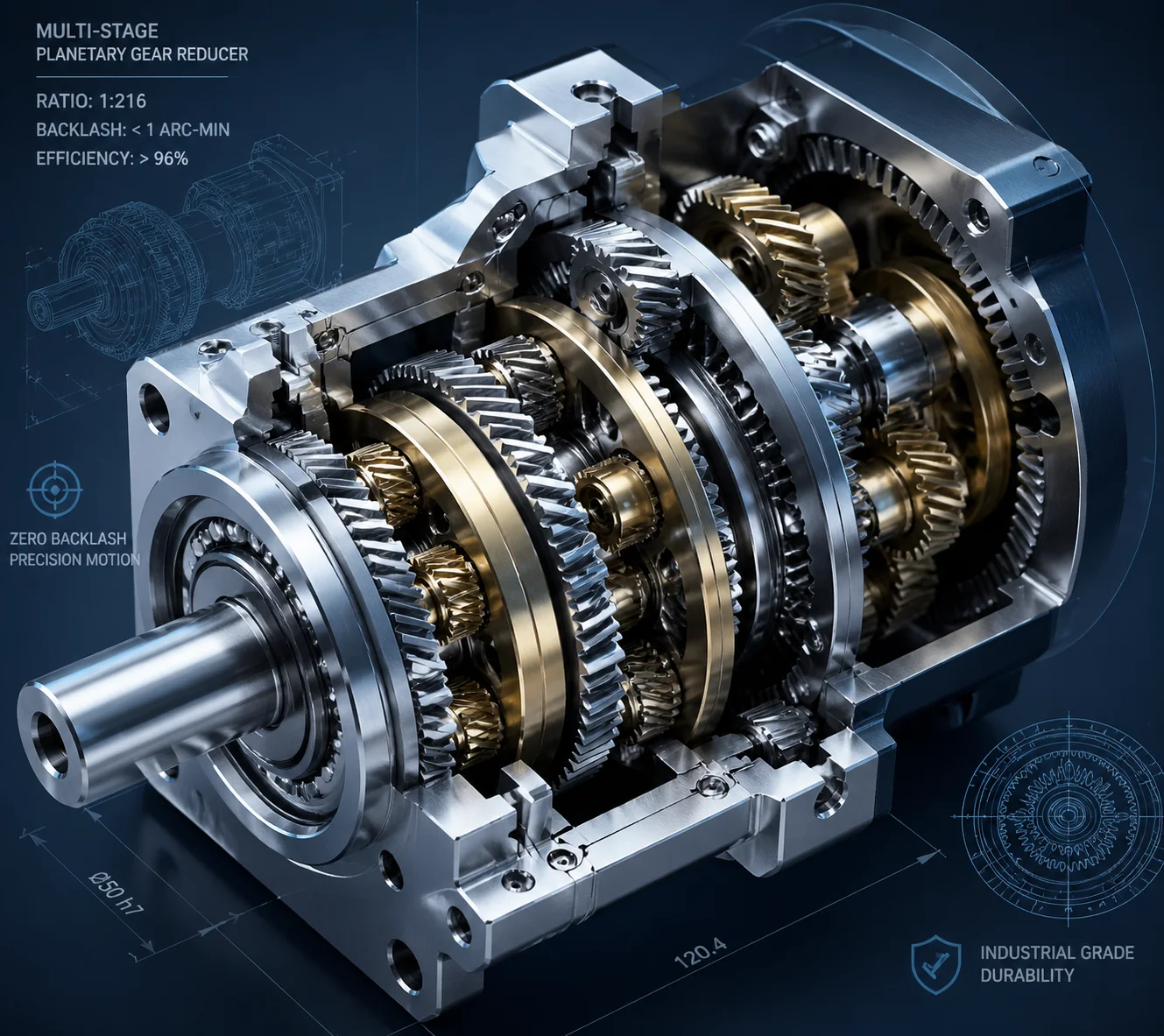 Precision machined metal gears PTZ camera reliability
Understanding Backlash and Why It Kills Accuracy
Backlash is the small amount of play between two meshing gear teeth. Every gear system has some. But the question is: how much, and how fast does it grow?
With plastic gears, the teeth are softer. After tens of thousands of pan and tilt cycles, the tips of the teeth wear down and become rounded. The gap between teeth grows. This is backlash creep, and it’s invisible from the outside. You won’t hear it. You won’t see it on the video stream — until one day your preset that was aimed at a school gate is now pointing 3 meters to the left.
With metal gears — especially precision-machined brass or stainless steel — the hardness of the material means the teeth hold their shape far longer. The backlash stays within spec for years, not months.
The Real-World Impact on AI and Auto-Tracking
Modern PTZ cameras don’t just sit still. They run AI-powered auto-tracking. They snap to preset positions dozens of times per hour. They follow vehicles across a parking lot and then return to home position. Every one of those movements depends on the mechanical accuracy of the gear train.
If your gears have worn and the backlash has grown by even 0.3°, here’s what happens at different zoom levels:
| Nivel de zoom | Backlash Error (0.3°) | Visible Drift at Target |
|---|---|---|
| 10X | 0.3° | ~1.5 meters at 300m |
| 25X | 0.3° | ~3.5 meters at 300m |
| 38X | 0.3° | ~5+ meters at 300m |
At 38X zoom — which is what many of our long-range cameras use — even a tiny mechanical error becomes a huge problem on screen. The camera thinks it’s pointing at the right spot. The encoder says it’s in position. But the gear has slipped just enough that the image is off-target.
How Planetary Gear Systems Help
In our PTZ designs, we use multi-stage planetary gear reducers 3. These distribute the load across multiple gear teeth at once, which reduces stress on any single tooth and extends the overall life of the gear train. Specialized PTZ gearbox manufacturers like ZHAOWEI 4 confirm that this structure is critical for achieving smooth, jitter-free motion at low speeds and high torque — exactly what you need for stable long-range surveillance.
The key takeaway: metal planetary gears don’t just last longer. They keep your camera accurate longer. And in a world where your customer is paying for AI-powered auto-tracking and license plate capture, accuracy isn’t optional — it’s the whole point.
Is the “Clacking” Noise in My PTZ a Sign of Gear Wear or Poor Alignment?
I’ve received videos from customers where their PTZ makes a rhythmic clicking or clacking sound every time it pans. Their first instinct is usually to ask if the motor is dying. Most of the time, it’s not the motor. It’s the gears.
A clacking noise during PTZ movement usually indicates either worn gear teeth with excessive backlash, a cracked or chipped tooth, or poor gear alignment from the factory. In metal gear systems, this noise is often caused by insufficient lubrication. In plastic gear systems, it’s more likely a sign of physical tooth damage that will get worse over time.
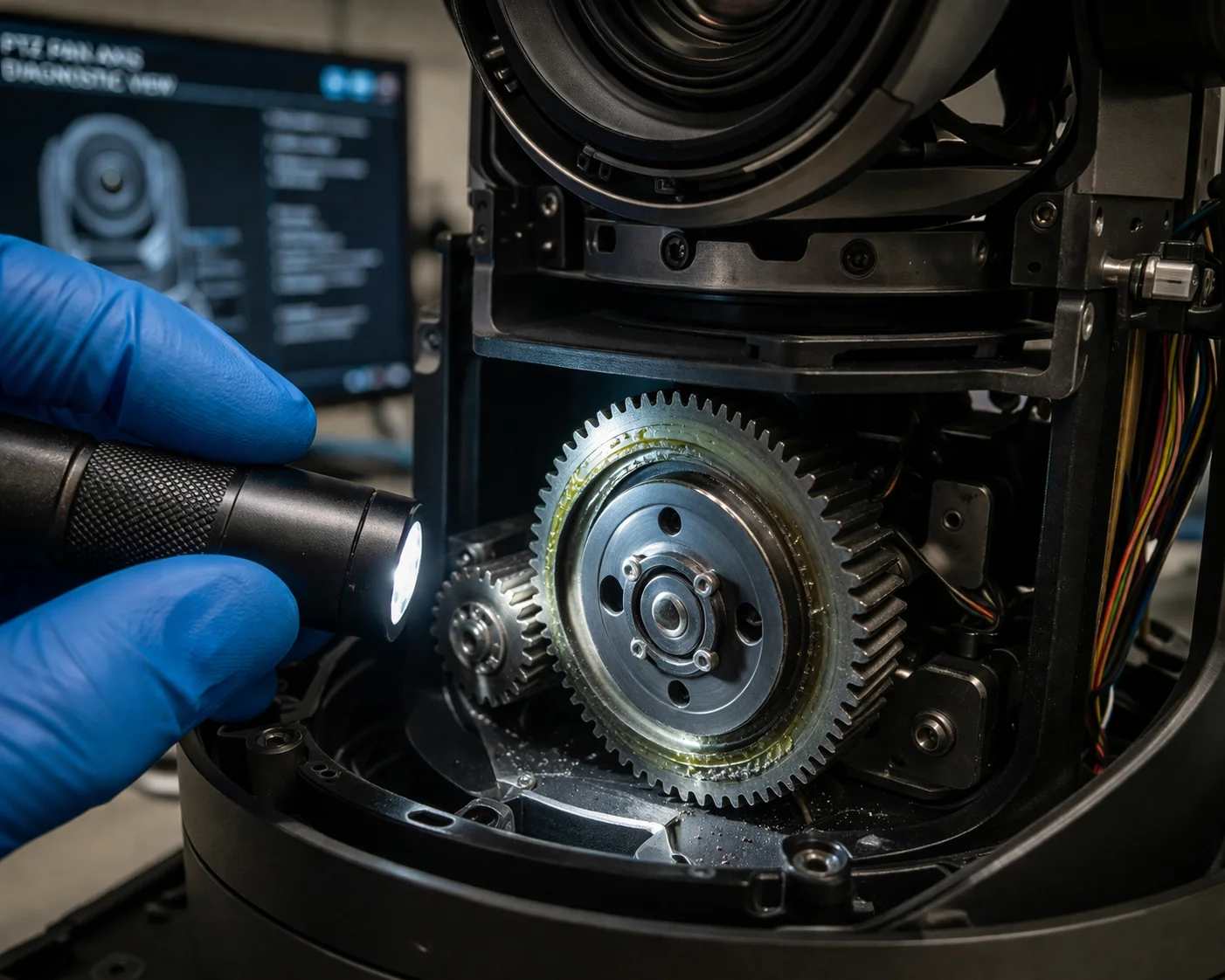 PTZ camera clacking noise gear wear diagnosis
How to Tell the Difference: Wear vs. Alignment
Not all clacking sounds mean the same thing. Here’s how I break it down when helping a customer diagnose the issue remotely:
Rhythmic clicking that matches rotation speed
This usually means one or more teeth on a gear are damaged — chipped, cracked, or worn flat. Every time the damaged tooth meshes with the opposing gear, it makes a click. If the sound happens at a consistent interval (say, once per full pan rotation), you can almost count the teeth to figure out which gear is affected.
With plastic gears, this kind of damage is often irreversible. The tooth doesn’t wear smoothly — it chips off in chunks. I’ve seen teardown photos where a single plastic gear tooth broke off and jammed the entire mechanism, locking the pan axis completely.
With metal gears, a similar sound is more likely caused by a burr or a lubrication issue. A re-grease can often fix it. The tooth itself is usually still intact.
Random clicking or grinding
This points to alignment problems. If the gears weren’t properly aligned during assembly — or if the housing has warped due to heat — the teeth don’t mesh cleanly. They skip, grind, or catch on each other.
This is where build quality matters enormously. At Loyalty-Secu, we run every PTZ through a burn-in test before shipment. The camera runs continuous pan and tilt cycles for hours while we monitor for abnormal sounds, current draw, and positioning accuracy. If a unit clicks, it doesn’t ship.
What Causes Gear Noise in the First Place
| Noise Type | Likely Cause (Plastic Gears) | Likely Cause (Metal Gears) |
|---|---|---|
| Rhythmic click | Chipped or cracked tooth | Burr on tooth surface or dry lubrication |
| Grinding sound | Teeth worn round, excessive backlash | Misalignment or foreign debris in gearbox |
| Sudden loud crack | Tooth fracture (catastrophic) | Extremely rare — usually housing issue |
| Increasing noise over time | Progressive wear, nearing end of life | Lubrication drying out, needs re-grease |
Why This Matters for Your Business
If you’re an integrator and your customer calls about a noisy PTZ, you need to know whether it’s a quick fix or a warranty claim. With metal gears, most noise issues can be resolved with maintenance. With plastic gears, noise is often the last warning before total mechanical failure. And in the U.S., sending a technician up a pole costs $500–$1,500 per visit. That’s why choosing the right gear material at the purchasing stage saves you real money downstream.
Do You Use Self-Lubricating Metal Alloys to Reduce the Need for Manual Greasing?
I get this question a lot from integrators who install cameras on 30-foot poles in remote locations. Once the camera is up there, nobody wants to climb back up to grease the gears every six months.
Yes — at Loyalty-Secu, we use brass and copper-alloy gears that have natural self-lubricating properties, combined with long-life industrial grease rated for extreme temperatures. This combination significantly reduces the need for manual re-lubrication over the camera’s operational life, which is typically 5–8 years in continuous-duty applications.
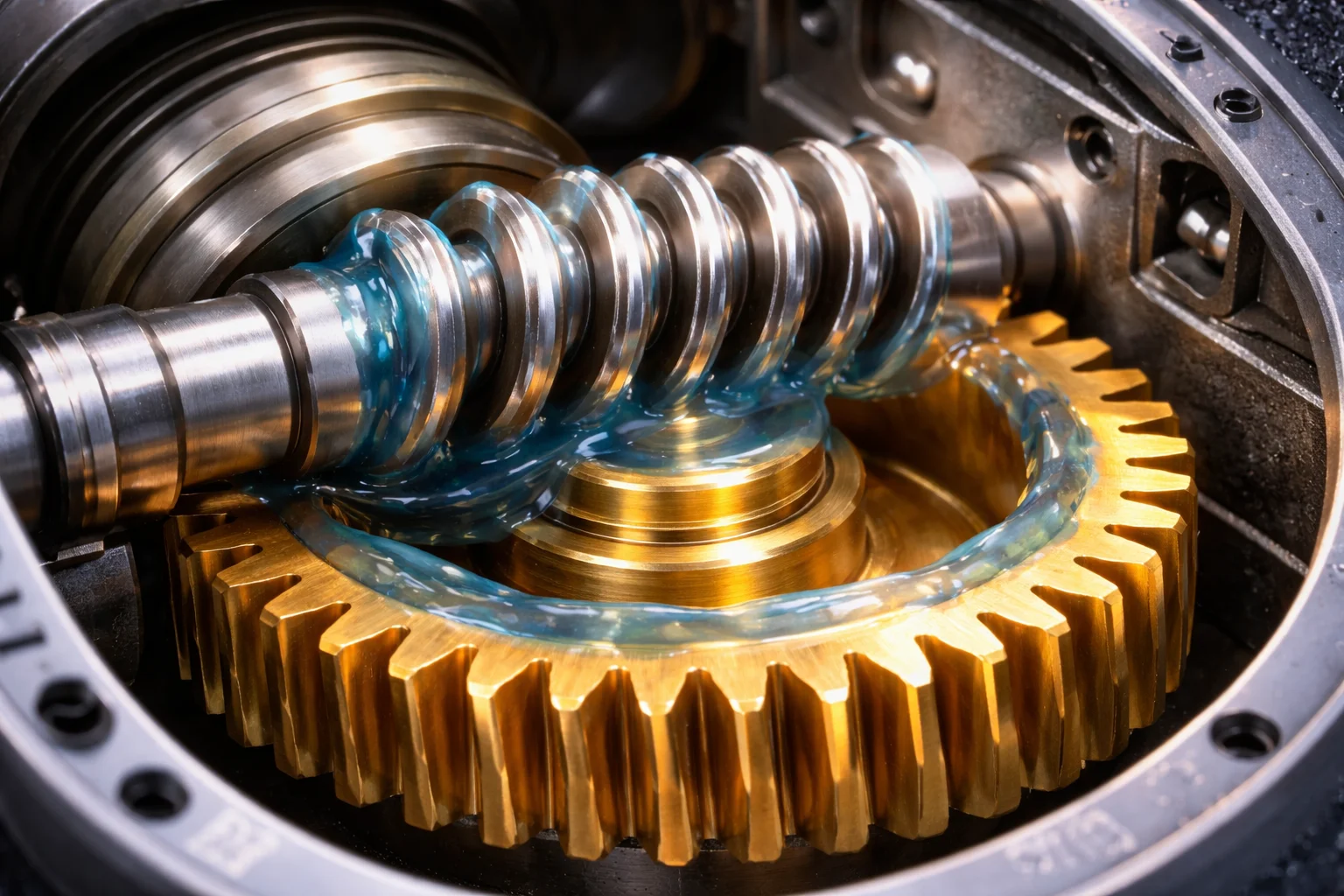 Self-lubricating metal alloy gears PTZ camera maintenance
Why Lubrication Matters More Than You Think
Every gear system generates friction. Friction generates heat. Heat accelerates wear. Without proper lubrication, even the best metal gears will eventually grind themselves down.
But here’s the thing most people miss: not all metals behave the same way when it comes to friction.
Brass and Bronze: Nature’s Bearing Material
Brass and bronze alloys have been used in bearings and gears for centuries because they have a naturally low coefficient of friction against steel. When a brass gear meshes with a steel worm gear (a common configuration in PTZ pan mechanisms), the brass acts almost like a built-in lubricant. It resists galling — that’s when two metal surfaces weld together under pressure — and it wears slowly and predictably.
This is why we choose brass 5 for our primary drive gears. It’s not the cheapest option. Plastic would cost less. But brass gives us two things plastic can’t: long-term dimensional stability and self-lubricating behavior under load.
The Grease Layer: Your First Line of Defense
On top of the metal’s natural properties, we apply industrial-grade lithium-complex grease to all gear surfaces during assembly. This grease is rated for -40°C to +70°C and has a service life measured in years, not months. It doesn’t dry out in desert heat. It doesn’t freeze solid in Canadian winters.
The sealed gearbox housing keeps dust, moisture, and insects out — all of which can contaminate grease and accelerate wear. As long as the housing seal stays intact, the grease stays effective for the full design life of the camera.
What About Plastic Gears and Lubrication?
Plastic gears are sometimes marketed as “self-lubricating” because materials like POM (Delrin) 6 have a low friction surface. And that’s true — in light-duty applications. But under the sustained loads and speeds of a PTZ patrol tour, plastic-on-plastic friction still generates enough heat to cause creep and deformation. Adding grease to plastic gears can actually cause problems: some lubricants attack certain plastics, causing them to swell or crack over time.
This is another hidden advantage of metal gears. They’re compatible with a wide range of industrial lubricants, giving you more flexibility in maintenance — if maintenance is ever needed at all.
Total Cost of Ownership: The Maintenance Factor
For integrators in the U.S., the math is simple. A single truck roll to a remote site costs $500 to $1,500. If a plastic-gear PTZ needs maintenance or replacement after 12–18 months, you’ve already spent more on labor than the camera cost. A metal-gear PTZ that runs for 5–8 years without mechanical intervention pays for itself many times over.
At Loyalty-Secu, we design our cameras so that the gear system is the last thing you ever have to worry about. Because in this business, the best maintenance is no maintenance.
Conclusión
Metal gears cost more upfront but last far longer under real-world PTZ demands. For any outdoor, high-frequency, or extreme-temperature deployment, they are the only serious choice — and they will save you money over the life of every project.
1. Thermal expansion coefficient of POM vs brass for gears. ︎ 2. Hikvision DS-2DE4425 plastic gear failure analysis. ︎ 3. Planetary gear reduction for high-torque PTZ motion. ︎ 4. ZHAOWEI PTZ gearbox engineering specifications. ︎ 5. Brass alloy properties for low-friction gear applications. ︎ 6. POM (Delrin) plastic gear temperature limitations. ︎ 7. Lithium-complex grease for wide-temperature PTZ operation. ︎ 8. Backlash measurement for PTZ preset accuracy testing. ︎ 9. Motor current spike detection for gear friction analysis. ︎ 10. IP66 gearbox sealing for dust and moisture protection. ︎