
I have seen many solar battery11 packs fail too early. The cells drift apart, the pack weakens, and my system loses usable power fast.
Yes. A supplier’s BMS can extend battery life if it uses active balancing1. Active balancing moves energy from strong cells to weak ones, reduces stress, and helps the pack stay more even over time.
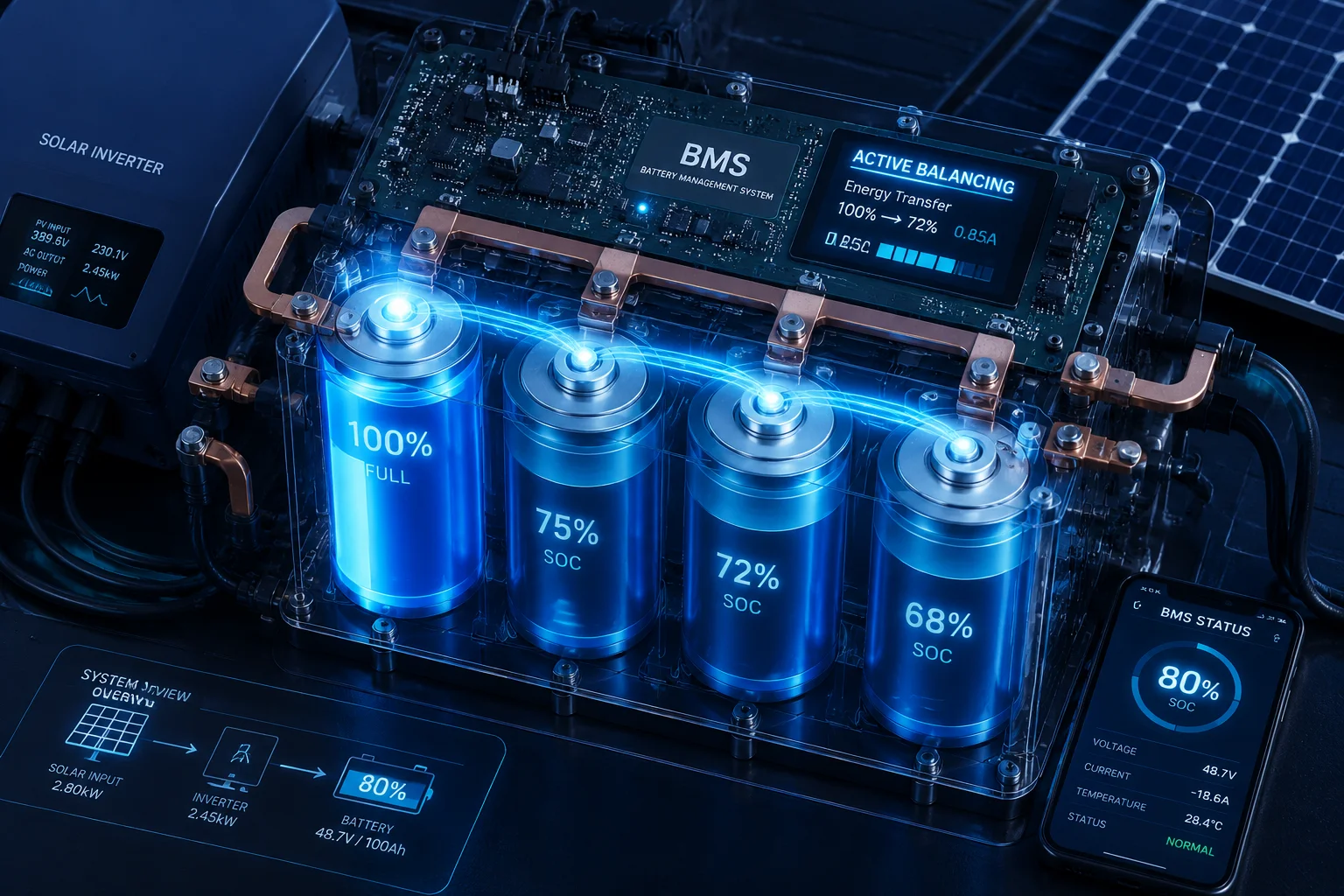
I want to look deeper because the real issue is not only balancing. I also care about voltage gaps, usable capacity after years, and whether the balancing current is strong enough for large 100Ah packs.
Table of Contents
How does active balancing prevent individual cell degradation2 in a 24/7 solar setup?
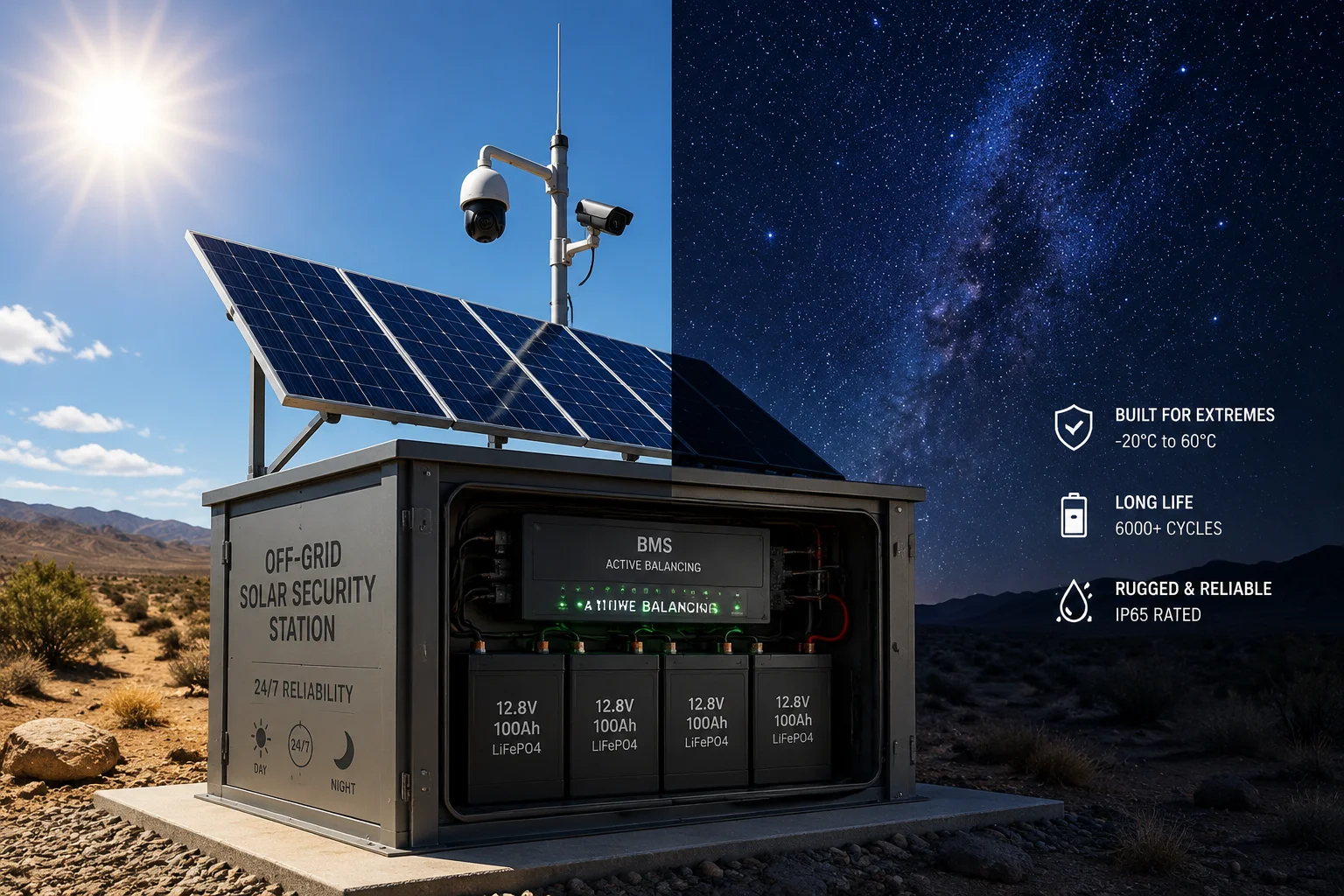
I have watched solar systems sit under load all day and all night. When one cell works harder than the others, the pack starts to age unevenly, and that hurts me twice: lower output and more service calls.
Active balancing helps by moving energy away from higher-voltage cells and into lower-voltage cells during charge or discharge. This keeps the cells closer together, reduces overcharge on the weak side, and slows down uneven wear in a 24/7 solar setup.
Why cell imbalance grows faster in nonstop solar use
I see a simple pattern in off-grid systems8. The battery charges in the day, then discharges at night, and this cycle repeats again and again. If one cell has a little more resistance, or if one cell sits in a warmer spot, that cell does not behave like the others. Over time, the difference gets bigger. Once that happens, the BMS has to protect the whole pack based on the weakest cell, not the strongest one. That means I lose capacity even when most cells are still fine.
How active balancing changes the stress map
A passive BMS4 burns extra energy as heat. I do not want that in a solar box that already lives in hot weather. An active BMS, on the other hand, shifts charge between cells. That means the stronger cells do less of the “extra work,” and the weaker cells get support before they fall too far behind. This is important in systems that run 24/7, because the pack does not get many long rest periods. The BMS must keep the pack healthy while the load keeps moving.
What I look for in real field use
I do not just ask whether a BMS says “active balancing.” I ask how much balancing current it can deliver, when it starts balancing, and whether it works near the top of charge only or across a wider range. I also want to know if it logs cell voltage data. If I can see the cell spread over time, I can tell if the system is stable or if one cell keeps drifting. That helps me plan maintenance before the pack fails.
Cell health table for 24/7 use
| Factor | Problem Without Active Balancing | Benefit With Active Balancing |
|---|---|---|
| Cell voltage spread | Grows over time | Stays tighter |
| Heat during balancing | More heat from resistors | Less waste heat |
| Weak cell stress | Higher | Lower |
| Pack usable life | Shorter | Longer |
Can the BMS handle a voltage deviation3 of more than 0.05V between different cells?
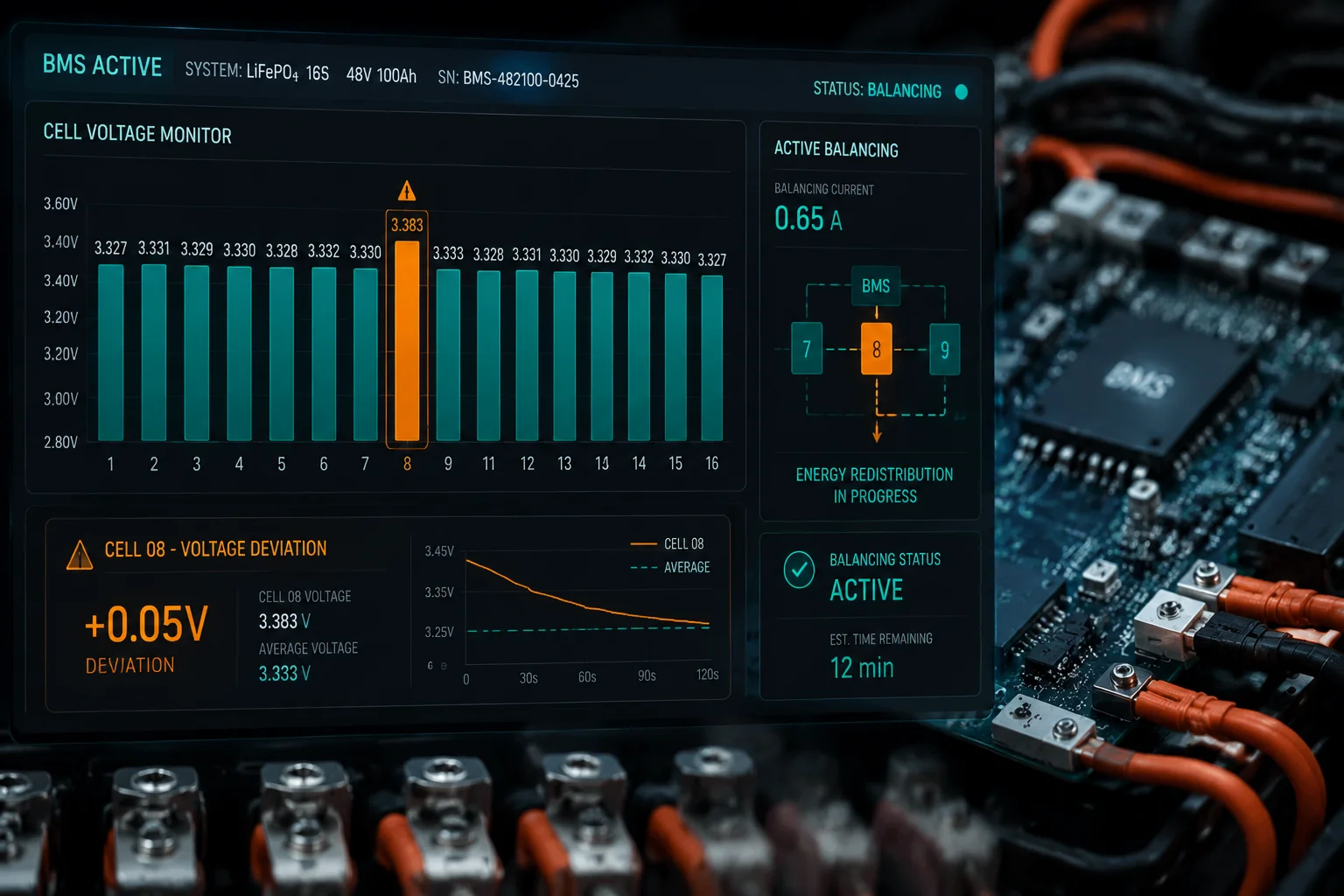
I have seen small voltage gaps become big problems. A 0.05V difference may look small at first, but in a real pack it can point to a cell that is aging faster, heating more, or charging at a different speed.
A good BMS should handle a 0.05V cell voltage deviation, but I do not treat that number as “safe forever.” It is a warning sign. A strong active balancing system should detect the gap, move energy as needed, and keep the cells within a tighter range before the gap grows.
Why 0.05V matters more than many people think
I do not judge battery health by one number alone, but a 0.05V gap can tell me a lot. In lithium packs7, cell balance affects both top-end charging and bottom-end discharge. If one cell reaches the upper limit first, the BMS must stop charging even if the rest of the pack is still not full. If one cell drops too fast under load, the BMS may cut off early. So a small gap can still reduce total system value.
When a BMS can handle the gap well
I want the BMS to do more than just protect. I want it to correct. That means it should start balancing early enough, not only at the very end of charge. It should also measure each cell well and react fast enough to stop the spread from growing. In a solar setup, where charging patterns change with weather, season, and load, the BMS must stay active and stable. If the supplier only gives a general claim, I ask for the balancing threshold10, accuracy, and current rating.
What happens if the BMS is too weak
If the balancing current is too low, the BMS may “see” the problem but fail to fix it fast enough. Then the voltage gap stays, and the pack keeps drifting. That often leads to reduced runtime, early cutoffs, and more heat in the weaker cell. Over time, I may see one cell age much faster than the others. At that point, the whole pack becomes harder to use, even if most cells still have life left.
Voltage deviation table
| Cell deviation | Common meaning | My action |
|---|---|---|
| Under 0.02V | Usually normal | Watch and log |
| 0.02V to 0.05V | Mild imbalance | Check balancing behavior |
| Over 0.05V | Warning sign | Inspect cells and BMS settings |
| Growing over time | Possible aging issue | Plan service soon |
Will active balancing improve the total usable capacity6 of my battery pack after 2 years?
I care about usable capacity more than nameplate capacity. A pack can still look “healthy” on paper and still give me less power in the real world. That hurts project uptime and makes me explain bad results to customers.
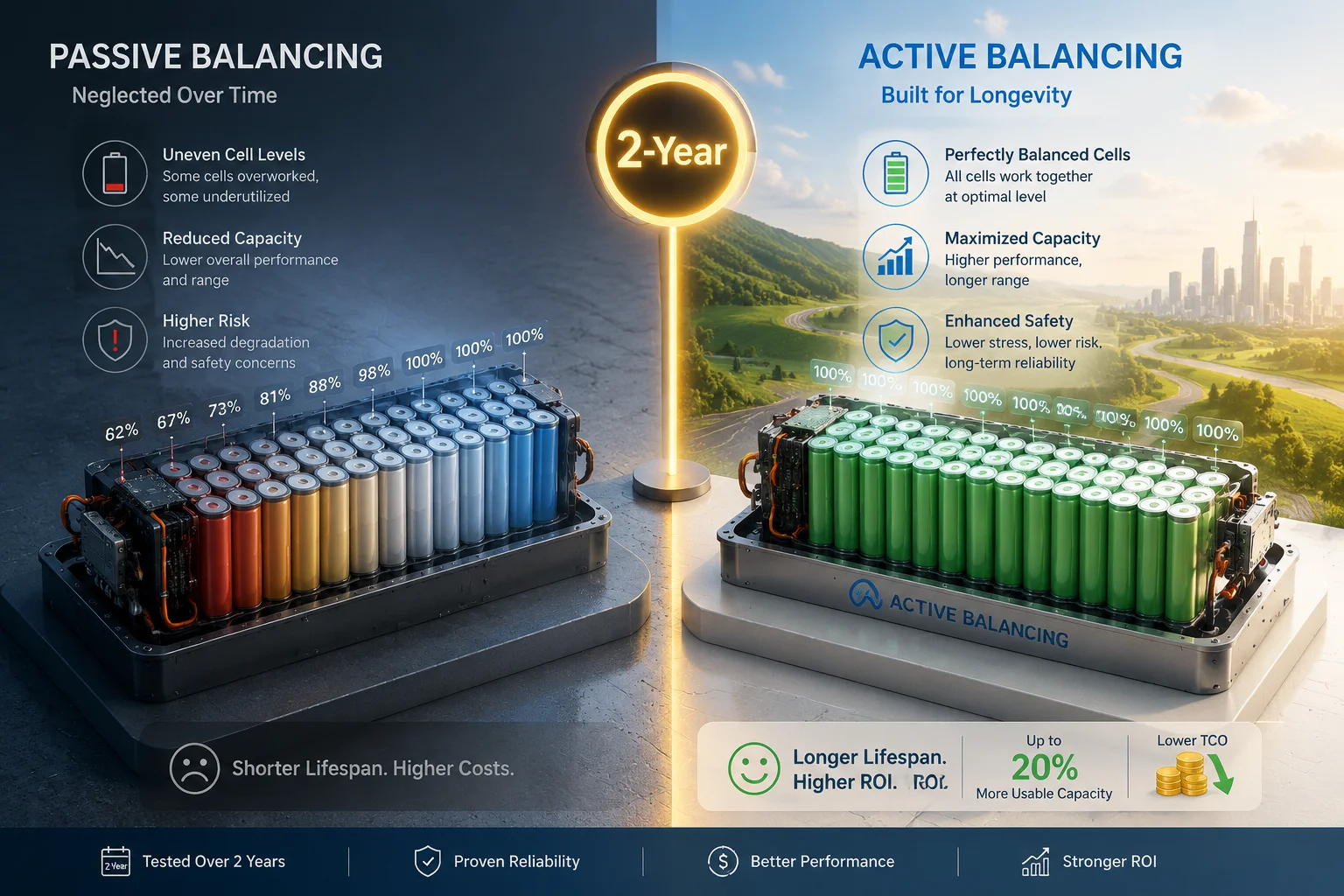
Yes. Active balancing can improve the total usable capacity after 2 years because it keeps cells closer together, reduces early cutoff from weak cells, and slows uneven aging. It does not stop aging, but it helps the pack keep more of its real working capacity for longer.
Why usable capacity falls even when the pack is not dead
I often see people think battery life means “the pack still turns on.” That is too simple. In the field, usable capacity means how much power I can take out before the BMS cuts off. If one cell ages faster, the BMS must stop the pack early to protect it. So the pack may still have energy left in some cells, but I cannot use it. That is wasted value.
How active balancing helps after long use
Active balancing cannot make old cells new again, but it can slow the spread between cells. That matters a lot over two years of daily cycling. If one cell starts to lag, active balancing can move energy to it during charge so it does not stay far behind. If the pack stays even, the BMS can charge and discharge more of the pack safely. That usually means better runtime and fewer early shutdowns. For solar systems in remote places, that can be the difference between a stable site and a support ticket.
What else affects the result
I do not blame the BMS alone. Battery chemistry, temperature, charge rate, depth of discharge9, and physical layout all matter. A hot enclosure can age cells faster. A poor charger can push the pack too hard. A cheap cell batch can also create more mismatch from day one. So if I want better usable capacity after two years, I need the full system to work together. Still, a strong active balancing BMS gives me a much better base than a simple passive one.
Capacity table after long use
| System choice | Likely effect after 2 years |
|---|---|
| Passive balancing only | More imbalance, less usable energy |
| Active balancing | Better cell match, higher usable energy |
| Poor thermal control | Faster decline |
| Good thermal control + active balancing | Best chance of stable output |
Is the balancing current5 (e.g., 1A or 2A) sufficient for high-capacity 100Ah battery packs?
I know many buyers look at 1A or 2A and wonder if that is enough for a large pack. That is a fair question. A 100Ah pack can hide imbalance for a while, but when the cells drift, the balancing system must be strong enough to catch up.
For high-capacity 100Ah packs, 1A or 2A balancing can be sufficient in many cases, but it depends on how large the imbalance is, how often the pack cycles, and how fast the cells drift. For heavy-duty use, I prefer higher balancing power and clear balancing logic.
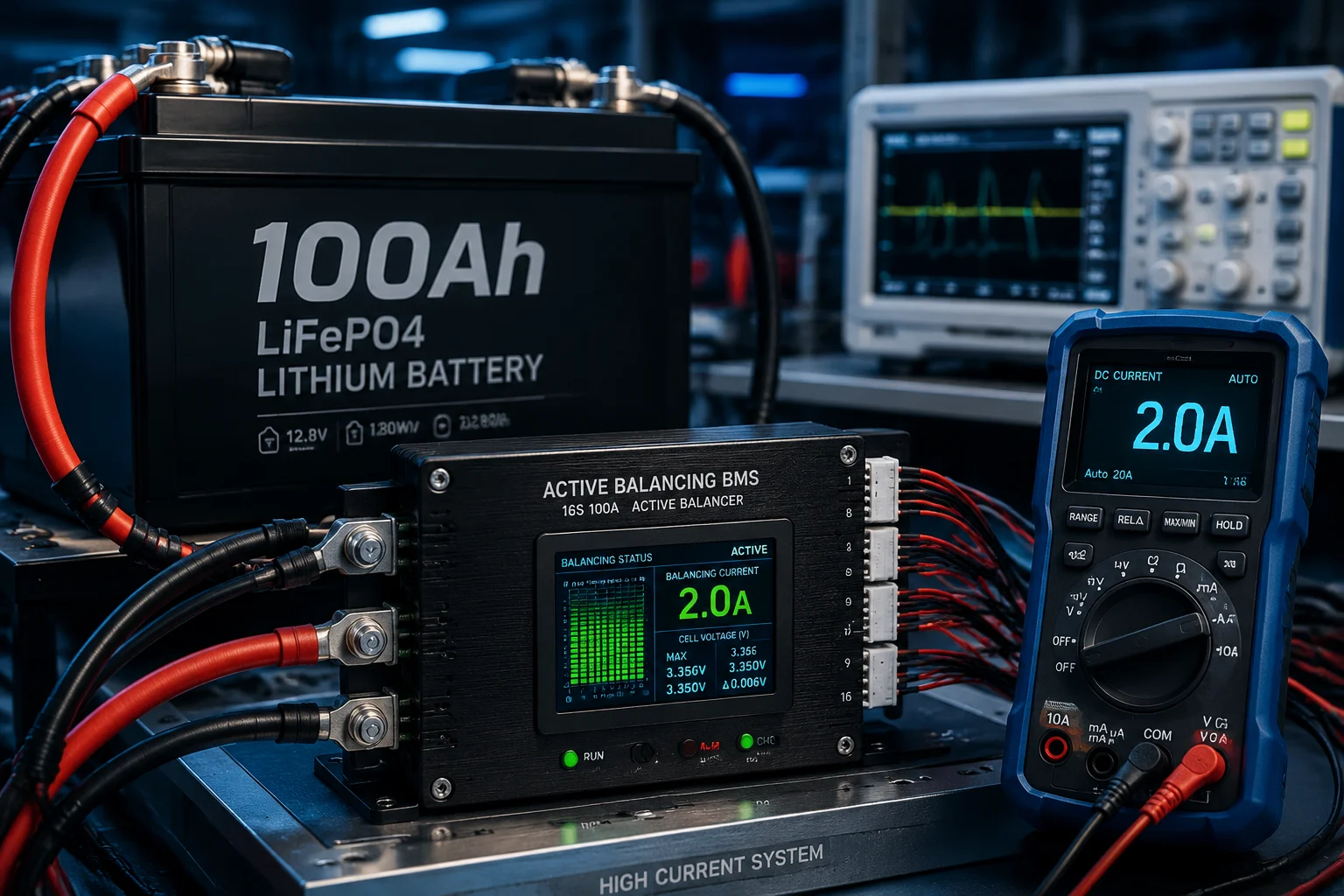
Why current size matters more in bigger packs
I think of balancing current like a repair tool. A small tool can fix a small problem, but it works slowly on a large system. In a 100Ah pack, the cell mismatch may not be huge each day, but over weeks and months it can build up. If the balancing current is too low, the BMS may never fully catch up. Then the pack keeps living with a small error that becomes a bigger one later.
When 1A is enough
I find 1A to be acceptable when the pack is well matched, the cells are new, the thermal environment is stable, and the system is not pushed too hard. In that case, the BMS only needs to trim small gaps. For many clean solar setups, that can work fine. But I still want the supplier to show data. I want to know the balancing start point, the max cell difference it can recover from, and how long it takes to pull the pack back into balance.
When 2A or more is better
I lean toward stronger balancing when the site is harsh. If the system sits in heat, if the loads are uneven, or if the pack cycles deeply every day, the cells will drift faster. In that case, 2A gives me more control. It shortens the time needed to correct imbalance and can better support larger capacity packs. For a remote solar camera site, I do not want to wait days for the BMS to fix a problem. I want it fixed before the weak cell starts limiting the whole system.
Balancing current comparison table
| Balancing current | Best use case | My view for 100Ah packs |
|---|---|---|
| 1A | Light to moderate imbalance | Good for stable systems |
| 2A | Faster correction, harsher sites | Better for demanding use |
| Below 1A | Small packs or very stable use | Often too weak |
| Above 2A | Stronger correction | Useful if the design supports it safely |
Conclusion
I trust active balancing when I want longer battery life, steadier output, and fewer surprises in real solar field use.
1. Learn how active balancing compares to passive and why it extends battery life. ↩︎ 2. Explore the mechanisms behind lithium cell aging and how to slow them. ↩︎ 3. Read about voltage imbalance thresholds and measurement accuracy in BMS design. ↩︎ 4. Compare passive (resistive) balancing with active balancing for solar applications. ↩︎ 5. See how balancing current ratings affect how fast cell imbalance is corrected. ↩︎ 6. Understand the difference between nameplate capacity and real-world usable energy. ↩︎ 7. Reference for lithium-ion chemistries and their balancing requirements. ↩︎ 8. Overview of off-grid solar design considerations for battery management. ↩︎ 9. Discover how DoD affects cycle life and balancing demands. ↩︎ 10. Learn about voltage thresholds at which balancing begins and ends. ↩︎ 11. Comprehensive guide to selecting solar batteries for off-grid or backup use. ↩︎