
I’ve seen too many PTZ cameras arrive at job sites with loose presets and shaky pan movements — all because the internal drive system couldn’t survive the shipping journey.
Most high-end PTZ cameras use a hybrid system: reinforced synchronous timing belts paired with precision metal pulleys. This design beats all-metal gears in three key areas — noise reduction, vibration absorption during long-distance shipping, and long-term maintenance-free operation. Pure metal gears create excessive noise and accelerate motor wear.
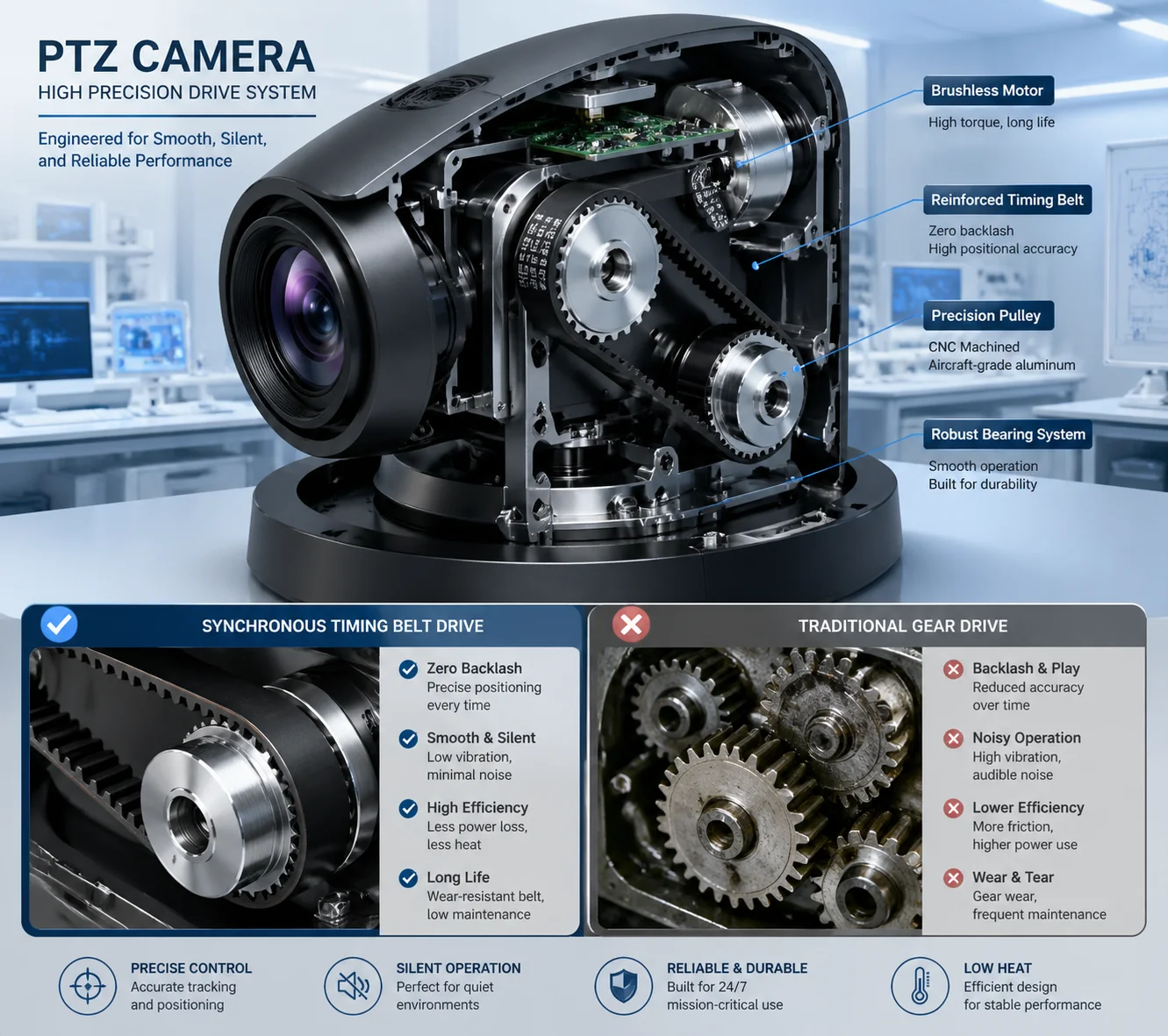 PTZ camera internal drive system belts vs metal gears
I want to walk you through the real engineering behind PTZ drive systems. Below, I’ll answer the four questions I hear most from system integrators and project managers who import cameras from China. Each answer comes from what I’ve learned building PTZ cameras at Loyalty-Secu since 2013.
Table of Contents
Will the Belt Drive in My PTZ Camera Slip or Loosen Due to Shipping Vibrations?
This is the number one fear I hear from integrators placing large orders. You spend thousands on cameras, ship them across the ocean, and then worry the belts inside are already loose before you even power them on.
No — a properly engineered timing belt will not slip or loosen during shipping. Unlike flat rubber belts, synchronous timing belts have teeth that lock into metal pulleys. They cannot slip. At Loyalty-Secu, our belts use Kevlar 1-reinforced fibers with near-zero stretch, so they hold factory tension even after a month of ocean freight.
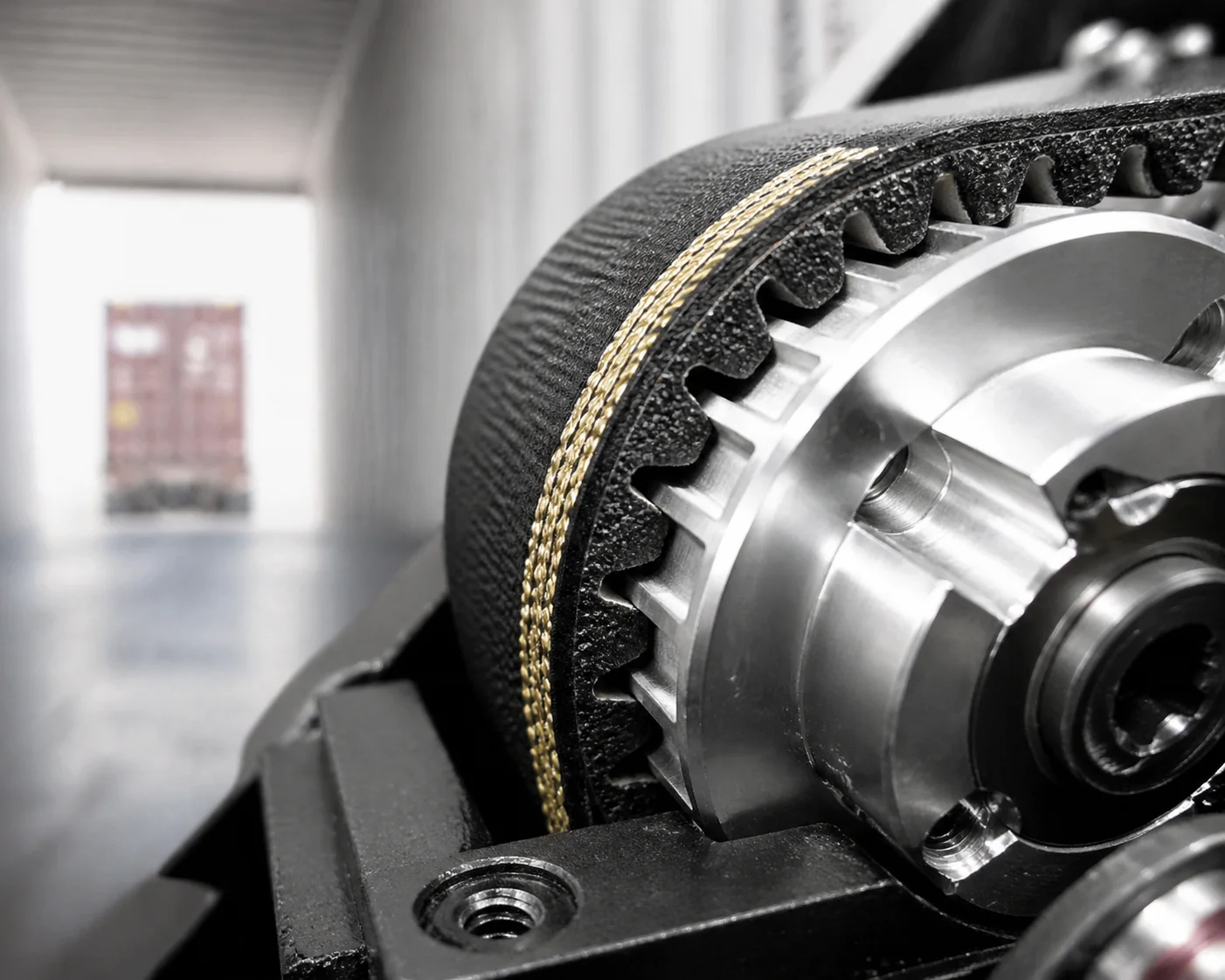 PTZ camera timing belt Kevlar reinforced shipping vibration
Why Cheap Belts Fail but Good Belts Don’t
Let me be clear — not all belts are the same. The market has two very different types of belt drives, and mixing them up causes real problems.
Flat rubber belts are the cheap option. Some low-cost PTZ factories use them because they cost almost nothing. These belts rely on friction alone to transfer power. Over time, they stretch. During shipping, the constant vibration loosens their grip on the pulleys. When you power up the camera on site, the pan axis drifts. Presets are off by 2–3 degrees. Your client calls you. You send a technician. That truck roll costs more than the camera itself.
Synchronous timing belts are a completely different product. They have molded teeth — like a zipper — that mesh with matching grooves on the metal pulley. There is zero reliance on friction. The belt physically cannot slip sideways or skip teeth under normal conditions.
What Happens Inside the Box During Shipping
Here’s what actually happens during a 30-day ocean freight journey from Shenzhen to Los Angeles:
| Shipping Phase | Vibration Type | Risk to Belt Drive | Risk to Metal Gears |
|---|---|---|---|
| Truck to port | Low-frequency bumps | None — belt absorbs energy | Gears may develop micro-backlash |
| Ocean container | Constant high-frequency vibration (1–5 Hz) | Kevlar fibers resist stretch | Metal-on-metal contact can wear without lubrication |
| Port crane handling | Sudden shock (up to 3G) | Belt flexes and returns to shape | Gear teeth can chip at contact points |
At Loyalty-Secu, we test every drive module against IEC 60068-2-6 2, which simulates 1G random vibration across a wide frequency range. The belt system passes every time because it absorbs energy instead of transmitting it through rigid metal parts.
The Auto-Tensioning Advantage
Our drive system also includes an auto-tension compensator. This is a spring-loaded idler pulley that maintains constant pressure on the belt. Even if temperature changes cause tiny dimensional shifts in the housing, the tensioner adjusts automatically. The result: preset accuracy stays within ±0.1° from the day it leaves our factory to the day you install it on a pole in Texas.
So if you’re importing 500 cameras for a city-wide project, you don’t need to re-calibrate every unit on arrival. They’re ready to go.
How Does the Gear Precision Affect My Preset Accuracy After Months of Operation?
I’ve had customers tell me their presets “drifted” after six months. They blamed the software. But when I asked them to open the housing, the real problem was always mechanical — worn gears or stretched belts.
Gear precision directly controls preset accuracy. If your PTZ uses low-quality plastic gears, the teeth wear down over thousands of pan-tilt cycles. This creates backlash — a tiny gap between gear teeth — that grows over time. Each degree of backlash means your preset misses its target. High-quality timing belt systems avoid this problem entirely because the belt teeth do not wear against metal in the same way.
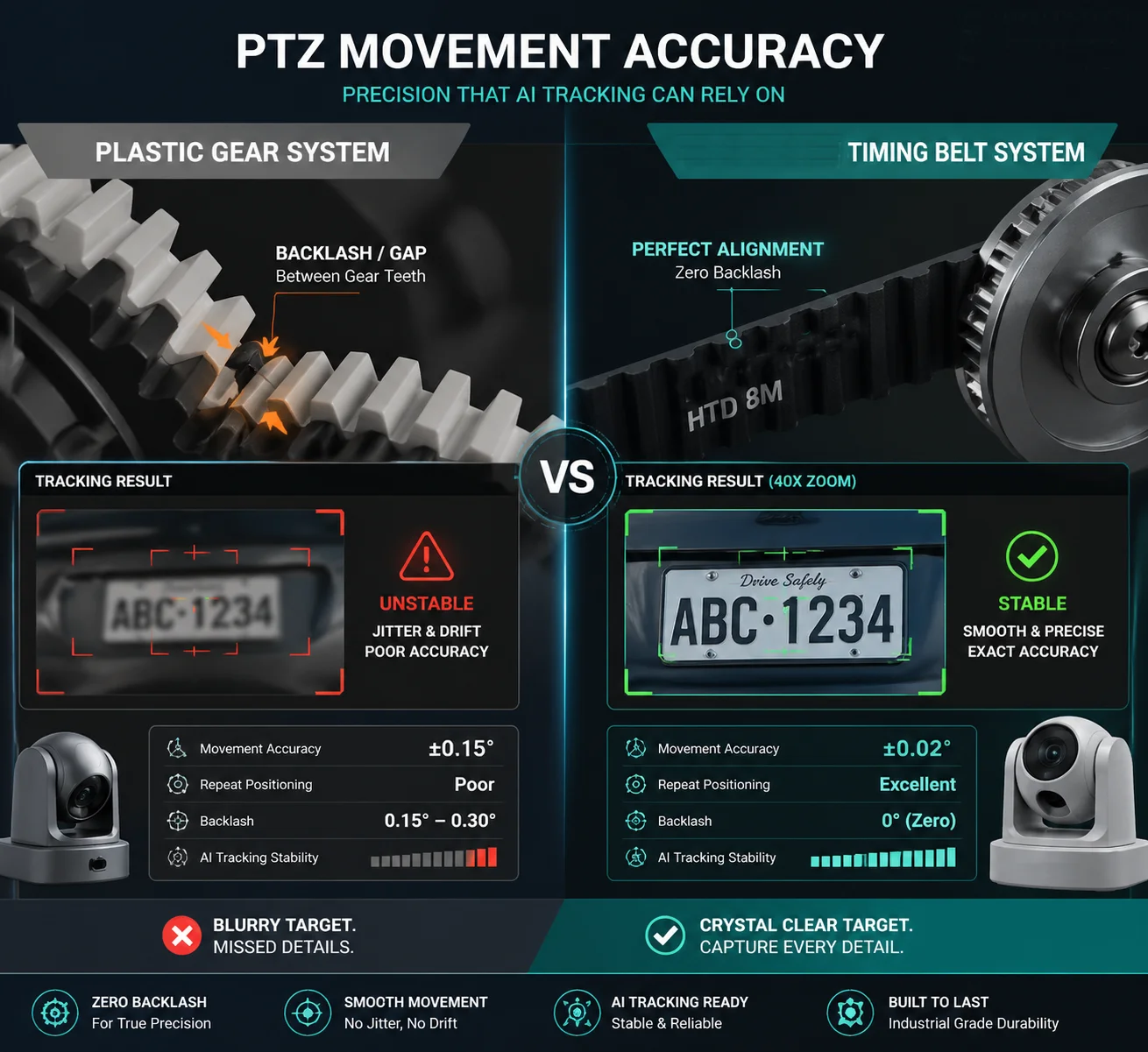 PTZ camera preset accuracy gear backlash over time
Understanding Backlash in Simple Terms
Backlash is the small gap between two meshing gear teeth. When the motor reverses direction, it has to cross that gap before the output shaft starts moving. During that gap, the camera is not moving — but the motor thinks it is. The encoder counts steps that produce no actual rotation. The result: the camera stops a fraction of a degree short of where it should be.
Over months, this error compounds. A preset that was perfect on day one is now off by 1° or more. At 40X zoom, 1° of error means your target is completely out of frame.
How Different Drive Systems Handle Long-Term Wear
| Factor | Plastic Gears | Metal Gears | Timing Belt + Metal Pulley |
|---|---|---|---|
| Backlash at install | 0.2–0.5° | 0.05–0.1° | < 0.05° |
| Backlash after 12 months | 1–3° (teeth wear fast) | 0.1–0.3° (slow wear) | < 0.1° (belt teeth are replaceable) |
| Noise level | Low initially, increases with wear | High from day one (gear whine) | Very low, stays low |
| Effect on AI tracking | Frequent lost targets | Occasional overshoot | Smooth, consistent tracking |
Why This Matters for AI Auto-Tracking
Modern PTZ cameras — including ours at Loyalty-Secu — use AI to automatically follow people or vehicles. The AI sends rapid start-stop commands to the motors. Each command requires the drive system to reverse direction instantly.
If there’s backlash in the gears, every direction change introduces a small delay. The AI overshoots the target, then corrects, then overshoots again. You see a “hunting” motion on screen — the camera wobbles back and forth instead of locking onto the subject.
With a timing belt system, the teeth are always engaged. There is no dead zone when reversing. The motor moves, and the camera moves at the exact same instant. This is why our dual-lens AI tracking cameras use belt drives — the fixed lens detects the target, and the PTZ lens follows it smoothly without any mechanical hesitation.
The Hidden Cost of “Precision” Metal Gears
Here’s something most salespeople won’t tell you. Yes, precision-ground metal gears have very tight tolerances at the factory. But they need lubrication to stay that way. Grease dries out. Dust gets in. After 2–3 years in an outdoor enclosure, the grease hardens and the gears start grinding. Re-greasing means sending a technician up a 10-meter pole. That single truck roll can cost $300–$500 in the US.
Our timing belts are self-lubricating. The belt material includes embedded PTFE 3 (the same material as non-stick pans). It runs dry, stays quiet, and needs zero maintenance for the full product lifespan.
Which Drive System Is Easier for Me to Maintain if a Mechanical Failure Occurs?
I always tell my clients: the best maintenance plan is no maintenance at all. But things break. When they do, you need a system that’s fast and cheap to fix.
Belt drive systems are significantly easier to maintain than gear systems. A worn timing belt can be replaced in 15 minutes with basic tools. Replacing a damaged metal gear often requires disassembling the entire pan-tilt mechanism, realigning multiple shafts, and recalibrating the encoder — a job that can take hours and may require factory-level equipment.
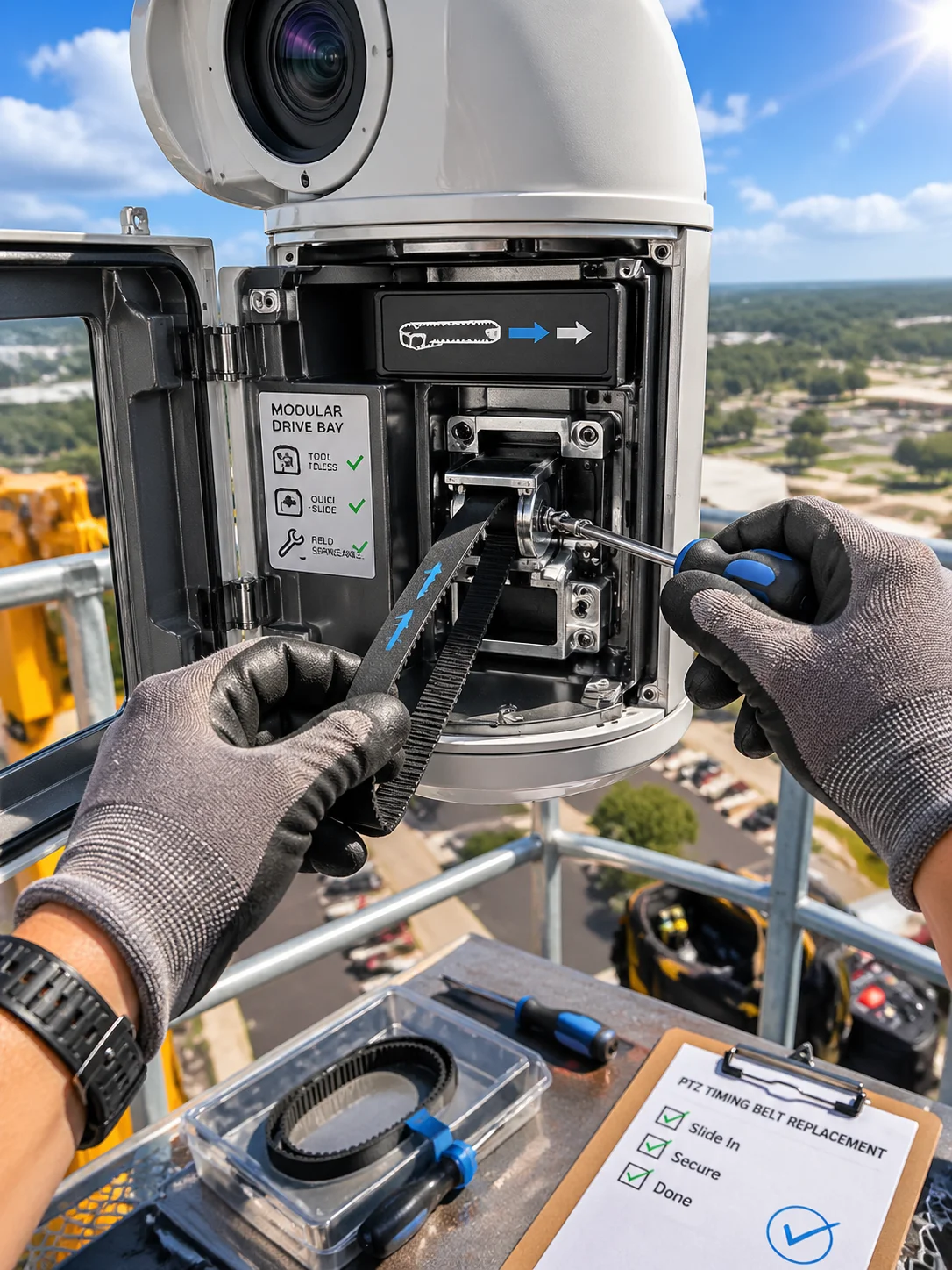 PTZ camera belt replacement easy maintenance field repair
What a Field Repair Actually Looks Like
Let me paint a real picture. Your technician is standing on a lift platform, 10 meters up, in the middle of a construction site. The camera stopped panning. He needs to fix it now.
With a belt system: He opens four screws on the housing cover. He sees the belt. If it’s damaged, he slides it off the pulleys, slides the new one on, and closes the cover. Total time: 15 minutes. Total parts cost: under $5.
With a gear system: He opens the housing. He sees a stack of meshing gears. One tooth is chipped. He needs to remove the motor mount, extract the damaged gear from the shaft, find the exact replacement (which may not be a standard part), press the new gear onto the shaft, realign it with the mating gear, and then run a calibration routine. Total time: 1–2 hours if he’s experienced. Total parts cost: $20–$50. And if he gets the alignment wrong, the camera will have backlash from day one.
The 10-Year Cost Comparison
For a project manager like David, the real question isn’t “which part is cheaper?” It’s “what does this cost me over 10 years across 200 cameras?”
| Cost Factor | Belt Drive System | Metal Gear System |
|---|---|---|
| Replacement part cost | $2–$5 per belt | $20–$50 per gear |
| Field repair time | 15 minutes | 1–2 hours |
| Technician skill required | Basic (any installer) | Advanced (trained technician) |
| Truck roll frequency (10 years) | 0–1 times | 2–4 times |
| Total maintenance cost per camera (10 years) | ~$50 | ~$500+ |
Why We Design for Field Serviceability
At Loyalty-Secu, we think about maintenance from the first day of product design. Our PTZ housings have quick-access panels. The belt path is visible without removing the main board. We even include a spare belt in every bulk shipment — so your warehouse always has parts on hand.
This is a direct result of listening to integrators like David. They told us: “I don’t care if the part costs $2 or $20. I care about how fast my guy can fix it and get off that ladder.” So we designed the entire drive module to be swappable as a single unit. Unbolt four screws, unplug one connector, swap the module, done.
That’s what a vertically integrated manufacturer can do. We own the mold shop. We own the PCB design. We control every dimension. So we can optimize for real-world field service — not just factory specs on a datasheet.
Does the Camera Have a Locking Mechanism to Protect the Gears During Transit?
I learned this lesson the hard way. Early in our company’s history, we shipped a batch of cameras without transit locks. Several units arrived with the pan axis free-spinning inside the box. The weight of the camera body, combined with shipping vibration, caused the drive system to cycle back and forth thousands of times during transit — with no power, no control, and no lubrication.
Yes — all Loyalty-Secu PTZ cameras include a mechanical transit lock that secures the pan and tilt axes during shipping. This lock prevents the camera head from rotating freely inside the packaging. It eliminates uncontrolled movement that could damage the drive belt, strip gear teeth, or knock the optical block out of alignment.
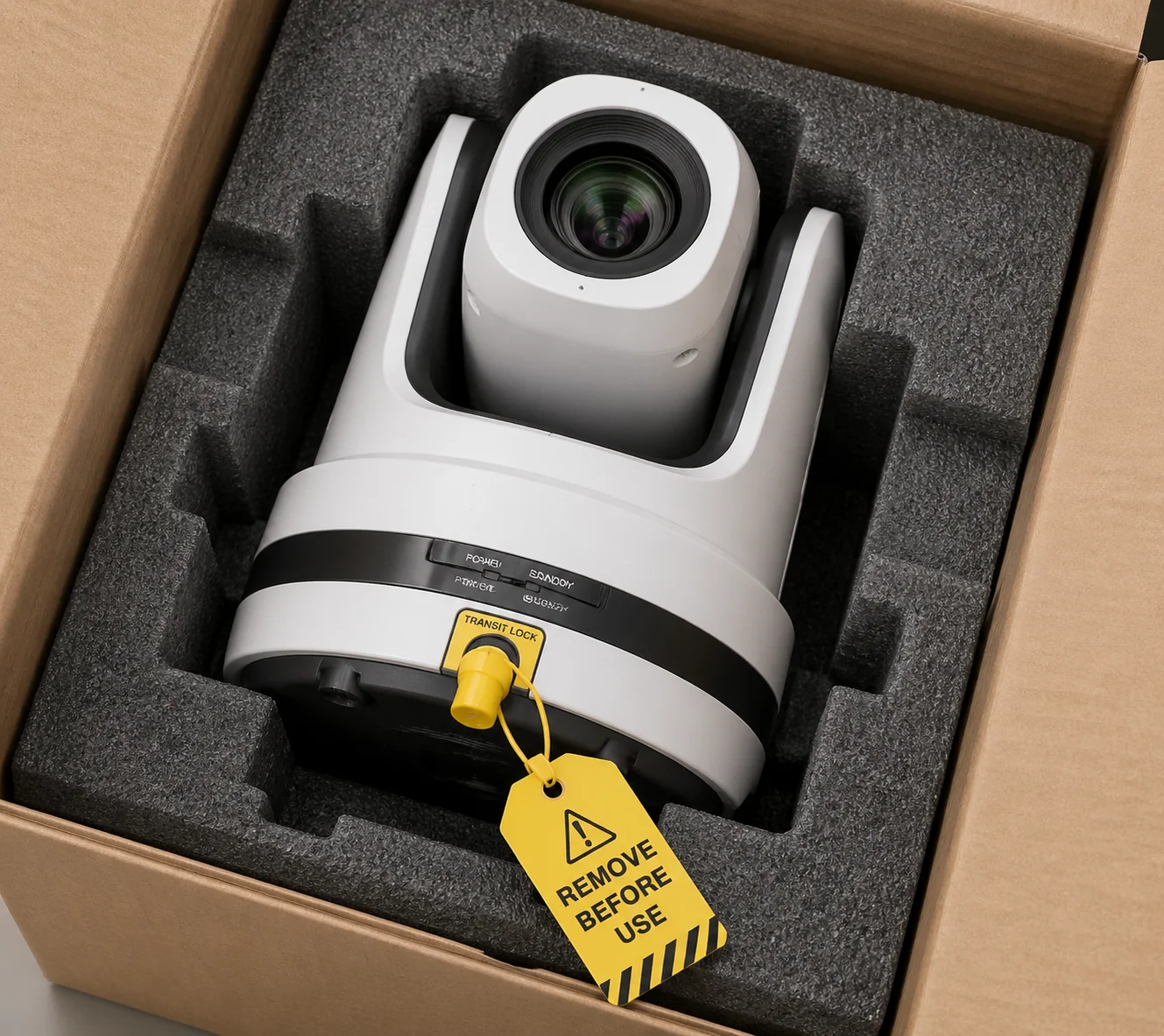 PTZ camera transit lock mechanism shipping protection
What the Transit Lock Actually Does
The transit lock is a simple but critical feature. It’s usually a small plastic or metal pin that slides into a hole in the pan gear or tilt bracket. When engaged, it physically prevents the camera head from rotating.
During shipping, the camera sits in foam packaging. But foam only protects against shock — it doesn’t stop rotation. Without a lock, the camera head is free to swing left and right with every bump. Each swing puts stress on the drive system. Over a 30-day ocean journey, that’s millions of micro-movements.
The Three Things That Break Without a Transit Lock
1. The drive belt or gear teeth. Uncontrolled rotation means the belt is being pulled by the weight of the camera head, not by the motor. This puts stress on the belt teeth at odd angles they weren’t designed for. In gear systems, the teeth can chip or develop flat spots.
2. The slip ring. PTZ cameras use a slip ring 4 to pass electrical signals from the stationary base to the rotating head. If the head spins freely during transit, the slip ring contacts can wear or scratch. This causes intermittent video signal loss after installation — one of the hardest faults to diagnose in the field.
3. The optical block. The imaging sensor and lens assembly (optical block) is the most fragile component inside any camera. It’s mounted on the tilt axis. If the tilt axis swings freely, the optical block experiences repeated shock loads. This can crack the sensor mounting adhesive or shift the lens alignment, causing blurry images that no amount of software adjustment can fix.
How to Verify the Lock Before You Install
When you receive a Loyalty-Secu camera, you’ll find a bright yellow tag on the housing that says “REMOVE TRANSIT LOCK BEFORE USE.” This tag is attached directly to the lock pin. Pull the pin, remove the tag, and the camera is ready to operate.
If you’re evaluating a new supplier and their cameras don’t have a transit lock — that’s a red flag. It means they haven’t thought about the supply chain between their factory and your job site. And if they cut corners on something this basic, what else did they skip?
I always recommend that David and other integrators add “transit lock” to their incoming inspection checklist. It takes 5 seconds to verify. And it can save you from a $2,000 warranty claim on a $400 camera.
Conclusion
The drive system inside your PTZ camera is not a minor detail — it decides your preset accuracy, shipping survival rate, and 10-year maintenance cost. Choose timing belts with metal pulleys, verify the transit lock, and work with a manufacturer who designs for real-world field conditions.
1. Kevlar fiber properties for high-strength, low-stretch belts. ↩︎ 2. IEC 60068-2-6 vibration testing standard for electronics. ↩︎ 3. PTFE self-lubricating properties for dry-running belts. ↩︎ 4. How slip rings transmit power and data in rotating devices. ↩︎ 5. Synchronous timing belt design and tooth engagement. ↩︎ 6. Backlash definition and measurement in gear systems. ↩︎ 7. AI auto-tracking PTZ camera motion control challenges. ↩︎ 8. PTFE vs. grease lubrication for outdoor camera gears. ↩︎ 9. Field serviceability design principles for security cameras. ↩︎ 10. Transit lock importance for PTZ camera ocean freight. ↩︎