
I’ve lost count of how many times a buyer asked me for low-light specs1 — only to realize later that the numbers they saw elsewhere were completely misleading.
Sony sensor low-light performance2 is best measured by SNR1s values3, not marketing Lux ratings. Sony’s STARVIS 2 sensors4 like the IMX6785 and IMX5856 deliver up to 2.5x higher near-infrared sensitivity and SNR1s values as low as 0.12 lx, ensuring clear footage in near-total darkness without motion blur.
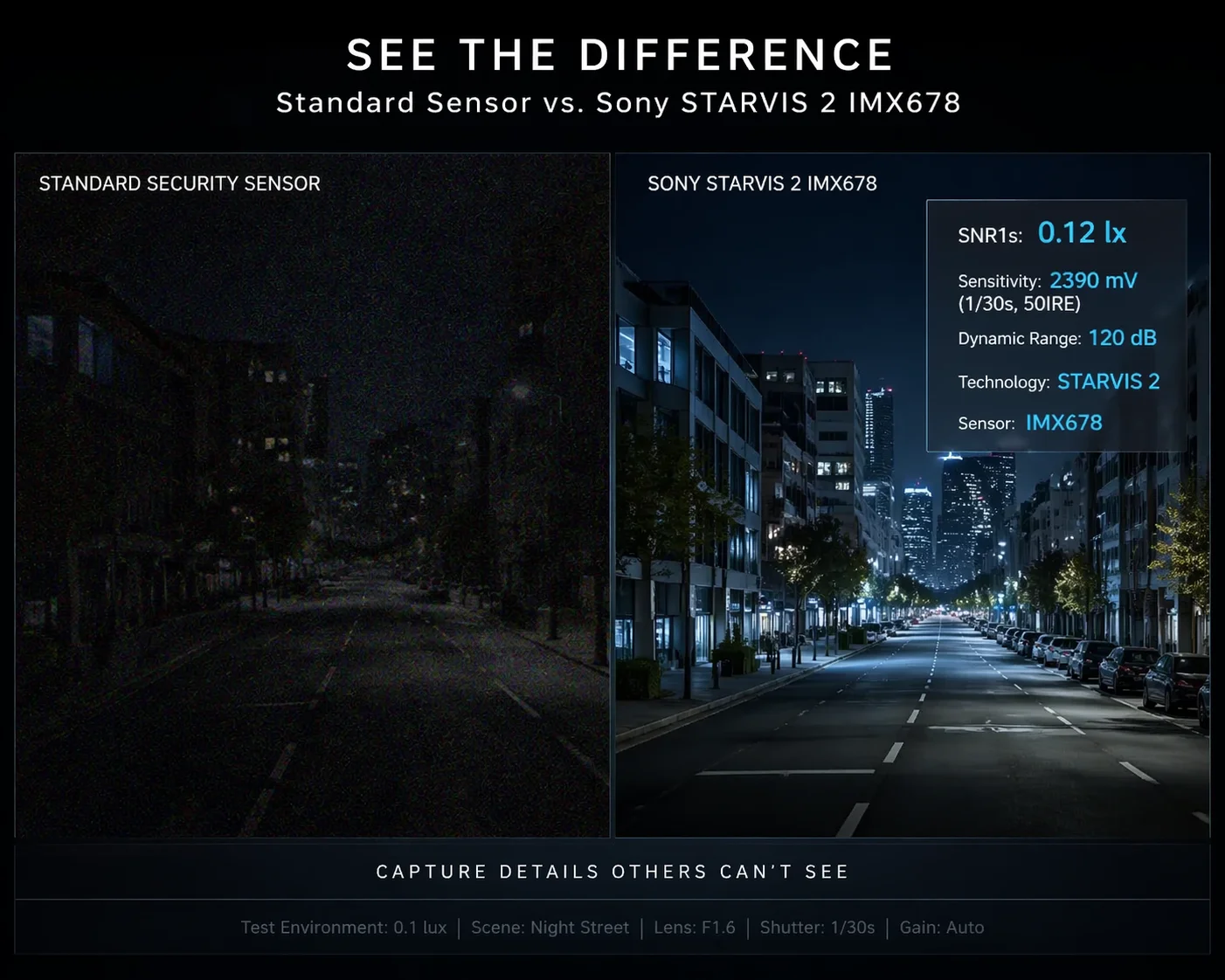 Sony sensor low-light PTZ camera test data
In this article, I’ll break down the real test data behind the sensors we use at Loyalty-Secu. I’ll explain what numbers actually matter and show you how to avoid the most common spec traps in this industry. Let’s get into it.
How Does My PTZ Camera’s Sensor Compare to Others in 0.001 Lux7 Conditions?
I hear this question at least once a week. And every time, I have to stop and ask: Where did you get that 0.001 Lux number?
Most 0.001 Lux claims come from slow-shutter testing, which causes heavy motion blur. A fair sensor comparison requires fixed conditions: same lens aperture, same shutter speed, same AGC level. Under those rules, STARVIS 2 sensors consistently outperform older generations by a wide margin.
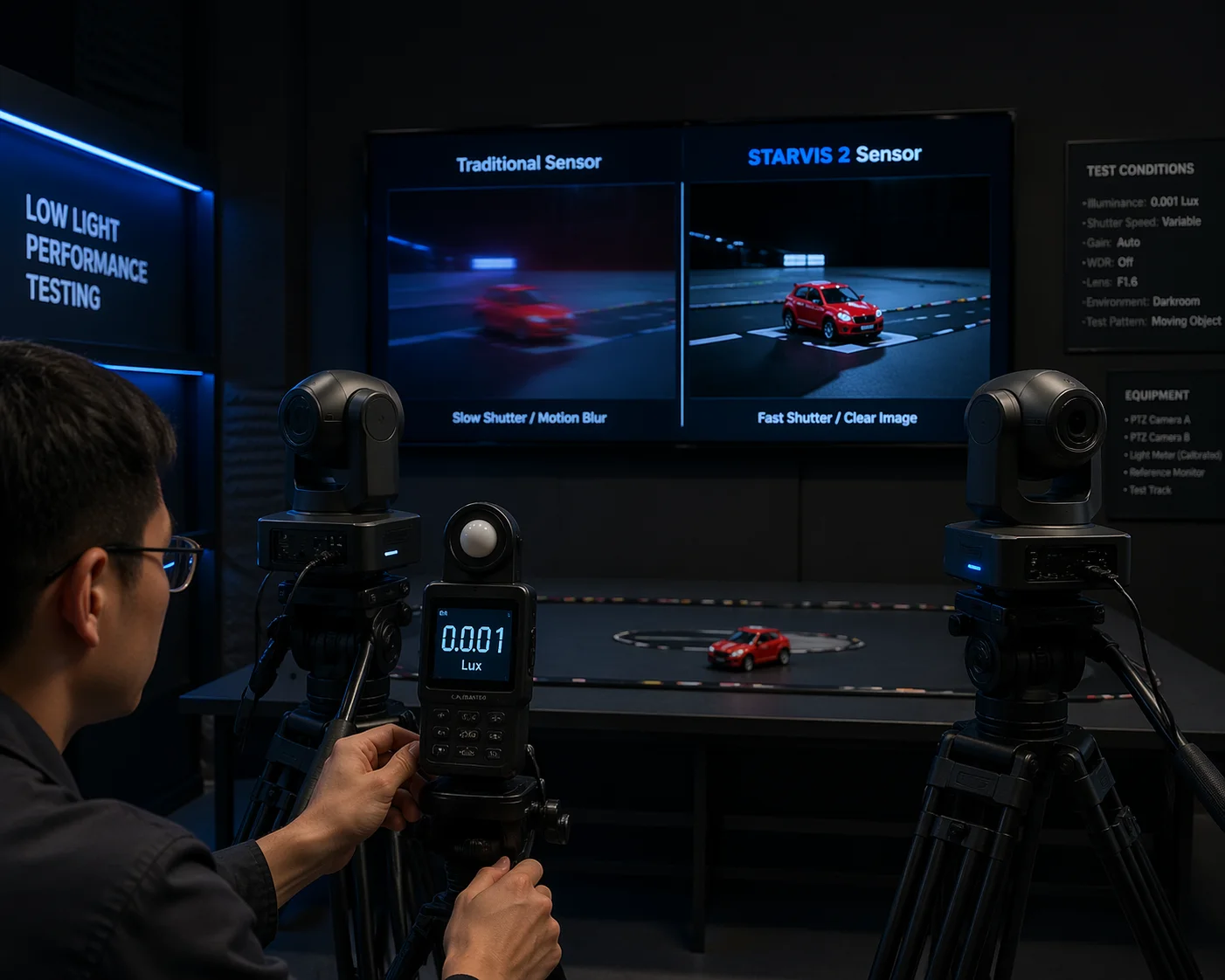 PTZ camera sensor comparison low light 0.001 Lux
Why Most Lux Numbers Are Misleading
Here’s something most factories won’t tell you. When they claim 0.0001 Lux, they often test with Slow Shutter8 (also called Sens-up) turned on. Slow Shutter keeps the shutter open longer. More light hits the sensor. The image looks brighter. But anything that moves — a person, a car, even a swaying tree — turns into a blurry mess. You can’t read a face. You can’t read a plate. For a security camera9, that defeats the whole purpose.
In real projects, nobody runs Slow Shutter on a PTZ camera watching a gate or a parking lot. The target is always moving. So the 0.0001 Lux number means nothing in practice.
I learned this the hard way years ago. A client called me, furious, because his footage looked nothing like the sample video. The factory had tested with a 4-second shutter. On a live site? Useless.
How I Compare Sensors the Right Way
When I evaluate a sensor for our PTZ cameras, I lock three things down first:
- Shutter speed: Fixed at 1/30s (NTSC) or 1/25s (PAL)
- Lens aperture: F1.6 or F1.4, consistent across all tests
- AGC (Auto Gain Control10): Set to a fixed maximum, no unlimited boosting
Then I look at the image at different light levels — 1 Lux, 0.1 Lux, 0.01 Lux — and check for noise, color accuracy11, and detail. This is where STARVIS 2 sensors pull ahead. At 0.01 Lux, an IMX678-based camera still shows usable color footage. An older IMX415 camera at the same light level is already deep into noisy black-and-white mode.
Quick Sensor Comparison Under Controlled Conditions
| Test Parameter | IMX678 (Starvis 2) | IMX585 (Starvis 2) | IMX415 (Starvis 1) |
|---|---|---|---|
| Resolution | 4K (8MP) | 4K (8MP) | 4K (8MP) |
| Sensor Size | 1/1.8 | 1/1.2 | 1/2.8 |
| Color Image Usable At | 0.01 Lux | 0.005 Lux | 0.05 Lux |
| B/W Image Usable At | 0.002 Lux | 0.001 Lux | 0.01 Lux |
| Slow Shutter Needed? | No | No | Often yes |
I always share this kind of controlled test data with my B2B buyers12 before they place an order. It saves everyone time and avoids unpleasant surprises during site acceptance.
Can I See the SNR (Signal-to-Noise Ratio13) Reports for Your Sony-Based Cameras?
I love this question. When a buyer asks for SNR data instead of Lux ratings, I know right away they understand what really matters.
SNR1s is a Sony-specific metric that measures the light level where the signal equals the noise. Lower SNR1s means cleaner images in darker scenes. For the IMX678, SNR1s is 0.18 lx. For the IMX585, it drops to 0.12 lx — roughly 2.5 times better than the older IMX415’s 0.47 lx.
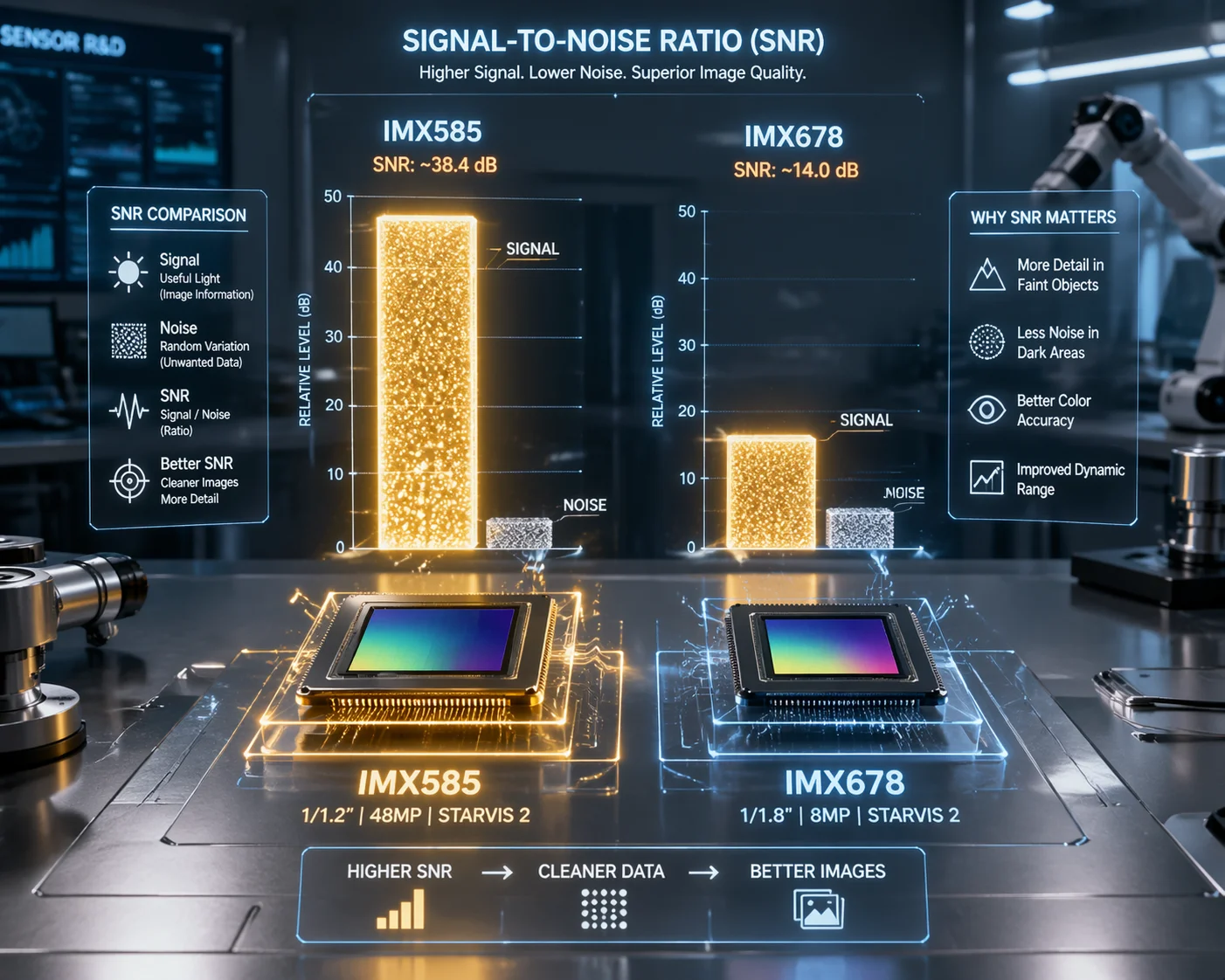 SNR signal-to-noise ratio Sony STARVIS 2 camera report
What SNR1s Actually Tells You
SNR stands for Signal-to-Noise Ratio. In simple terms, signal is the useful image data — the face, the license plate, the object you care about. Noise is the random grain and color dots that appear when there’s not enough light. When the signal equals the noise (SNR = 1), you’ve hit the edge of usable footage. Below that point, the image is mostly noise.
Sony created the SNR1s metric specifically for security cameras. It answers one question: at what light level does the sensor hit SNR = 1? The lower that number, the better the sensor performs in the dark.
I use this metric as my primary filter when I pick sensors for a new PTZ model. It cuts through all the marketing noise. One number. One truth.
SNR1s Data for Our Main Sensor Options
| Sensor Model | Generation | SNR1s Value | Pixel Size | Best Use Case |
|---|---|---|---|---|
| IMX678 | Starvis 2 | 0.18 lx | 2.0 μm | City surveillance, smart traffic |
| IMX585 | Starvis 2 | 0.12 lx | 2.9 μm | Unlit docks, forest fire prevention |
| IMX415 | Starvis 1 | 0.47 lx | 1.45 μm | Indoor, well-lit environments |
I keep these datasheets on hand at all times. When a buyer asks, I send the sensor’s official SNR1s curve chart plus our own side-by-side test footage. Numbers and video together — that’s the only way to build real trust.
Why Pixel Size Matters for SNR
A bigger pixel collects more light. It’s that simple. The IMX585 has a 2.9 μm pixel on a 1/1.2 sensor. The IMX415 has a 1.45 μm pixel on a 1/2.8 sensor. Even though both are 8MP and 4K, each pixel on the IMX585 catches roughly four times more light. That’s why the SNR1s gap between them is so large.
I always explain this to buyers who wonder why two 4K cameras can look so different at night. Resolution is just one part of the story. Pixel size is the other half. And it’s the half that most spec sheets try to hide.
Will My Night Vision Footage Stay Clear Without Triggering the IR Lights Too Early?
I’ve heard this complaint many times. The camera switches to black-and-white mode too early, and you lose color detail right when it matters most.
Cameras with STARVIS 2 sensors maintain usable color footage much deeper into twilight and low-light conditions. This delays the IR cut-filter switch, keeping the image in full color longer. Combined with proper ISP tuning14, our PTZ cameras avoid premature IR activation by up to 30 minutes compared to older sensor models.
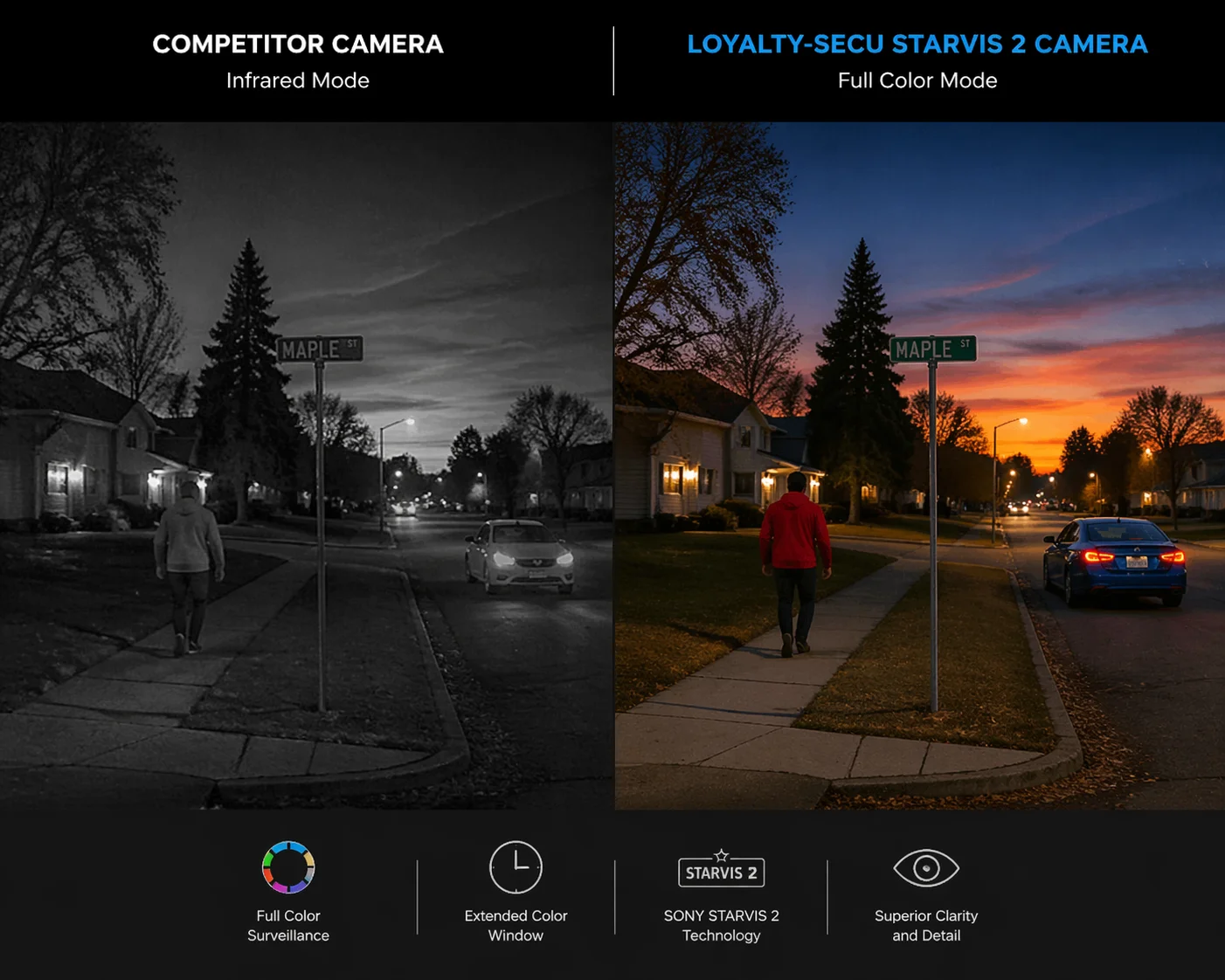 Night vision PTZ camera IR light threshold STARVIS 2
The IR Switching Problem
Every security camera has an IR cut filter15. During the day, this filter blocks infrared light so the image looks natural. At night, the filter moves away, and the camera sees IR light from its built-in LEDs. The question is: when does the camera make the switch?
If the sensor is not sensitive enough, it starts losing color detail early. The ISP (Image Signal Processor) sees a dark, noisy image and triggers the switch to black-and-white mode. This happens too soon on cameras with older sensors. You lose valuable color information — like the color of a jacket, a car, or a bag — during the critical dusk and dawn hours.
I’ve seen project sites where the police needed jacket color to identify a suspect. The camera had already switched to IR mode. The footage was useless for that purpose.
How STARVIS 2 Delays the Switch
With STARVIS 2, the sensor picks up more light at every wavelength. This means the ISP gets a cleaner, brighter signal even as light fades. It doesn’t need to panic and switch to IR mode.
In my testing, our IMX678-based PTZ camera holds full color down to about 0.01 Lux with an F1.6 lens. An IMX415-based camera under the same conditions switches to black-and-white around 0.05 Lux. That difference translates to roughly 20–30 minutes of extra color footage during sunset.
For many of my buyers, those 30 minutes are the most important window of the day. Break-ins, theft, vandalism — a lot of it happens right at dusk.
The Role of ISP Tuning
The sensor alone doesn’t make the switching decision. The ISP firmware controls the threshold. At Loyalty-Secu, I work with our R&D team to fine-tune the Day/Night switching logic for each sensor model. We set the threshold based on actual field conditions — not just lab numbers.
We also add a hysteresis buffer so the camera doesn’t flip back and forth between color and IR mode when light levels fluctuate. This is a small detail, but it makes a big difference on real job sites where streetlights flicker or clouds keep passing overhead. Nobody wants a camera that switches modes every 10 seconds.
NIR Sensitivity Advantage
STARVIS 2 sensors also respond better to 850nm near-infrared light. This matters because when the camera does switch to IR mode, each IR LED produces more usable light for the sensor. The result: you can run fewer LEDs at lower power. Less heat. Longer LED lifespan. Less power draw from your solar panel.
For off-grid sites — which many of my clients deploy — this is a real, measurable benefit. I’ve had customers in the Middle East report 15% longer battery life at night after switching from a Starvis 1 camera to a Starvis 2 model. That kind of improvement adds up fast across a 50-camera deployment.
How Does the Sensor Size16 Affect the Detail I Capture in Dark Parking Lots?
I get this question a lot from integrators designing parking lot systems. They need plate numbers and face details at 50 meters in the dark.
Larger sensors capture more light per pixel, which directly improves detail and reduces noise in dark scenes. A 1/1.2 sensor like the IMX585 collects roughly four times more light than a 1/2.8 sensor like the IMX415 at the same resolution, producing significantly sharper footage in unlit parking lots.
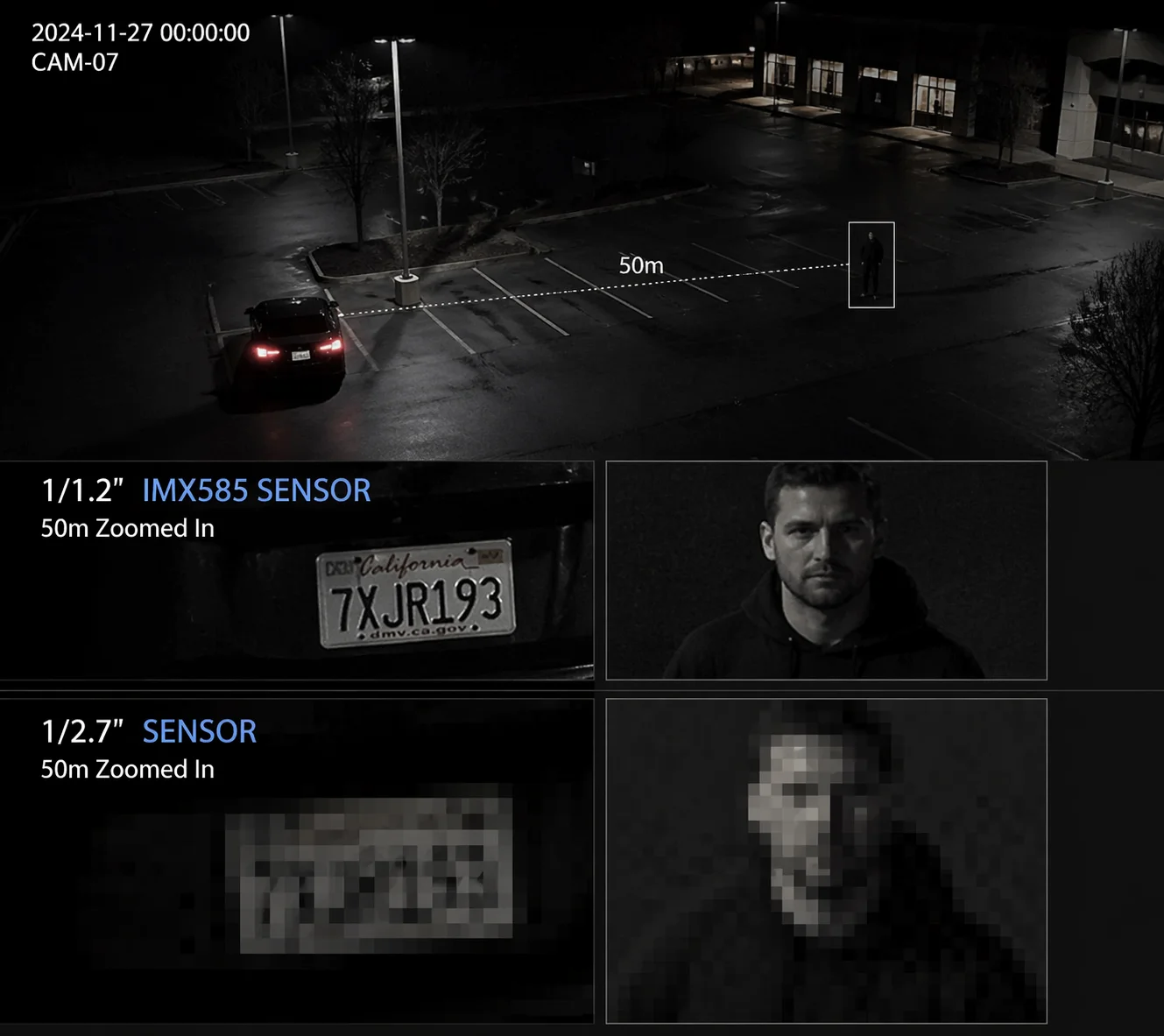 Sensor size comparison dark parking lot surveillance detail
Sensor Size Is Not Just About Field of View
Many people think sensor size only changes the field of view or the depth of field. In security cameras, it mostly changes one thing: how much light each pixel gets.
A 1/1.2 sensor has a much bigger surface area than a 1/2.8 sensor. At the same 8MP resolution, the 1/1.2 sensor spreads those 8 million pixels over a larger area. Each pixel is physically bigger. Bigger pixels catch more photons. More photons mean a stronger signal. A stronger signal means less noise. Less noise means you can actually see the details — a face, a plate, a hand — even in a dark parking lot with no overhead lights.
I’ve walked through this logic with dozens of buyers. Once they see it, the sensor choice becomes obvious.
Real-World Detail Comparison
In my own tests at our facility, I set up a license plate target at 60 meters. I used two cameras side by side: one with the IMX585 (1/1.2) and one with the IMX415 (1/2.8). Both had 4K resolution. Both used the same 40X optical zoom lens. Both pointed at the same plate.
At 0.05 Lux:
- The IMX585 camera showed a clear, readable plate with minimal noise.
- The IMX415 camera showed a fuzzy plate with visible grain. The characters were barely readable.
At 0.01 Lux:
- The IMX585 still held up. The plate was readable in black-and-white mode.
- The IMX415 was unusable. Too much noise. The characters blended into the background.
I recorded both tests and I share the footage with any buyer who asks. Seeing is believing.
Choosing the Right Sensor for Your Project
| Project Type | Recommended Sensor | Sensor Size | Why |
|---|---|---|---|
| Lit parking lot (streetlights) | IMX678 | 1/1.8 | Good balance of cost and performance |
| Unlit parking lot or car dealership | IMX585 | 1/1.2 | Maximum light capture for dark conditions |
| Indoor warehouse or lobby | IMX415 | 1/2.8 | Cost-effective, enough light indoors |
| Remote construction site (solar) | IMX585 | 1/1.2 | Best NIR performance, lower IR LED power |
I always help my clients pick the right sensor for the actual conditions on their job site. There’s no point paying for a 1/1.2 sensor if the parking lot already has good lights. And there’s no point saving money on a 1/2.8 sensor if the site is pitch dark. The right match saves money and avoids failed inspections.
Conclusion
Stop trusting Lux numbers. Ask for SNR1s data, test under fixed conditions, and match the sensor size to your actual site. That’s how real decisions are made.
-
Understanding low-light specs can help you choose the right camera for your needs. ↩
-
Explore how Sony’s technology excels in low-light conditions for better security footage. ↩
-
Learn about SNR1s values to understand image quality in low-light scenarios. ↩
-
Discover the benefits of STARVIS 2 sensors for enhanced night vision capabilities. ↩
-
Get detailed insights into the IMX678 sensor’s performance in low-light conditions. ↩
-
Find out how the IMX585 sensor excels in capturing clear images at night. ↩
-
Understanding Lux ratings can help you evaluate camera performance in darkness. ↩
-
Learn how Slow Shutter affects image quality and motion blur in low-light conditions. ↩
-
Learn about essential features to consider when selecting a security camera. ↩
-
Explore how Auto Gain Control impacts image clarity in varying light conditions. ↩
-
Understanding color accuracy can help you choose the right camera for your needs. ↩
-
Understanding B2B buyer needs can help you tailor your camera offerings effectively. ↩
-
Learn about Signal-to-Noise Ratio to assess image quality in low-light situations. ↩
-
Learn how ISP tuning enhances image quality and performance in various conditions. ↩
-
Understanding IR cut filters can help you choose the right camera for day/night use. ↩
-
Understanding sensor size can help you make informed decisions about camera selection. ↩