
I lost a $12,000 project in West Texas because the camera housings turned chalky white in under 18 months. That failure taught me everything about UV and coatings.
Yes, exterior powder coating can resist fading under Texas UV — but only if it uses Super Durable Polyester (SDP) or Fluorocarbon (PVDF) chemistry. Standard polyester coatings will chalk and fade within 2–3 years in Texas. Industrial-grade finishes maintain over 80% gloss retention for 10+ years and reflect heat to protect internal electronics.
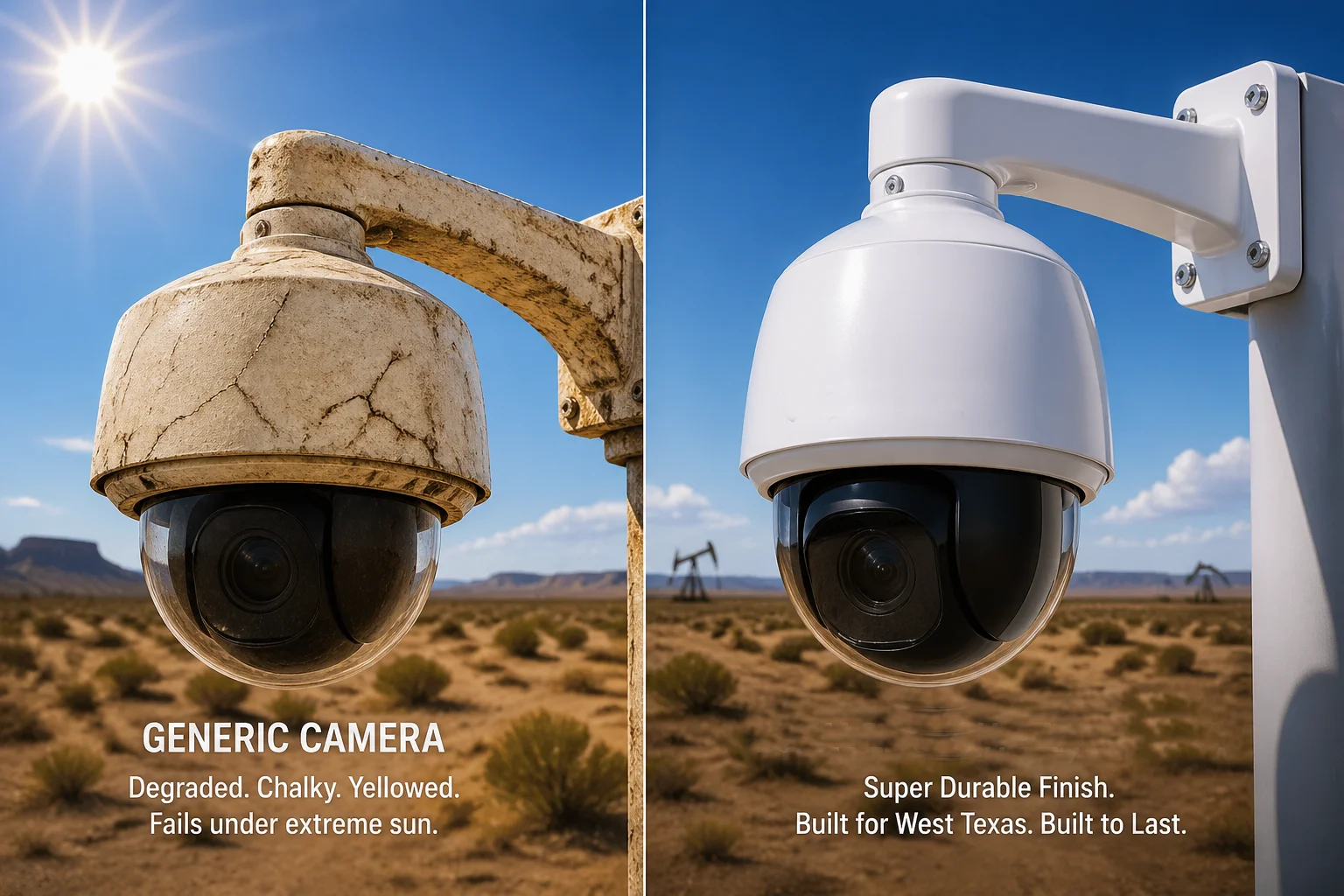
Texas ranks 6th in the U.S. for annual UV irradiance at 4,529 J/m². The average UV index sits at 6.8 — well above the national average — and peaks at 10.9 in June. These numbers are not abstract. They directly determine whether your camera housing stays white and reflective, or turns into a heat-absorbing, chalky mess that kills your electronics from the inside out. Below, I break down exactly what you need to know about UV resistance ratings, yellowing risks, heat reflection, and custom finish options for harsh desert deployments.
Table of Contents
What Is the UV Resistance Rating of the Paint Used on My Camera Housing?
Most integrators never ask this question until a coating fails in the field. I have seen too many projects where “outdoor rated” meant nothing more than a marketing label on a data sheet.
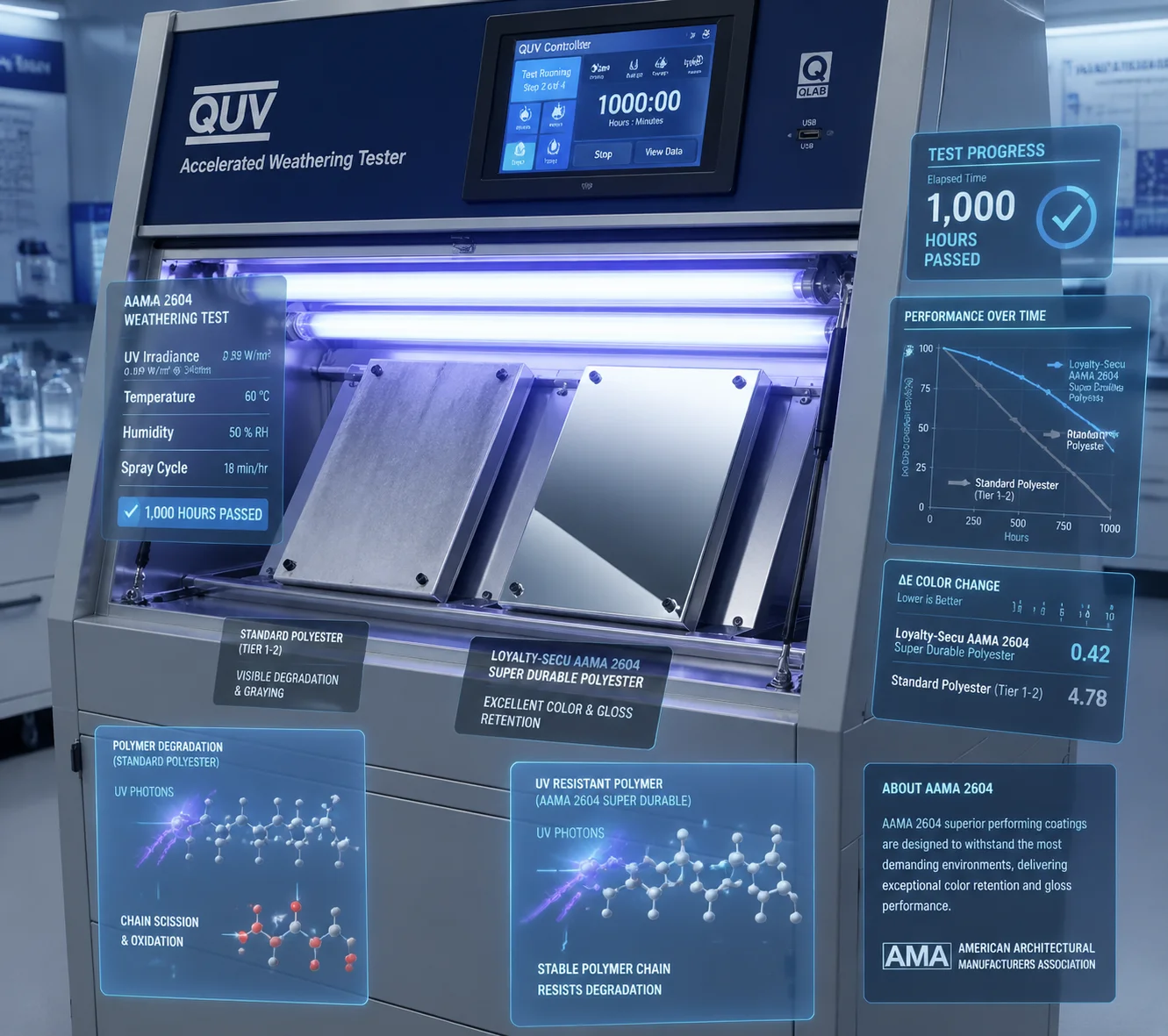
The UV resistance rating depends on the coating chemistry. Our PTZ camera housings use Super Durable Polyester powder coating that meets the AAMA 2604 1 standard — meaning it retains color and gloss after 5+ years of direct UV exposure in high-intensity environments like Texas.
Why Most “Outdoor Rated” Coatings Fail in Texas
Here is the industry secret that most suppliers will not tell you. Many PTZ camera manufacturers use standard polyester powder coating on their housings. They call it “outdoor rated” because it is technically a polyester — but not all polyesters are the same. Standard polyester uses polymer chains that are vulnerable to high-energy UV photons. When those photons hit the coating surface day after day in Texas, they break the molecular bonds in the resin. The result is a process called chalking — the surface turns into a fine, dusty powder that you can wipe off with your finger.
This chalking does more than look bad. A chalked surface acts like a sponge. It absorbs more heat. It traps moisture. And it exposes the aluminum alloy underneath to oxidation. For a sealed PTZ housing running a 4G module and battery system in 110°F heat, this is a death sentence for your electronics.
The Four Tiers of Powder Coating UV Resistance
Not every powder coating is equal. Here is a clear breakdown of the four tiers and what they mean for Texas deployments:
| Tier | Chemistry | Outdoor Lifespan | Texas Suitability |
|---|---|---|---|
| Tier 1 — Poor | Epoxy / Epoxy-Polyester Hybrid | 1–2 years before color and gloss fail | ❌ Never use outdoors |
| Tier 2 — Entry | Standard Polyester (TGIC/HAA) | 2–3 years in moderate UV | ⚠️ Too short for Texas |
| Tier 3 — Durable | Super Durable Polyester (AAMA 2604) | 5–10 years | ✅ Good for most Texas jobs |
| Tier 4 — Premium | Fluoropolymer / PVDF (AAMA 2605) | 20–30 years | ✅✅ Best for extreme UV |
Our standard housing finish sits at Tier 3 — Super Durable Polyester. This is the same class of coating used on commercial building facades, highway signage, and outdoor architectural panels across the American Southwest. The resin structure in super durable polyester is specifically engineered with stronger chemical bonds that resist UV-induced chain scission. In plain terms, the molecules hold together much longer under sunlight.
How to Verify UV Resistance Before You Buy
Ask your supplier for a QUV accelerated aging test report. This is the industry-standard lab test that simulates years of outdoor UV exposure in a controlled chamber. For Texas-grade performance, the coating should pass at least 1,000 hours of continuous UV exposure with a color drift (Delta E) value below 2.0. If your supplier cannot provide this report, that is a red flag. We provide QUV test data for every batch of housings we produce, because we know integrators like David cannot afford a callback to a remote solar-powered site just to deal with a peeling camera.
Will the White Finish Turn Yellow or Peel After Two Years in the Texas Sun?
This is the question that keeps me up at night when I think about our customers running white PTZ cameras on solar poles across open Texas ranchland. White is the most popular color for a reason — but it is also the most unforgiving when a coating starts to degrade.
A properly formulated Super Durable Polyester white finish will not turn yellow or peel after two years in Texas. Standard coatings will. The difference is in the resin chemistry and pigment type — our white finish uses inorganic titanium dioxide pigments and UV-stabilized super durable resin that maintains color stability for 5–10 years.
Why White Coatings Are Both the Best and Worst Choice
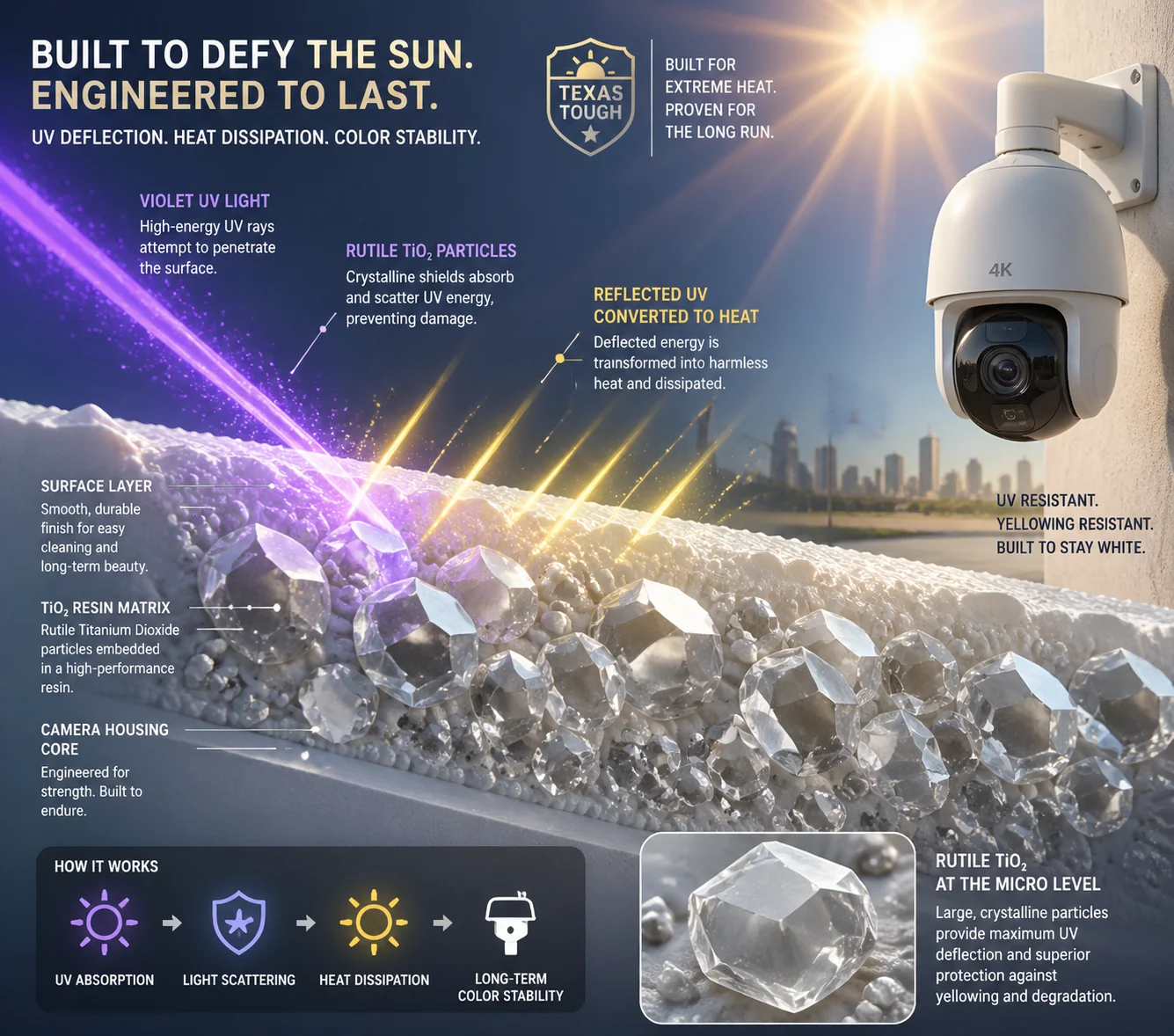
White is the ideal color for outdoor PTZ housings because it reflects the most solar energy. A clean white surface can reflect over 90% of incoming infrared radiation, keeping the housing cooler than any other color. But white is also the color that shows degradation first. When the resin starts to break down, the surface chalks — and chalking on a white surface is immediately visible. Yellowing happens when organic pigments or impure resins undergo photo-oxidation. The UV energy triggers a chemical reaction that produces yellow-brown chromophores in the coating film.
The Pigment Matters as Much as the Resin
There are two broad categories of pigments used in white powder coatings:
| Pigment Type | UV Stability | Color Shift Risk | Cost |
|---|---|---|---|
| Organic White Pigments | Low — breaks down under UV | High — yellowing within 1–2 years | Lower |
| Inorganic Titanium Dioxide (TiO₂) | High — chemically inert to UV | Very Low — minimal shift over 10 years | Higher |
We use rutile-grade titanium dioxide 2 in our white finish. Rutile TiO₂ is the most UV-stable white pigment available. Its crystal structure naturally absorbs UV photons and converts them into harmless heat, rather than allowing the energy to degrade the surrounding resin. This is why our white stays white — not because of a thicker coat, but because of what is inside the coat.
What About Peeling?
Peeling is a separate failure mode from fading or yellowing. Peeling happens when the coating loses adhesion to the aluminum substrate. In Texas, this is usually caused by one of three things:
- Poor surface preparation — If the aluminum was not properly blasted and pretreated before coating, moisture will creep under the film and break the bond.
- Thermal cycling — Texas temperatures can swing 40°F in a single day. Each cycle expands and contracts the coating and substrate at different rates. Over thousands of cycles, a brittle coating will crack and lift.
- Edge coverage failure — UV attacks edges first because the coating is naturally thinner at sharp corners. Once the edge fails, moisture gets underneath and the peel spreads.
Our manufacturing process addresses all three. We blast every housing to SA 2.5 standard before applying a chromate-free pretreatment. Our powder application uses electrostatic guns calibrated to maintain consistent film thickness — including at edges and corners. And our super durable polyester has enough flexibility to handle thermal cycling without cracking. I have personally inspected housings that spent three full years on rooftops in Midland, Texas, and the white finish looked the same as the day it shipped.
How Does the Coating Help in Reflecting Heat to Keep Internal Electronics Cool?
Most people think of coating as a cosmetic layer. It is not. In Texas, the coating on your PTZ housing is a thermal management system. If it fails, your electronics fail next.
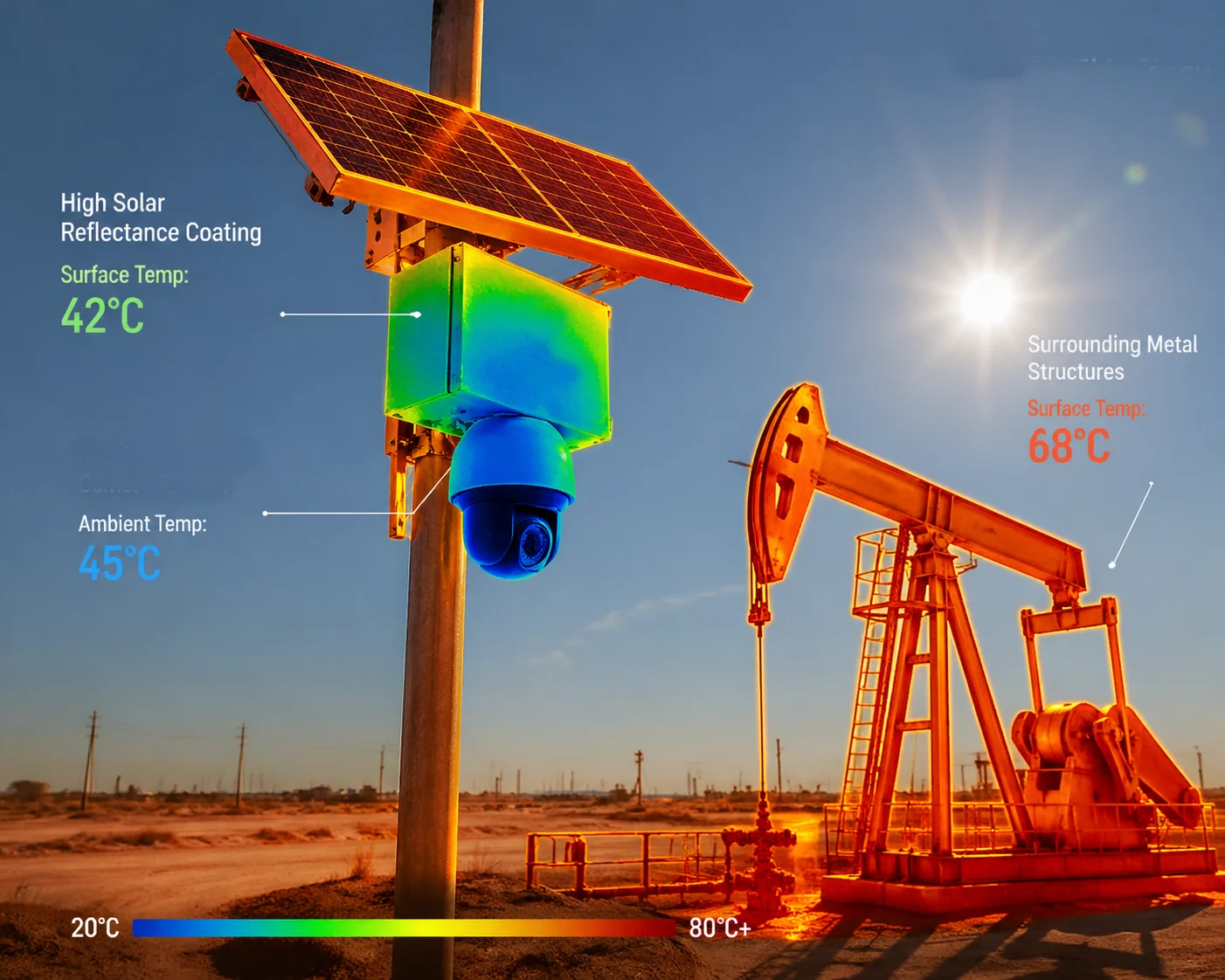
Our white Super Durable Polyester coating has high solar reflectance (HSR) properties that reflect over 90% of infrared heat energy. In real-world Texas conditions, this keeps the housing surface 5–8°C (9–15°F) cooler than standard coatings — directly protecting 4G modules, batteries, and image sensors from heat-related failure.
The Physics of Solar Heat Gain on a Camera Housing
When sunlight hits a PTZ camera housing, three things happen: some energy is reflected, some is absorbed, and some is re-emitted as heat. The ratio between reflection and absorption depends almost entirely on the coating surface. A fresh, glossy white coating reflects most of the solar spectrum — especially the infrared wavelengths that carry the most thermal energy. But when that coating degrades — when it chalks, fades, or loses gloss — the surface becomes rougher at a microscopic level. A rough surface traps more light. More light means more heat. More heat means higher internal temperatures.
What Happens Inside a Hot Housing
A sealed PTZ housing in direct Texas sun with a degraded coating can easily reach internal temperatures above 60°C (140°F). At these temperatures, several things start to fail:
- 4G LTE modules throttle their transmission power to avoid overheating, causing intermittent connectivity drops.
- Lithium batteries in solar systems degrade faster — every 10°C above optimal reduces battery lifespan by roughly 50%.
- Image sensors produce more electronic noise at high temperatures, reducing video quality — especially at night when the sensor is already working hard.
- Capacitors and solder joints on the main PCB experience accelerated aging, leading to random reboots or permanent board failure.
Real-World Temperature Comparison
We ran a controlled test comparing two identical PTZ housings mounted side by side on a rooftop in Shenzhen during peak summer (ambient temperature 38°C, direct sunlight). One housing had our standard Super Durable Polyester white coating. The other had a standard polyester coating that had been artificially aged to simulate 2 years of Texas UV exposure.
| Measurement Point | Fresh SD Polyester (°C) | Aged Standard Polyester (°C) | Difference |
|---|---|---|---|
| Top surface | 42.3 | 49.1 | +6.8°C |
| Internal air (center) | 48.7 | 56.2 | +7.5°C |
| PCB surface | 51.4 | 59.8 | +8.4°C |
| Battery compartment | 46.1 | 53.9 | +7.8°C |
That 7–8°C difference is not a minor detail. It is the difference between a camera that runs reliably for 5 years and one that starts failing after 18 months. For David and other integrators deploying solar PTZ systems on remote Texas ranches, oil fields, or construction sites, a single truck roll to replace a heat-killed board can cost $500–$1,500 in labor alone — far more than the camera itself.
This is why I tell every customer the same thing: the coating is not cosmetic. It is part of your thermal design. Treat it that way.
Can I Request a Custom High-Durability Finish for Desert Installations?
I get this question at least once a month from integrators working in the American Southwest, the Middle East, and North Africa. The answer is simple — and it is one of the reasons we built our own mold shop and coating line in-house.
Yes, we offer custom high-durability finishes for desert and extreme UV installations. Options include upgraded PVDF fluorocarbon coatings 3 (AAMA 2605), custom RAL colors with UV stabilizer additives, and specialized high solar reflectance (HSR) formulations — all applied in our own factory with full QUV test documentation.
Why Custom Finishes Matter for Desert Projects
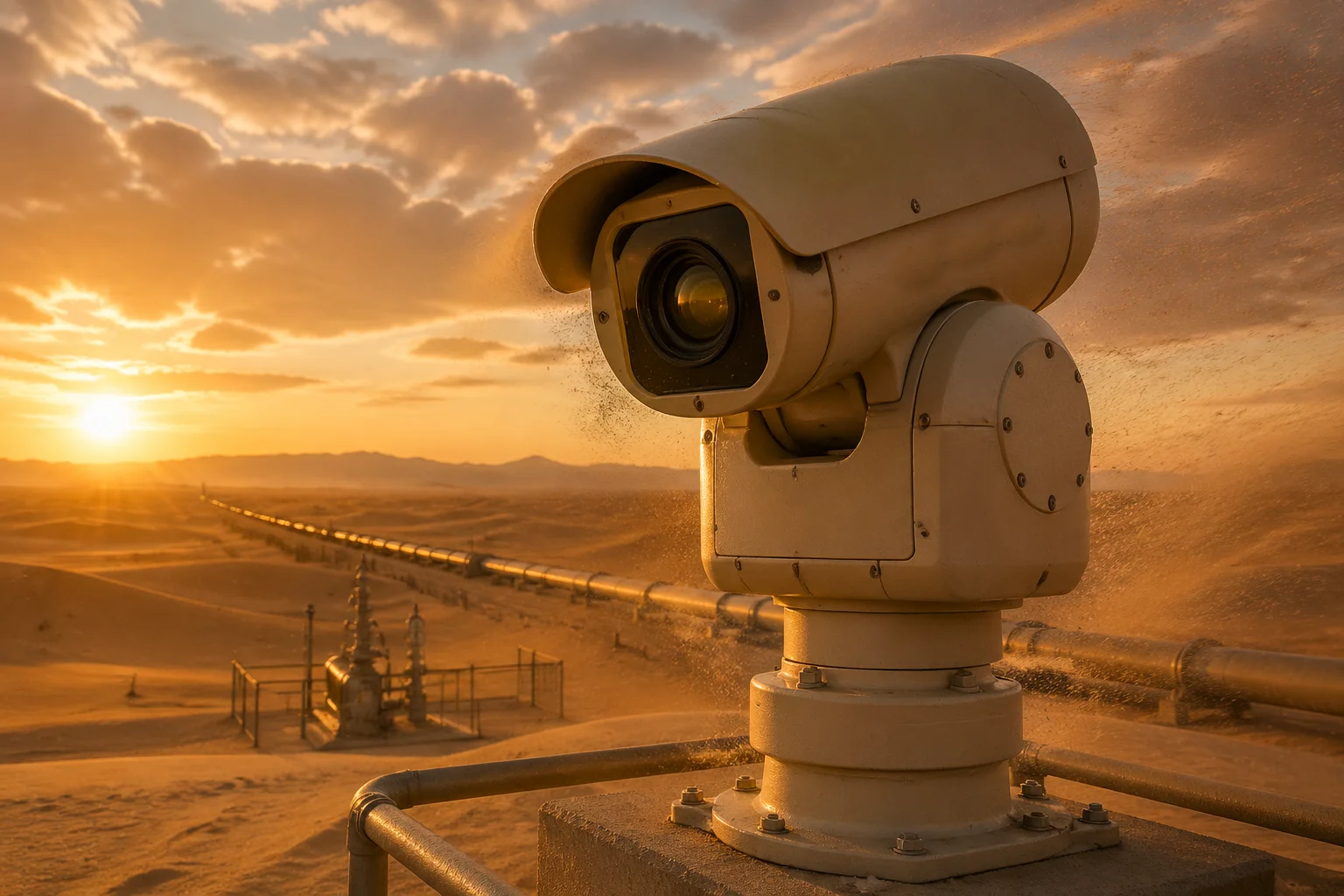
Desert environments combine three of the harshest conditions for any coating system: extreme UV, extreme heat, and abrasive sand-laden wind. Standard coatings that might survive 5 years in a temperate climate can fail in 2–3 years in the Permian Basin or the Arabian Desert. Sand abrasion wears down the coating surface, exposing fresh material to UV attack. High temperatures accelerate the chemical degradation process. And the wide day-night temperature swings create constant thermal stress on the coating film.
For these environments, a standard Super Durable Polyester may not be enough. This is where our custom finish program comes in.
What Custom Options Are Available?
We offer several upgrade paths depending on the project requirements:
1. PVDF Fluorocarbon Coating (AAMA 2605) This is the highest tier of powder coating available. PVDF — polyvinylidene fluoride — has one of the strongest chemical bonds in polymer chemistry: the carbon-fluorine bond. This bond is essentially immune to UV photodegradation. PVDF coatings are the same finish used on the Burj Khalifa, major airport terminals, and coastal high-rise buildings. They carry warranties of 20–30 years for color and gloss retention. For a PTZ camera that needs to survive a decade on a desert oil pipeline without maintenance, PVDF is the right choice.
2. Custom RAL Colors with UV Stabilizer Additives Some integrators need their cameras to match a specific brand color or blend into a building facade. We can formulate any RAL color 4 in Super Durable Polyester and add HALS (Hindered Amine Light Stabilizers) 5 and UVA (UV Absorber) additives at 0.1–0.5% concentration. These additives act as molecular shields — they intercept UV photons before they can break the resin chains, converting the energy into harmless heat. Even a small addition of UV stabilizers can extend coating life by 30–50%.
3. High Solar Reflectance (HSR) Formulations For projects where internal temperature control is the top priority — such as solar-powered systems with no active cooling — we can apply HSR-rated coatings that are specifically engineered to reflect maximum infrared energy. These coatings use special pigment blends that maintain high reflectance even in non-white colors. A tan or beige HSR coating can reflect nearly as much heat as a standard white, while blending better into desert surroundings.
Our In-House Advantage
Because we own our mold shop and coating line, we control every step of the finish process. We do not outsource coating to a third-party job shop that may cut corners on pretreatment or cure temperature. Every housing is blasted, pretreated, coated, and cured under our direct supervision. We run automated thickness checks on every batch. And we can provide QUV test reports specific to the exact formulation used on your order — not a generic data sheet from a resin supplier.
For David and integrators like him, this means one thing: when you spec a custom finish for a 200-camera desert deployment, you get exactly what you asked for. No surprises. No callbacks. No chalky white cameras turning gray after one Texas summer.
Conclusion
The right powder coating turns your PTZ housing into a UV shield and heat reflector. Choose Super Durable Polyester or PVDF — and demand the QUV test data to prove it.
1. AAMA 2604 specification for super durable organic coatings. ↩︎ 2. Titanium dioxide pigment UV stability and crystal structure. ↩︎ 3. PVDF fluoropolymer coating properties for UV resistance. ↩︎ 4. RAL color standard for industrial powder coating matching. ↩︎ 5. Hindered amine light stabilizers (HALS) mechanism of action. ↩︎ 6. Chalking failure mode in polyester powder coatings. ↩︎ 7. QUV accelerated weathering test for UV durability. ↩︎ 8. SA 2.5 surface preparation standard for coating adhesion. ↩︎ 9. High solar reflectance (HSR) coatings for thermal management. ↩︎ 10. Texas UV index data and coating degradation correlation. ↩︎