
I’ve lost count of how many times a client called me because their off-grid camera died after three rainy days. It’s a painful problem.
Yes, a smart controller can auto-adjust camera power based on real-time SOC. The system reads battery percentage continuously and steps down camera functions in stages — cutting IR lasers, lowering video bitrate, and entering sleep mode — to keep the system alive through extended low-light periods.
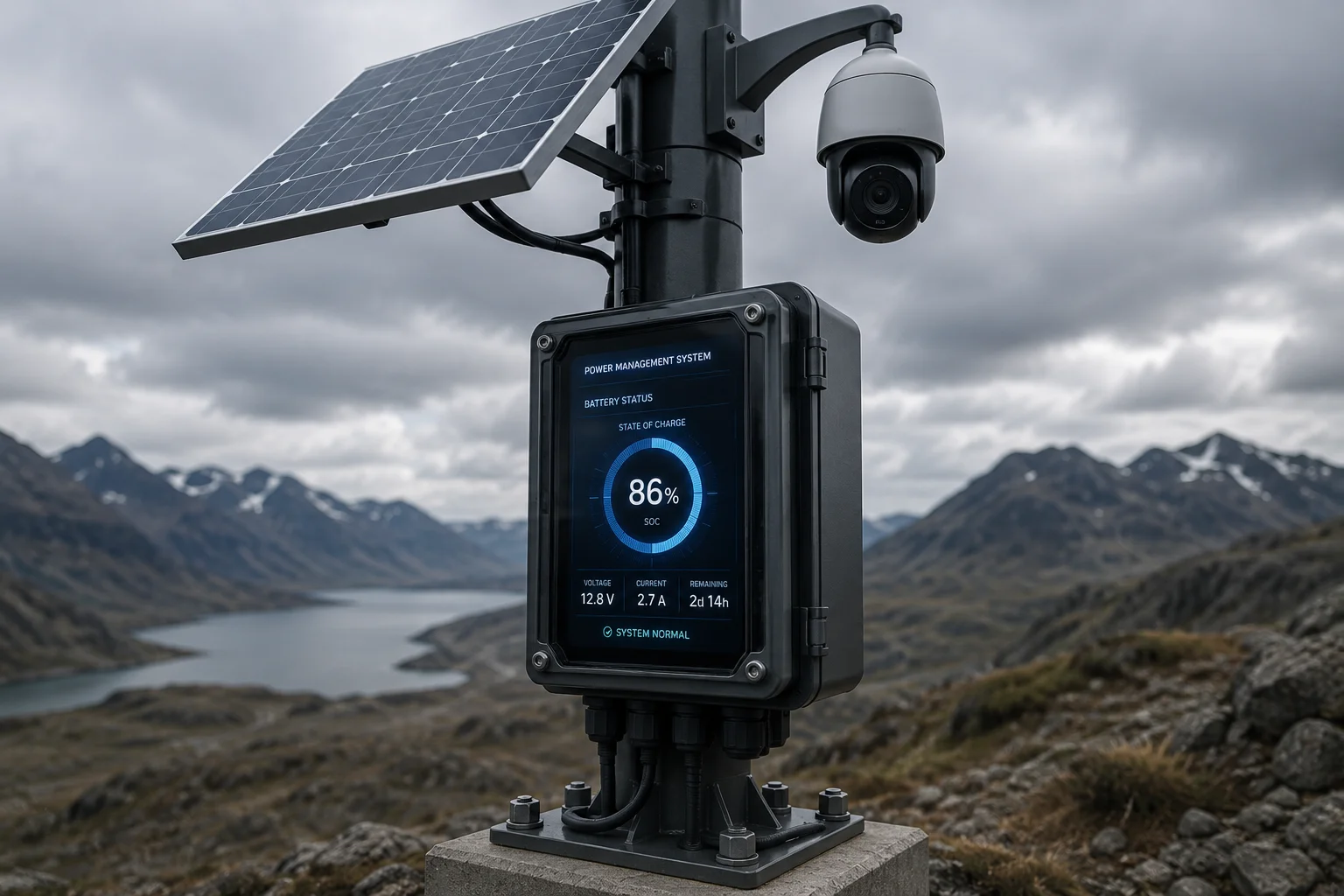
Below, I’ll walk you through exactly how this works at each threshold, what you can customize, and why this logic is the difference between a system that survives 10 days of rain and one that goes dark on day three.
Table of Contents
Will the Camera Automatically Disable the High-Power Laser IR if the Battery Hits 30%?
Running a 50W laser IR1 all night when your battery is already at 30% is like flooring the gas pedal with your fuel light on. I’ve seen it kill systems overnight.
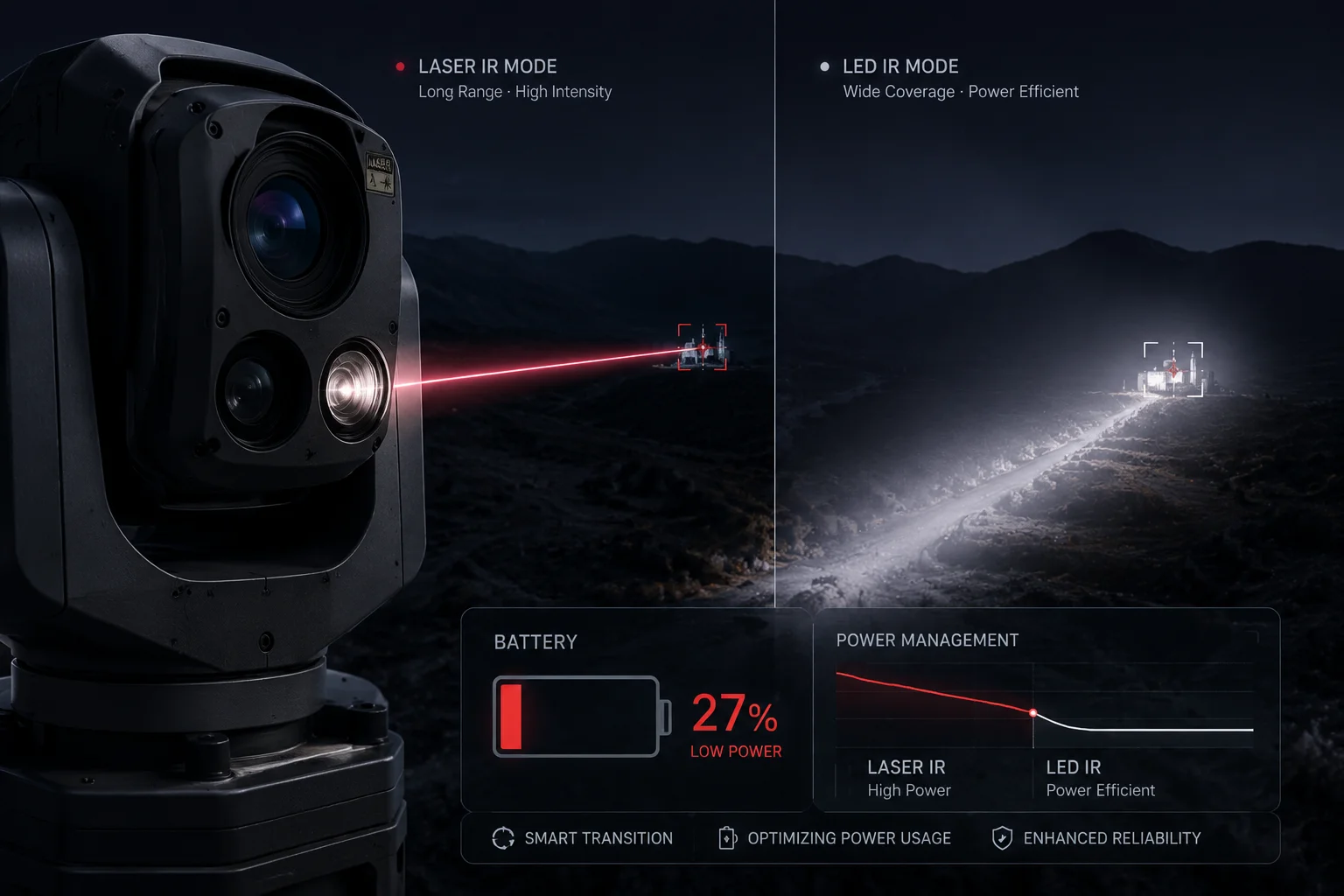
When SOC drops below a set threshold (typically 30–40%), the controller sends a command to the camera to shut down the high-power laser IR and switch to standard infrared LEDs. This single action alone can cut nighttime power draw by 50% or more.
How the IR Shutdown Logic Works
The controller monitors battery voltage and SOC in real time. When the value crosses your preset line — say 30% — it triggers a relay or sends a digital command over RS4852 to the camera module. The camera then switches from its high-power laser illuminator to a low-power IR LED array.
This is not a slow fade. It’s a hard switch. The reason is simple: laser IR modules on long-range PTZ cameras3 can draw 15W to 30W on their own. Standard IR LEDs on the same camera might draw 3W to 5W. That’s an instant saving of 10W to 25W.
What Happens to Image Quality?
You lose range. A laser IR that lights up targets at 500 meters will be replaced by standard IR that covers maybe 80 to 100 meters. But here’s the trade-off: you keep the system running. A dead camera sees nothing at any range.
Practical Threshold Settings
| SOC Level | IR Behavior | Estimated Power Saving |
|---|---|---|
| Above 40% | Full laser IR active | Baseline (no saving) |
| 30% – 40% | Laser IR off, standard IR on | 10W – 25W saved |
| Below 25% | All IR off, camera enters trigger mode | 15W – 30W saved |
Can You Override This?
Yes. In most of our systems, you can set the threshold anywhere from 20% to 50% through the app or web interface. If you know a site has good solar exposure and tomorrow will be sunny, you might let the laser run longer. If a week of storms is coming, you tighten the threshold early.
I always tell clients like David: set it once based on your worst-case weather window, then forget it. The controller handles the rest. You don’t want to babysit a camera on a pole 40 miles from the nearest road.
Does the System Enter a “Deep Sleep” Mode to Prioritize Basic Heartbeat Pings Over 4K Video?
Streaming 4K video 24/7 over 4G burns through battery like nothing else. I’ve tested it — a fully charged 40Ah battery lasts barely two days under constant 4K streaming.
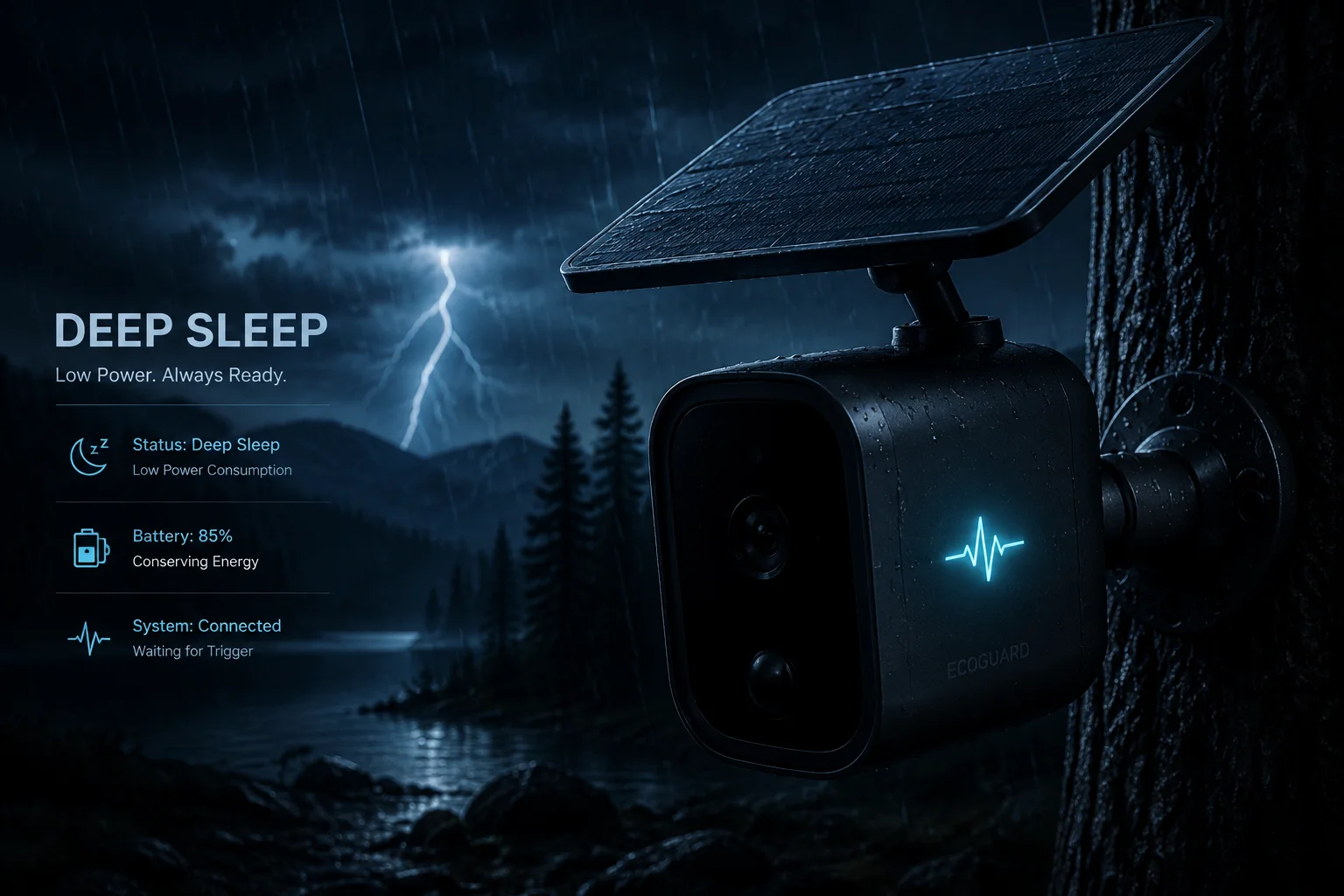
Yes, when SOC falls below a critical level (usually 15–25%), the system enters Deep Sleep mode. It stops all video streaming and recording, keeps only a minimal heartbeat ping alive over 4G, and waits for either a motion trigger or solar recharge to wake up.
What “Deep Sleep” Actually Means in Hardware Terms
Deep Sleep is not just software throttling. The controller physically cuts power to certain subsystems. The image sensor (ISP) goes idle. The video encoder stops. The 4G module7 drops from full data mode to a low-power registration mode where it sends a tiny packet — maybe 50 bytes — every 30 to 60 seconds. This packet tells your cloud platform: “I’m still here. Battery is at X%. Waiting.”
That heartbeat ping uses less than 0.1W. Compare that to full 4K streaming over 4G, which can pull 6W to 10W from the camera alone.
The Wake-Up Mechanism
When the system is in Deep Sleep, it’s not blind. A PIR sensor4 or a low-power radar module stays active. These sensors draw micro-amps. If a person or vehicle enters the detection zone, the sensor sends a hardware interrupt to the main processor. The camera boots in 1 to 2 seconds, records a clip, pushes an alert, and goes back to sleep.
Deep Sleep Power Budget
| Component | Active Power | Deep Sleep Power |
|---|---|---|
| Image sensor + ISP | 3W – 5W | 0W (off) |
| 4G module (streaming) | 2W – 4W | 0.05W (heartbeat only) |
| Video encoder | 1W – 2W | 0W (off) |
| PIR / Radar sensor | 0.1W | 0.1W (always on) |
| Controller MCU | 0.5W | 0.3W (low-power mode) |
| Total | 6.6W – 11.6W | < 0.5W |
Why This Matters for Multi-Day Rain Events
A 40Ah lithium battery5 at 12V holds about 480Wh of usable energy (assuming 80% depth of discharge). At full power (10W average), that’s 48 hours. In Deep Sleep at 0.5W, that same battery lasts 960 hours — 40 days. Even accounting for occasional wake-ups and recordings, you can easily survive 10 to 15 days of zero solar input.
This is the math that matters to integrators like David. It’s not about fancy features. It’s about whether the system is still online when the sun comes back.
Can I Set Custom Thresholds for When the Camera Should Stop Non-Essential AI Tracking?
AI tracking is powerful, but it’s also power-hungry. The processor runs hot, the PTZ motor moves constantly, and the whole system draws peak current. In an off-grid setup, that’s a luxury you can’t always afford.
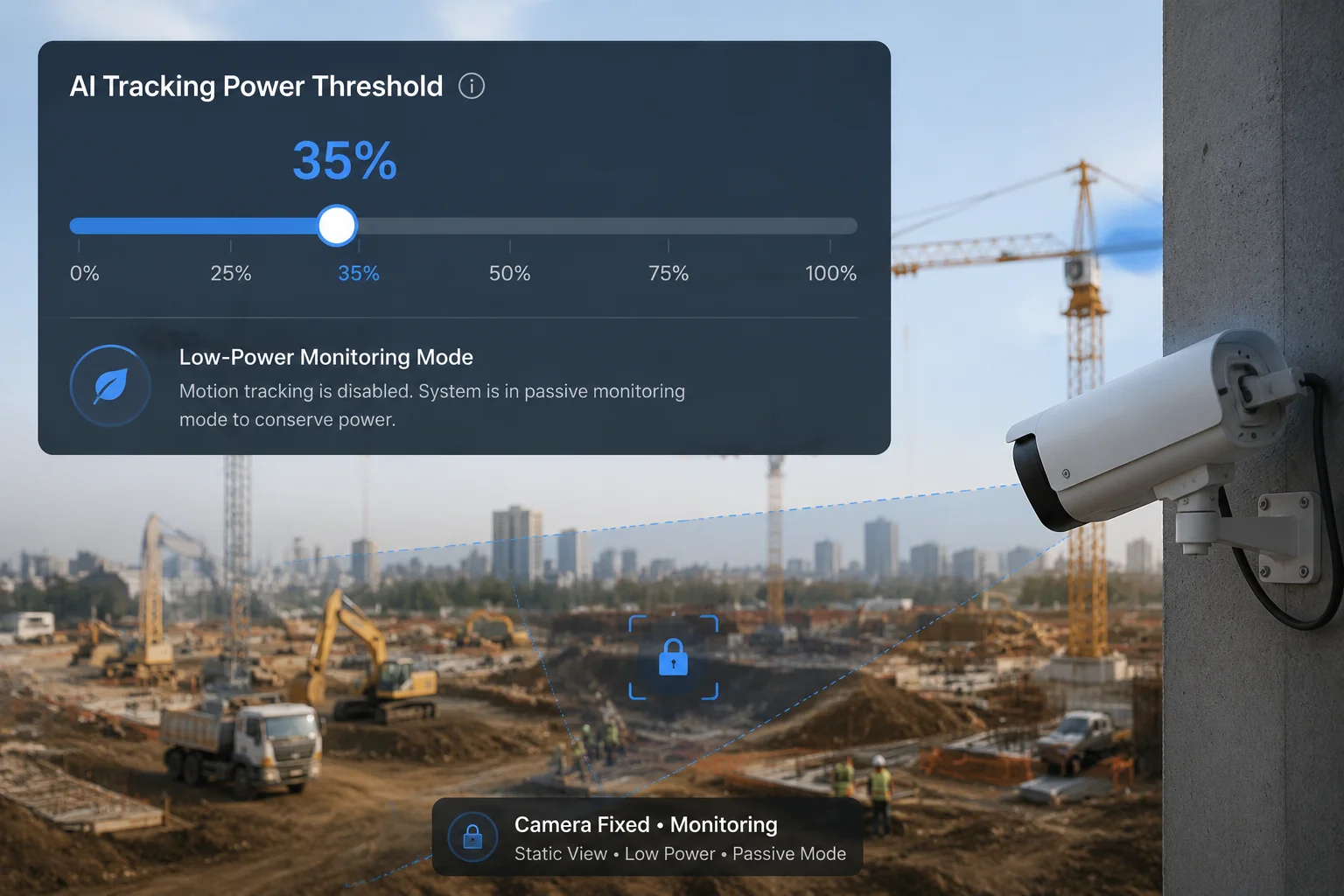
Yes, you can set custom SOC thresholds to disable AI tracking features. Most controllers allow you to define the exact percentage — say 35% or 40% — at which the system stops auto-tracking, locks the PTZ in a preset position, and switches to passive detection only.
Why AI Tracking Is a Power Problem
AI-based auto-tracking does three expensive things at once:
- Continuous video analysis — The neural network processor (NPU8) runs object detection on every frame. This adds 1W to 3W of constant draw.
- Motor movement — The PTZ motors adjust pan, tilt, and zoom to follow a target. Each motor activation creates a current spike of 2A to 5A for a brief moment.
- Extended recording — Tracking events tend to generate longer video clips, which means more encoding, more storage writes, and more 4G upload time.
When your battery is healthy, this is fine. When SOC is dropping and the sky is grey, every watt counts.
How to Configure the Threshold
In our controller interface, you’ll find a section called “Power Management” or “Energy Strategy.” Inside, there’s a slider or input field for each feature:
- AI Tracking Off: Set to your preferred SOC (e.g., 35%)
- PTZ Patrol Off: Set to your preferred SOC (e.g., 40%)
- White Light Off: Set to your preferred SOC (e.g., 45%)
Once the battery drops below your number, the feature shuts off automatically. When the battery charges back above that number (plus a hysteresis buffer of 3–5%), the feature turns back on.
The Hysteresis Buffer Explained
Why the buffer? Without it, the system would flicker. Imagine SOC sitting right at 35%. AI tracking turns off. Battery recovers to 35.1%. Tracking turns on. Battery drops to 34.9%. Tracking turns off again. This cycling is bad for hardware and confusing for the user.
The hysteresis buffer9 means: if your “off” threshold is 35%, the “on” threshold might be 38% or 40%. The system needs to recover meaningfully before it re-enables the feature.
What Replaces AI Tracking When It’s Off?
The camera doesn’t go blind. It falls back to simpler detection methods:
- PIR-triggered recording — No AI needed. A hardware sensor detects heat signatures and triggers a basic recording.
- Fixed preset monitoring — The PTZ locks onto your most important angle and stays there.
- Motion detection (pixel-based) — A lightweight algorithm that uses almost no extra processing power.
These fallback methods use a fraction of the power while still giving you basic security coverage.
How Does the SOC-Based Logic Help My Camera Survive 10 Consecutive Days of Rain?
Ten days of rain with no sun. That’s the nightmare scenario for any off-grid solar system. I’ve tested our setups in exactly this condition, and the SOC-based logic is what makes survival possible.
The SOC-based logic helps your camera survive extended rain by progressively reducing power consumption as the battery drains. It moves through stages — from full power to energy saving to deep sleep — stretching a 40Ah battery from 2 days of runtime to over 15 days.
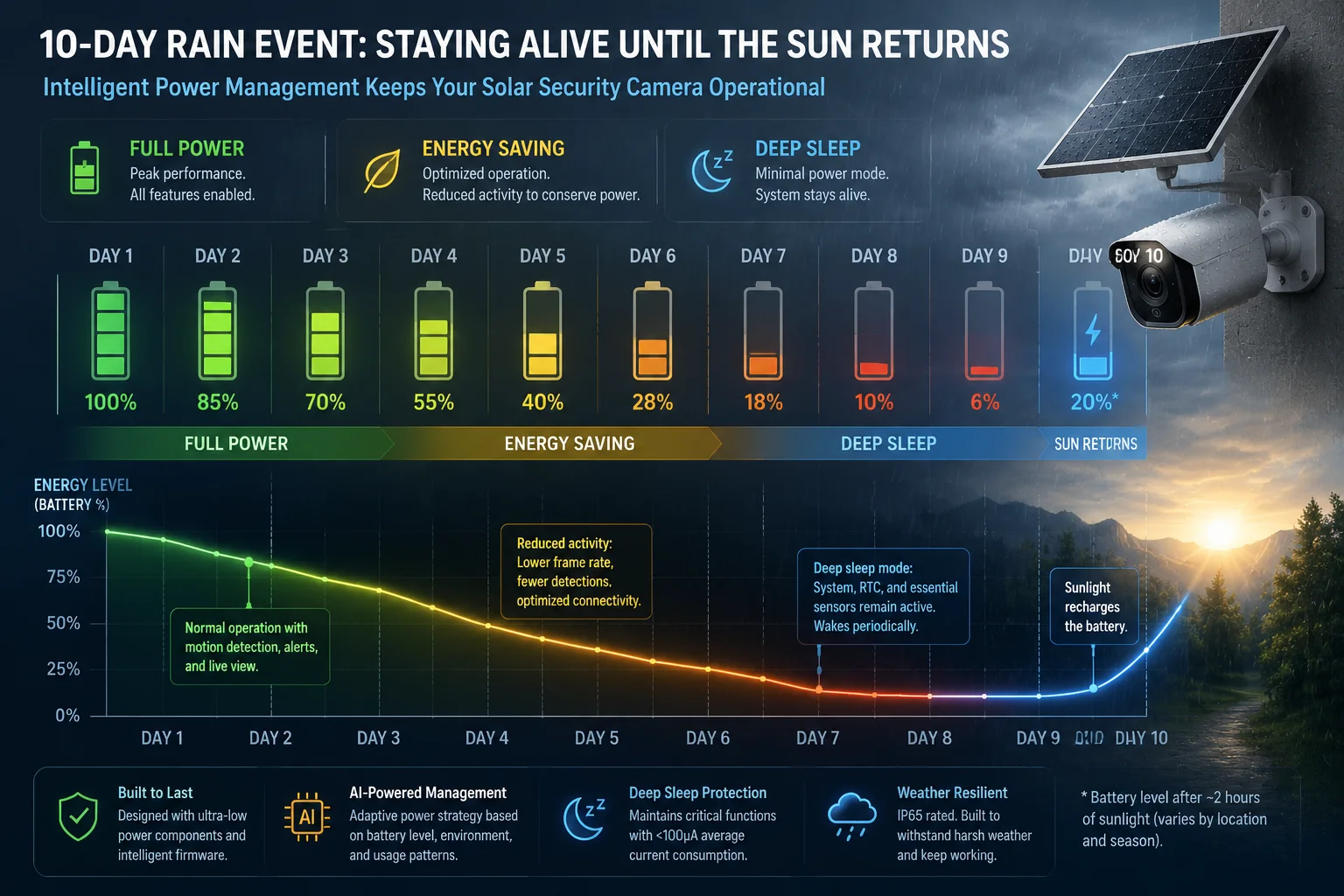
The Math Behind 10-Day Survival
Let’s work through a real example. Assume a 12V 40Ah lithium battery with 80% usable capacity. That gives you 384Wh of energy to work with.
Without SOC logic (constant full power at 10W): 384Wh ÷ 10W = 38.4 hours. Dead in less than 2 days.
With SOC logic (staged power reduction):
- Day 1–2: Full power at 10W. Battery drops from 100% to 40%. Used about 230Wh.
- Day 2–4: Energy saving mode at 4W. Battery drops from 40% to 25%. Used about 72Wh.
- Day 4–10+: Deep sleep at 0.5W. Battery drops from 25% to 15%. Uses about 3Wh per day.
The remaining capacity below 25% is roughly 82Wh. At 0.5W average (with occasional wake-ups bumping it to maybe 1W effective), that’s 82 hours minimum — over 3 additional days in the worst case, and potentially 6 to 8 days if triggers are rare.
The Role of MPPT During Cloudy Days
Here’s something many people miss: even during heavy rain, solar panels still produce some power. Not much — maybe 5% to 15% of their rated output — but it’s not zero.
A good MPPT controller6 squeezes every available milliwatt from the panel. On a 100W panel during heavy overcast, you might get 5W to 15W for a few hours around midday. That’s enough to offset Deep Sleep consumption entirely and even trickle-charge the battery slightly.
A 10-Day Rain Scenario Timeline
| Day | SOC Range | Operating Mode | Daily Consumption | Solar Input (est.) |
|---|---|---|---|---|
| 1 | 100% → 75% | Full Power | ~120Wh | 30Wh (overcast) |
| 2 | 75% → 50% | Full Power | ~120Wh | 20Wh (heavy rain) |
| 3 | 50% → 40% | Full → Energy Saving | ~80Wh | 15Wh (heavy rain) |
| 4–5 | 40% → 25% | Energy Saving | ~48Wh/day | 10Wh/day |
| 6–10 | 25% → 15% | Deep Sleep | ~12Wh/day | 8Wh/day |
Notice that by day 6, the solar input nearly matches the consumption. The system reaches a rough equilibrium in Deep Sleep mode. This is how it survives — not by having a massive battery, but by being smart about when to use power.
What Happens on Day 11 When the Sun Returns?
The MPPT controller detects rising panel voltage and begins bulk charging. As SOC climbs back through each threshold, features re-enable in reverse order. By the time the battery hits 40% again (usually within a few hours of good sun), the camera is back to full operation. No manual intervention needed. No truck roll. No phone call from an angry client.
This is the value proposition I explain to every integrator: the system manages itself. You deploy it, configure your thresholds once, and it handles the rest — rain or shine.
Conclusion
A smart controller with SOC-based power logic turns your solar camera from a fair-weather device into an all-weather survivor. Set your thresholds, trust the staged logic, and your system stays online when others go dark.
1. Learn about infrared illuminators, including laser-based versions used for long-range night vision. ↩︎ 2. RS485 is a standard for serial communication used in industrial and camera control applications. ↩︎ 3. Pan-tilt-zoom cameras are commonly used in surveillance for their ability to cover large areas. ↩︎ 4. Passive infrared sensors detect motion by measuring infrared radiation changes. ↩︎ 5. Lithium-ion batteries are commonly used in solar systems due to high energy density and cycle life. ↩︎ 6. Maximum Power Point Tracking optimizes solar panel output to harvest maximum energy. ↩︎ 7. 4G cellular modules enable wireless data transmission for remote camera systems. ↩︎ 8. Neural Processing Units are specialized hardware for accelerating AI inference tasks. ↩︎ 9. Hysteresis prevents rapid on/off switching by adding a deadband around threshold levels. ↩︎