
I’ve watched customers lose trust in their entire security system because a distant lamp kept triggering false alarms all night long.
At 800 meters, modern dual-spectrum PTZ cameras1 can distinguish humans from heat spots by combining thermal shape analysis2 with 40X optical zoom3 AI verification. The system uses pixel clustering, gait patterns, and skeleton key-point detection to confirm a target is human before sending an alert.
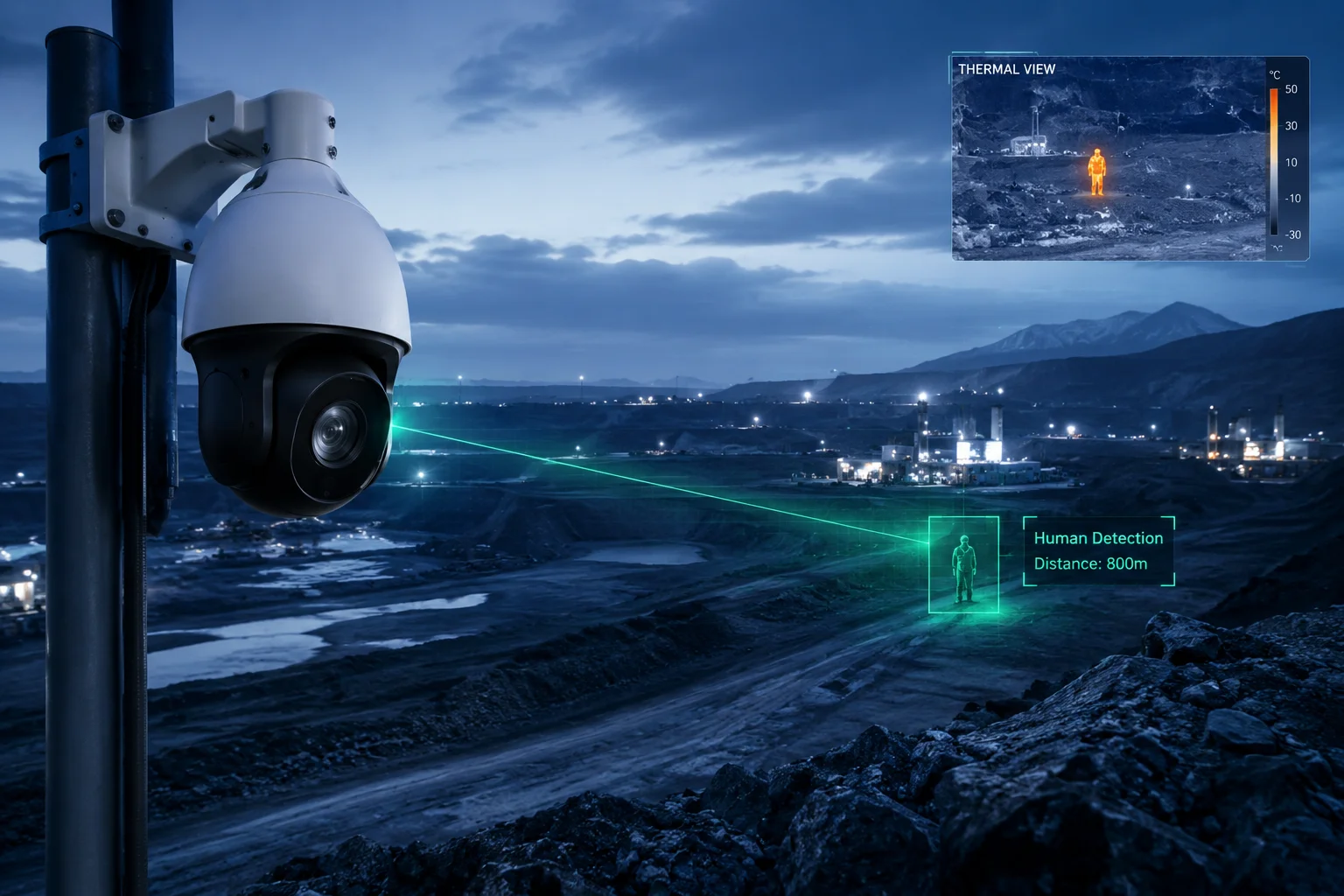
Below, I’ll break down exactly how this works at each stage — from target classification logic to minimum pixel requirements. If you’re evaluating long-range PTZ systems for remote sites, this is the technical truth you need before signing a purchase order.
Table of Contents
How Does the “Target Classification” Distinguish Between a Person and a Distant Lamp or Reflection?
I’ve seen too many projects fail because the integrator assumed “motion detection” was enough to tell a person from a hot exhaust pipe at 800 meters.
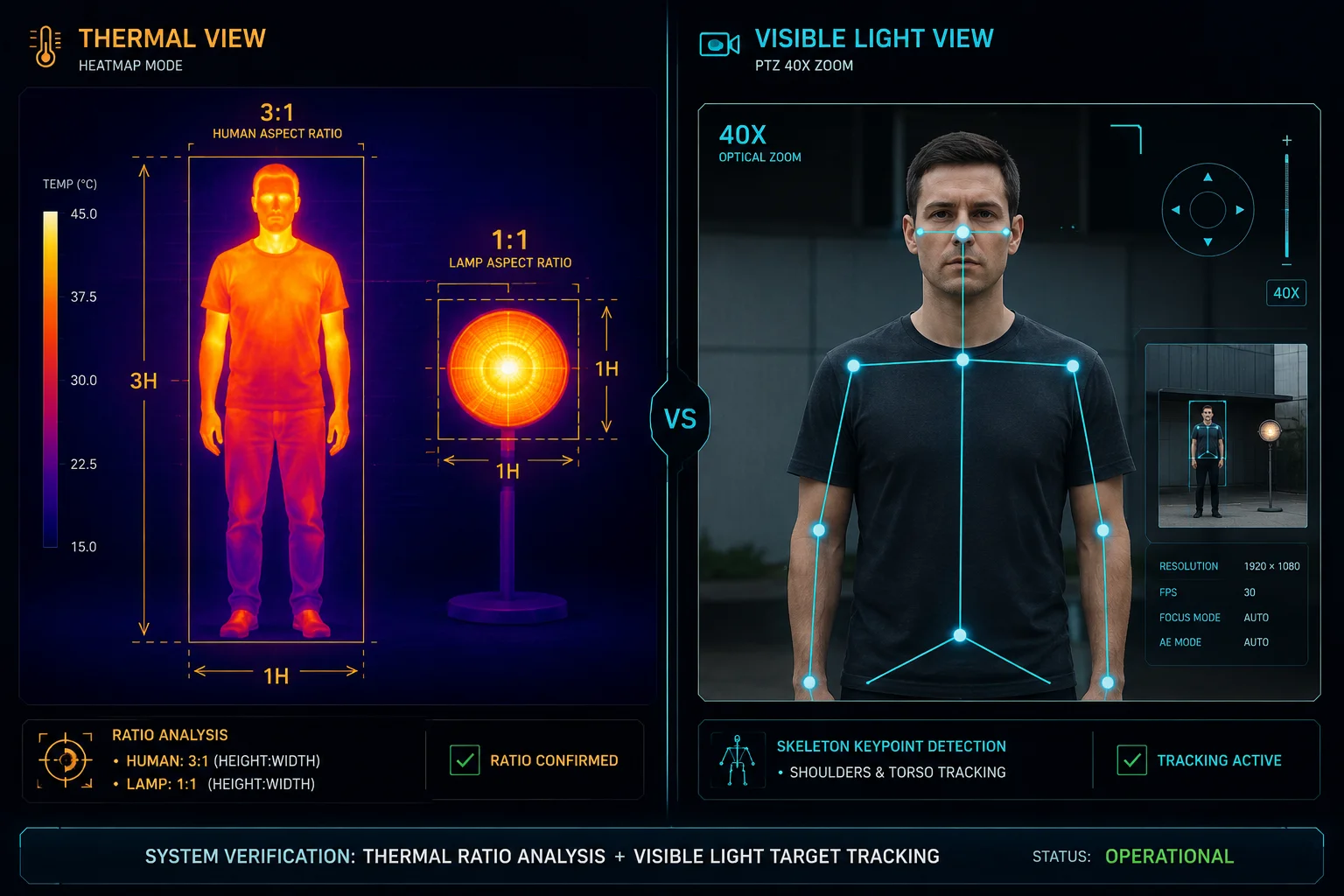
Target classification at 800m works by analyzing the thermal signature’s shape ratio, movement vector, and radiometric contrast — not just brightness. The AI compares the blob’s aspect ratio against a human body model and checks if it moves at walking speed (3–5 km/h) before labeling it “human.”
Why Simple Motion Detection Fails at Long Range
At 800 meters, a person might only occupy 10–20 pixels on a standard sensor. A reflection from a metal roof or a swaying lamp can produce a similar-sized bright spot. Traditional motion detection just looks for pixel changes between frames. It cannot tell the difference.
This is where deep learning target classification4 steps in. The algorithm does not ask “did something move?” It asks “does this moving object look like a human body?”
How the AI Actually Classifies Targets
The process runs in two layers:
Thermal layer (always-on scanning):
- The thermal sensor picks up all heat sources in its field of view.
- The firmware runs pixel clustering5 — grouping connected warm pixels into blobs.
- Each blob gets measured for height-to-width ratio. A human standing upright has a ratio near 3:1 or 4:1. A lamp or reflection is usually 1:1 or irregular.
- The blob’s movement speed and direction get tracked across frames.
Visible light layer (confirmation):
- Once the thermal layer flags a “suspect” blob, the PTZ slews the 40X zoom lens to that exact coordinate.
- The visible-light AI runs skeleton detection — looking for head, shoulders, torso, and legs.
- If it finds at least 5 key body points, it confirms “Human.” If not, it labels the target “Non-Human Heat Source” and stays silent.
Classification Decision Table
| Feature Checked | Human | Lamp / Reflection | Campfire |
|---|---|---|---|
| Aspect ratio | 3:1 to 4:1 (vertical) | ~1:1 (round or irregular) | Wide, low profile |
| Movement speed | 3–5 km/h typical | Static or flickering | Static |
| Edge consistency | Smooth, bilateral symmetry | Sharp or jagged edges | Irregular, dancing |
| Skeleton key-points found | Yes (5+) | No | No |
| Thermal intensity pattern | Warm core, cooler limbs | Uniform hot spot | Hot center, fading edges |
This multi-check approach is why a well-configured dual-spectrum system can achieve over 95% accuracy at 500–800 meters, even in cluttered thermal environments like Texas ranch land with hot fences and reflective metal buildings.
Will the AI Trigger an Alert for a Small Campfire or Heat Source at 800m Without Human Presence?
I once had a customer in Arizona call me furious because his system sent 47 alerts in one night — all from a smoldering brush pile 600 meters away.
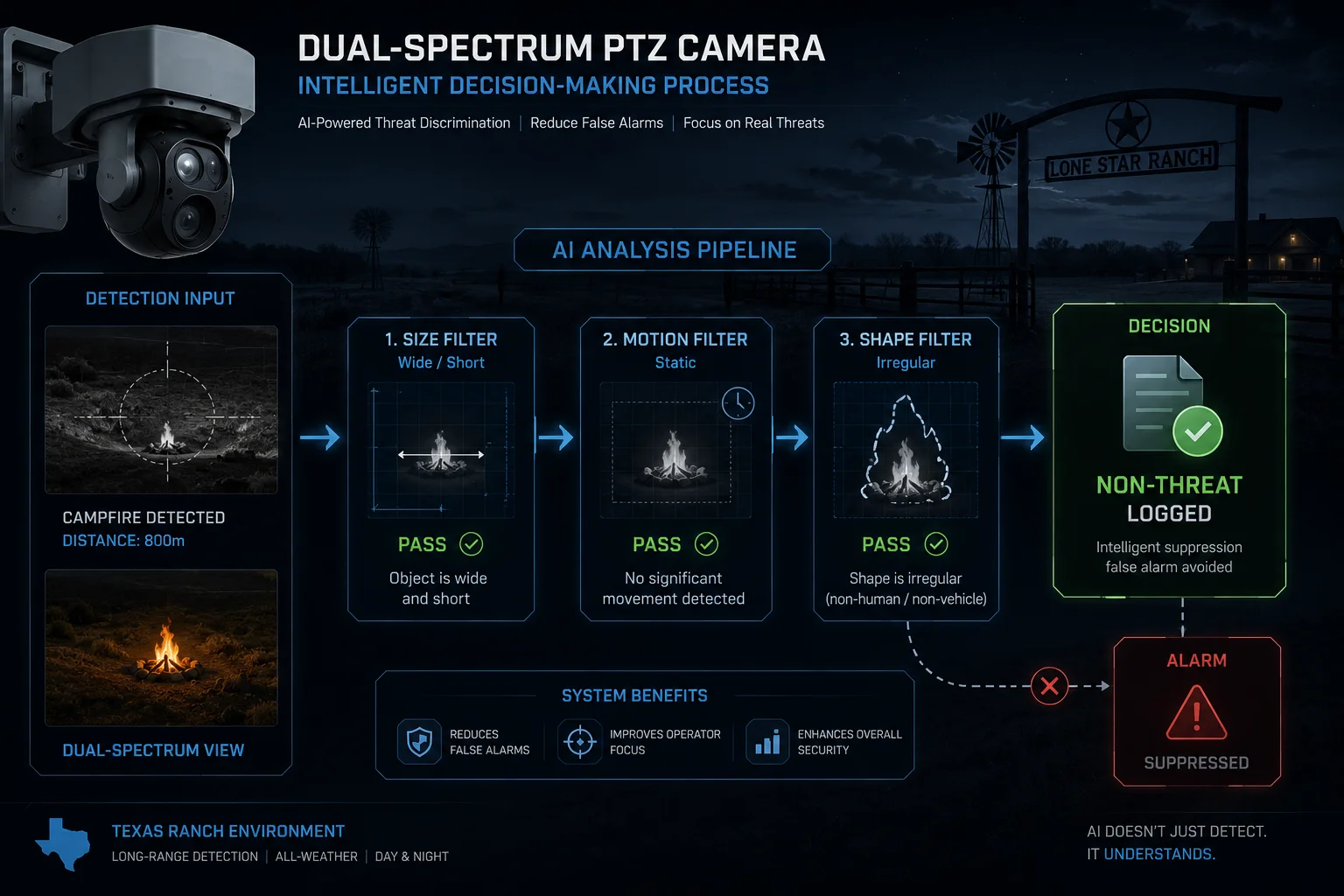
A properly configured dual-spectrum PTZ will not alert on a campfire alone at 800m. The thermal module detects the heat source, but the AI classification engine requires human-shaped features and locomotion patterns before escalating to an alarm. A static, wide-profile heat blob gets logged but not pushed to your phone.
The Difference Between “Detection” and “Alarm”
This is a critical distinction that many buyers miss. Detection means the system sees something. Alarm means the system decides that something is a threat and notifies you.
In a good system, every heat source at 800m gets detected. But only sources that pass the human classification filter become alarms. Here’s the logic flow:
Step-by-Step Filtering Process
- Thermal scan picks up a new heat blob at 800m.
- Size filter: Is the blob within the expected pixel range for a human at that distance? A campfire is usually wider and shorter than a person.
- Motion filter: Is the blob moving at human walking speed? A campfire is static. Wind-blown flames flicker but don’t translate across the frame.
- Shape filter: Does the blob have vertical symmetry and limb-like extensions? Fire does not.
- Visible light cross-check: The PTZ zooms in. Does the 40X image show a person? If it only shows flames or glowing embers, the system classifies it as “Non-Threat Thermal Event.”
What Happens With Edge Cases
Some situations are harder:
- A person standing next to a campfire: The system will detect both the fire and the person. The human skeleton detection will trigger on the person, and you’ll get an alert.
- A person walking away from a fire at 800m: The thermal blob splits into two objects. The moving one gets tracked and classified separately.
- An animal near a heat source: Most modern AI models include an “animal” class. A deer at 800m has a horizontal body ratio (~1:2), not vertical like a human. The system can label it “Animal” and suppress the alarm if you’ve configured it that way.
Alert Configuration Best Practices
| Scenario | Recommended Setting | Result |
|---|---|---|
| Campfire only, no person | Detection ON, Alarm OFF | Logged, no push notification |
| Person near campfire | Detection ON, Alarm ON | Push notification sent |
| Vehicle headlights at 800m | Vehicle class filter ON | Classified as “Vehicle,” separate alert rule |
| Sun reflection on metal | Static object filter ON | Ignored after 3 seconds of no movement |
The key takeaway: you should never receive a phone alert at 2 AM for a campfire. If your current system does that, it lacks proper AI classification — it’s just doing basic thermal threshold detection, which is a 10-year-old approach.
Does the Algorithm Use “Gait Analysis” to Confirm a Moving Target Is a Person at Extreme Ranges?
I get this question a lot from system integrators who’ve read about gait analysis in academic papers and want to know if it actually works in the field at 800 meters.
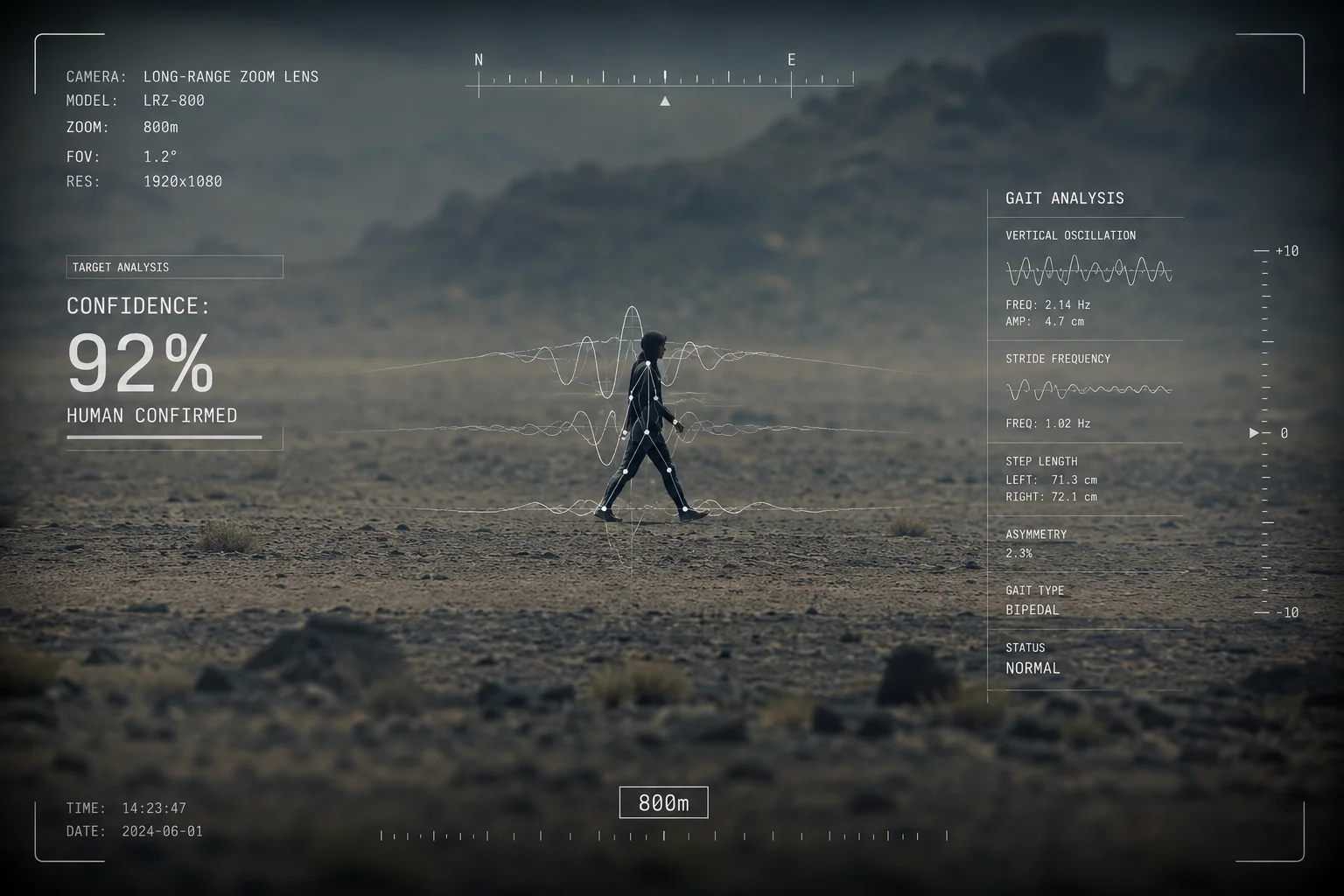
Yes, advanced PTZ firmware uses simplified gait analysis at long range — not full biomechanical modeling, but periodic limb oscillation detection. The AI checks if the target’s pixel cluster shows rhythmic vertical displacement consistent with human walking. This adds a confirmation layer beyond static shape analysis.
What “Gait Analysis” Means at 800m (vs. Lab Conditions)
In a university lab, gait analysis means tracking 17+ joint positions, measuring stride length, and identifying individuals by their unique walking pattern. That requires the subject to fill hundreds of pixels on the sensor.
At 800 meters, you don’t have that luxury. A person might be 40–80 pixels tall on a 40X zoomed image. Full joint tracking is not possible. So what does the AI actually do?
Simplified Gait Detection in the Field
The algorithm looks for three things:
1. Periodic vertical oscillation When a person walks, their center of mass bobs up and down by about 4–5 cm per step. At 800m with 40X zoom, this translates to a 1–2 pixel periodic shift. The AI tracks this micro-oscillation over 2–3 seconds. A lamp post doesn’t bob. A swaying tree branch has random motion, not periodic.
2. Lateral limb separation Even at low pixel counts, a walking person’s legs separate and rejoin in a rhythmic cycle. The thermal blob’s width pulses slightly wider, then narrower, at roughly 1.5–2 Hz (normal walking cadence). The AI measures this frequency.
3. Directional translation The blob moves consistently in one direction at 3–5 km/h. This rules out wind-blown objects (random direction) and vehicles (too fast).
When Gait Analysis Fails
Gait analysis has limits at extreme range:
- Running targets: A person running at 800m moves faster than the expected 3–5 km/h window. The system may initially classify them as “unknown moving object” before the visible light zoom confirms.
- Crawling targets: No vertical oscillation, no limb separation. The system relies entirely on thermal shape and visible-light confirmation.
- Heavy atmospheric shimmer: In summer heat, air distortion can create false oscillation patterns. The system needs EIS (Electronic Image Stabilization) to filter this out.
Gait Analysis Confidence Levels
The AI doesn’t just say “yes” or “no.” It assigns a confidence score:
- Above 85%: Auto-alert as “Human Confirmed.”
- 60–85%: Alert as “Probable Human — Verify.”
- Below 60%: Log only, no push notification.
This tiered approach means you get fewer false alarms while still catching real intrusions. For David’s ranch in Texas, where coyotes and deer trigger basic systems constantly, gait analysis is the difference between a useful security tool and an expensive noise machine.
What Is the Minimum Pixel Height Required for the AI to Confirm a Human ID at 800 Meters?
I’ve tested dozens of cameras from different factories, and this single number — minimum pixel height — is where most spec sheets lie or stay silent.
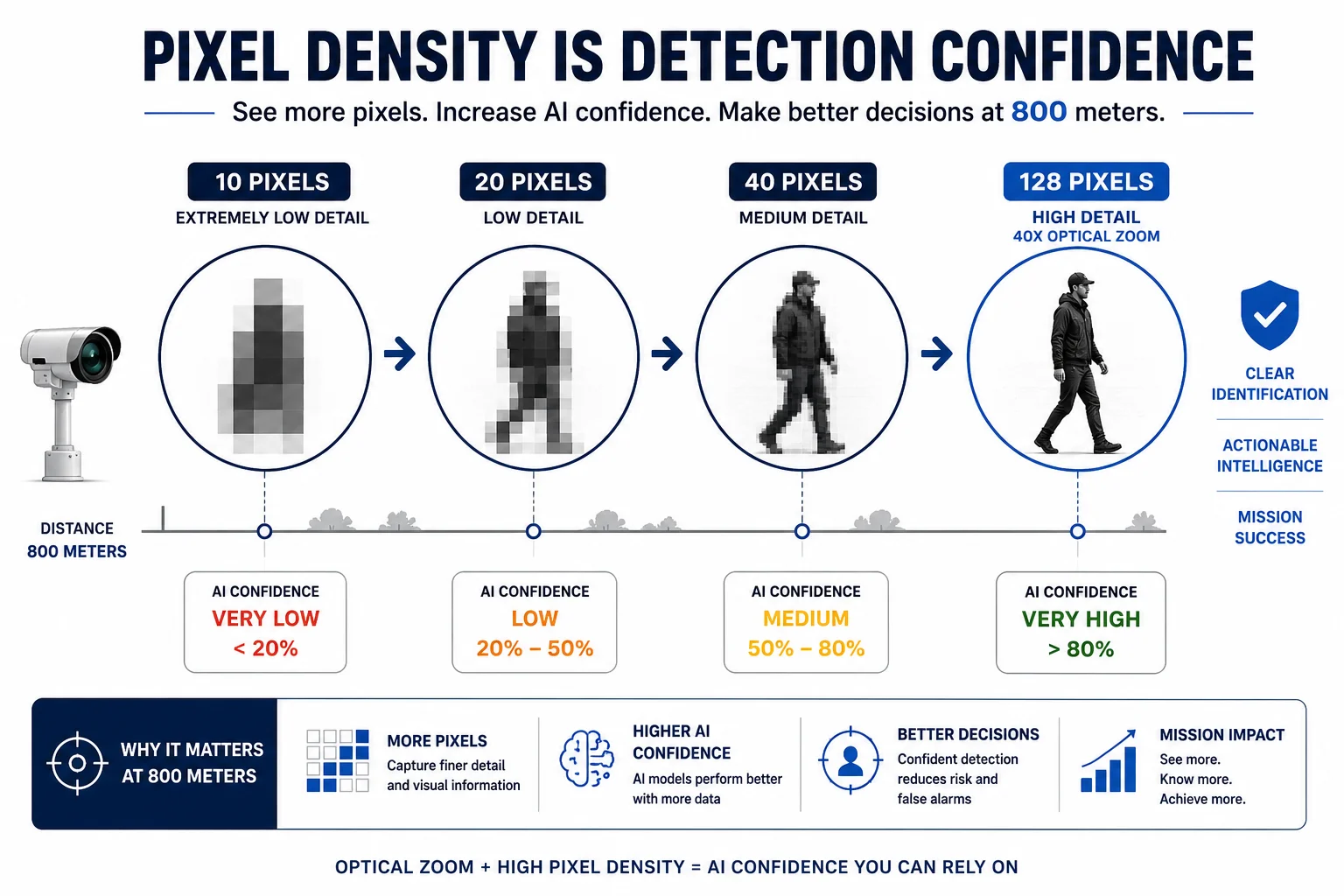
The industry standard minimum pixel height for reliable human classification is 64 pixels. For positive identification (confirming it’s a person, not just “something human-shaped”), you need at least 128 pixels of target height. At 800m, only a 40X or higher optical zoom lens can deliver this.
The Math Behind Pixel Height at 800m
Let’s do the real calculation. An average person is 1.7 meters tall. At 800 meters with a standard 4mm lens on a 1/2.8″ sensor, that person occupies roughly 4–5 pixels. That’s invisible to any AI.
With a 40X optical zoom (focal length around 160mm at full zoom), the same person at 800m occupies approximately 80–100 pixels in height. Now the AI has enough data to work with.
Pixel Height vs. Detection Capability
| Pixel Height of Target | What AI Can Do | Typical Zoom Required at 800m |
|---|---|---|
| < 20 pixels | Nothing useful — just a dot | No zoom or low zoom |
| 20–40 pixels | Detect “something is there” | 10X–20X |
| 40–64 pixels | Classify as “person-shaped” (low confidence) | 25X–35X |
| 64–128 pixels | Confirm human classification (high confidence) | 38X–40X |
| 128+ pixels | Identify clothing color, bag, posture | 40X+ with super-resolution |
Why “Digital Zoom” Doesn’t Count
Some manufacturers claim “200X zoom” by combining 20X optical with 10X digital. Digital zoom just enlarges existing pixels. It adds no new information. A 20-pixel-tall person digitally zoomed to 200 pixels is still just 20 pixels of real data, stretched and blurry.
For AI classification at 800m, only optical zoom matters. The lens must physically resolve the target onto the sensor with enough real pixels.
Super-Resolution as a Force Multiplier
Modern firmware includes AI super-resolution6. This takes multiple consecutive frames of the same target and reconstructs a higher-resolution image by combining sub-pixel shifts between frames. It can effectively boost a 64-pixel target to behave like a 90–100 pixel target for classification purposes.
But super-resolution has requirements:
- The target must be relatively stable (not running).
- The camera must have good stabilization (EIS or optical IS).
- Processing adds 100–300ms of latency.
What This Means for Your Project
If you’re deploying at sites where 800m detection is a hard requirement — oil fields, border perimeters, large solar farms — you need to spec your camera with at least 40X true optical zoom7. Anything less, and your AI is guessing, not classifying.
I always tell my customers: “Don’t trust any factory that claims human detection at 800m with a 20X zoom. The physics don’t allow it. Ask them for the pixel-on-target calculation. If they can’t provide it, walk away.”
For David’s use case — protecting a large Texas property with clear sight lines — a dual-spectrum PTZ with 40X visible zoom plus a 25mm or 50mm thermal lens gives you reliable human classification out to 800m in day and night conditions. Add a laser IR illuminator8 for the visible channel at night, and you have a system that actually works, not just one that looks good on a datasheet.
Conclusion
At 800m, real human-vs-heat-spot identification requires 40X+ optical zoom, dual-spectrum AI fusion, and at least 64 pixels on target — no shortcuts exist.
1. Understand how dual-spectrum (thermal + visible) cameras combine sensors for enhanced detection. ↩︎ 2. Learn the basics of thermal shape analysis for object classification. ↩︎ 3. Understand why optical zoom is critical for resolving small targets at long range. ↩︎ 4. Learn how deep learning models classify objects in camera feeds. ↩︎ 5. See how pixel clustering groups connected warm pixels into blobs for analysis. ↩︎ 6. Understand how AI super-resolution reconstructs higher-detail images from multiple frames. ↩︎ 7. Understand why true optical zoom (not digital) is essential for pixel count at 800m. ↩︎ 8. See how laser IR illuminators enhance visible-channel night vision. ↩︎